
Larry David on ‘Life, Larry, and the Pursuit of Unhappiness’

▶ Watch Video: Larry David on “Life, Larry, and the Pursuit of Unhappiness”

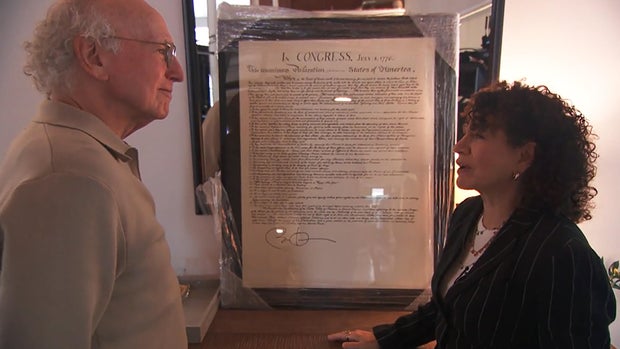
At Larry David’s Los Angeles office, there are posters, pictures, and the Preamble to the Declaration of Independence – sort of. Among its clauses: “It is illegal to ask to share an umbrella.”

What’s wrong with that? “Because the person who has the umbrella is getting wet, ’cause you’re squeezing in,” he explained. “Bring your own umbrella!”

And what if it’s a loved one?  “Ehhhh, no.”

Also missing from the actual Declaration’s list of grievances: “It is illegal to stroke one’s beard.” “I can’t stand seeing men doing this,” said David.

“What if you’re Dr. Freud?” I asked.

“Hmm, yeah, I don’t know,” he replied.
larry-davis-susie-essman-declaration-of-independence.jpg
Larry David shows Susie Essman a version of the Declaration of Independence with clauses that didn’t quite make it, such as, “After January 7th, it is illegal to wish anyone a ‘Happy New Year!'”

CBS News

Asked if he’s upset these weren’t in the Founding Fathers’ original document, David said, “I think there should’ve been some humor in that Declaration. There should be jokes in everything. Are you kidding?”

That includes American History. So, leave it to a creator of “Seinfeld” and “Curb Your Enthusiasm” to give us “Life, Larry and the Pursuit of Unhappiness,” the limited seven-episode sketch comedy series that premiered this past Friday on HBO and HBO Max. It’s a history, he says, that is completely skewed – like the Founding Father who wanted the Declaration to read, “No sharing of dessert.” (“Get your own damn piece of pie, Franklin!”)

larry-david-hbo-1920.jpg
There were divisive voices in the Continental Congress, not the least of which was Larry David’s emotional plea against the sharing of desserts: “It’s unsanitary!”

HBO

David also plays a World War I soldier pretending to be dead (“If I was in that war, knowing who I am, I would run and pretend I got shot”), and a man sitting next to civil rights pioneer Rosa Parks. (“I know that she refused to go to the back of the bus. But what if she was sitting next to me? She’d want to go to the back of the bus!”)

rosa-parks-sitting-next-to-obnoxious-bus-passenger-larry-david-hbo.jpg
Rosa Parks (Jurnee Smollett) sitting next to an obnoxious bus passenger (Larry David) in “Life, Larry, and the Pursuit of Unhappiness.” 

HBO

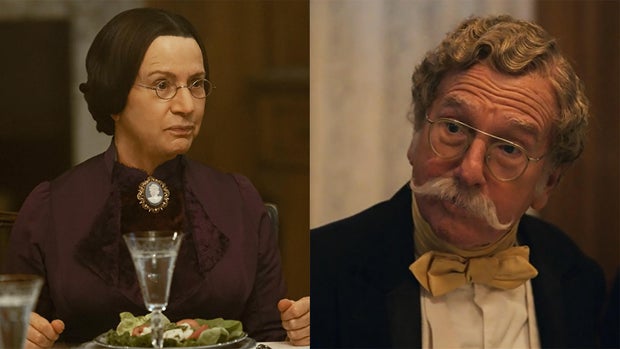
I’m even in the show, playing suffragist Susan B. Anthony. “I just thought it would be funny if I could play a really sexist character,” said David. “As soon as I heard the name Susan – oh, Susie’s gotta be Susan B. Anthony. So, I thought it would be a funny dynamic and, you know, we just go at it.”

I did do a lot of research on Susan B. Anthony, including watching a Ken Burns documentary about her, and reading all about her. None of that served any purpose in doing the scene. “Of course not,” David smiled. “Why would it?”
susie-essman-larry-david-hbo.jpg
Susan B. Anthony (Susie Essman), and a man who doesn’t suffer suffragists (Larry David), in “Life, Larry, and the Pursuit of Unhappiness.” 

HBO

There are historic figures behind the show as well. The producers are former President Barack Obama and Michelle Obama.

And while David never got any notes from HBO the entire time we did “Curb Your Enthusiasm,” that was not the case with the former president. “He really liked the show,” David said. “He had an issue with one of the sketches. And he started telling me that, ‘I don’t think this is …’  And I looked [askance] at him. And he said, ‘When I was president, if there was an issue, I would ask their opinions, and if somebody had a good idea I would listen to it. And I was the President of the United States.’ And I said, ‘I’m the president here!'”

The Brooklyn-born David, who turns 79 on July 2 (Happy birthday!), was always interested in the subject, being a history major in college. “People would always say to me, ‘What are you gonna do with that?'” David said. “I’m not gonna do anything with it!”

What did his mother think when he told her he was going to be a history major? “As long as I was in college, that was plenty,” she said. “She wanted me to be a mailman.”

The postal service didn’t deliver. Luckily, comedy did.

In “Life, Larry and the Pursuit of Unhappiness,” everything that has happened over the past 250 years that has been progress, David paints as nightmares. He finds the funny (and annoying) in just about everything, including being a passenger on the Wright Brothers’ airplane. “Those planes that keep you on the runway? Such needless torture,” he said. “It’s sadism!”

On this 250th anniversary of the nation, Larry David gives us something to laugh at, not a bad way to celebrate. And it’s only in America that this could have happened. Where else? France?

David pondered: “U.K.?” Maybe. “Norway? Sweden?”

“Nah. They don’t have a sense of humor like we have,” I said. “You’re the American dream!”

“Okay, thanks,” he laughed.

WEB EXCLUSIVE: Watch an extended interview with Larry David (Video)

Extended interview: Larry David

26:52

To watch a trailer for “Life, Larry, and the Pursuit of Unhappiness,” click on the video player below:

For more info:

     
Story produced by Gabriel Falcon. Editor: Ed Givnish. 


Join CBS for “The Great American Block Party 250,” a primetime special on Saturday, July 4, hosted by CBS Evening News anchor Tony Dokoupil and Entertainment Tonight’s Nischelle Turner, featuring live musical performances, celebrations around the country, and the largest fireworks show in history in the skies over the nation’s capital. Tune in July 4 at 8 p.m. ET on CBS and stream it on Paramount+ and CBS News 24/7.
What the death sentence for former Syrian dictator Bashar al-Assad tells us about the future of the country

(CNN) — The judge who sentenced Syrian President Bashar al-Assad to death in absentia last week was himself sentenced to death in absentia by the same regime years earlier.Irony in its purest form.Judge Fakhr al-Din al-Aryan defected from the Ministry of Justice in 2013 joining the judicial bodies of the opposition. His reinstatement as judge after Assad was toppled and fled the country for Russia in December 2024 is an illustration of the country’s pursuit of transitional justice.Some Syrians celebrated in the streets after the death sentence handed down to al-Assad and his younger brother, Maher. Words like “historic” and “symbolic” tripped off the tongue.For the first time, after decades of brutal Assad rule – by both Bashar al-Assad and his father, Hafez al-Assad before him - the model of impunity in Syria has been broken, even if the penalty is unlikely to ever be carried out.The Syrian civil war, which started in 2011, killed hundreds of thousands of people, displaced millions more and has ravaged the country’s economy.Ibrahim al-Assil, a senior research fellow at the Harvard Kennedy School’s Middle East Initiative, said the sentences handed down last week are “significant politically and significant emotionally, but at the same time this is only one part of justice that many Syrians have waited for - and are still demanding.”For the United Nations, justice is just one of the “four pillars of transitional justice” with truth, reparation and guarantees of non-recurrence carrying equal weight.What does Assad’s sentencing mean for Syria?When Assad fled Syria for exile in Moscow in December 2024, he left behind institutions and a legal system his family had built over six decades.Al-Assil says the sentencing was “the first step to look at the new state, to ask these questions, are new rules and new institutions emerging in Syria that differentiate between justice under Assad and justice post-Assad.”Another question is whether this sentencing met the standards of credible transitional justice.Amnesty International has urged Syria to end trials in absentia and the use of the death penalty, incorporate crimes under international law into domestic legislation and reform the judiciary. The justice ministry rejected the criticism, saying the proceedings complied with Syrian law and included the participation of victims and their representatives.Fadel Abdul Ghany, founder of the Syrian Network for Human Rights which has been documenting victims of the Assad regime since 2011 says: “We need lots of cases, not only one, especially targeting the highest rank, so that the feeling of anger in between the people is reduced, so that Syria can move ahead.”Al-Assil agrees that more localized trials need to follow, bringing as many perpetrators of the former regime’s brutal system to justice as possible. “For many families, they are still looking for those who disappeared, and they want to know where they are, what happened to them…maybe for a family in Homs transitional justice looks very different to a family in Dara’a.”Few believe Russian President Vladimir Putin would ever extradite Assad from his self-imposed exile in Moscow. The death sentence complicates any extradition under Russian law, but a decision not to hand over a former close ally to face justice would be far more political than legal, experts say.What is going right in SyriaThe legalities of transitional justice may be complex, but this verdict is still seen as a landmark moment for justice.When asked what else gives him hope for Syria’s future, Abdul Ghany says; “I think what’s working is freedom of speech, freedom of criticism… Syrians can speak freely and criticize the government, authority, even the high-ranking.” He added that he frequently criticizes the new government without repercussions.Ahmed al-Sharaa, the former rebel commander who has served as Syria’s President since 2025, has been outward looking since taking power.After Assad’s ouster, Syria has bolstered ties with the United States which has lifted most of its crippling sanctions on the country. It has renewed relations with its Arab neighbors who cut ties with Damascus during Assad’s crackdown on protests and welcomed French President Emanuel Macron to Syria in July, the first Western leader to visit since 2024.Al Sharaa reached an agreement with Moscow just days ago over two key Russian outposts in Syria; the Mediterranean coastal bases will be transferred to Syrian control.Entrenched challenges remain, however, in the quest for national unity in Syria. Tensions between the Syrian Army and the Druze minority in southern Syria continue to spark deadly encounters. Al-Assil says he sees no breakthrough on the horizon yet. “The government still seems to deal with the issue as only security and military issue while it’s also a social issue.”There is also persistent friction between Arab and Kurdish communities in the northeast of the country, and the government has had to respond to pockets of violence against the religious Alawite minority along Syria’s coast.Al-Assil also insists that Syria still needs a national dialogue process “to talk about all those divisions between ethnicities and minorities but also to talk about what Syria is and what they want Syria to be and that process is still not there.”The-CNN-Wire™ & © 2026 Cable News Network, Inc., a Warner Bros. Discovery Company. All rights reserved.
Read Next Story