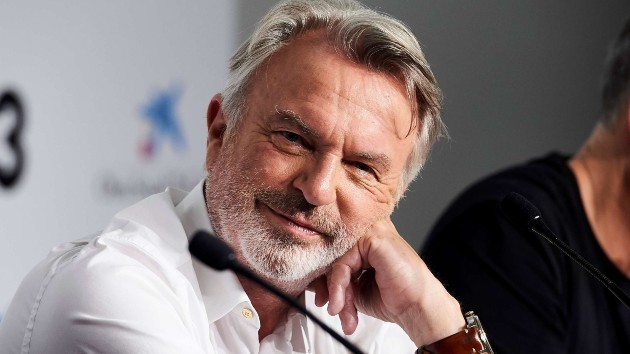
Actor Sam Neill, known for his roles in the Jurassic Park films and Peaky Blinders, died on Monday, according to his official social media account. He was 78.
“Sam was surrounded by family and passed with the dignity that has characterised his whole life,” the statement, which was posted early on Monday, said. “The loss was sudden and unexpected but blessed by the fact that Sam remained cancer free.”
Neill, who was born Nigel John Dermot Neill on Sept. 14, 1947, in Omagh, County Tyrone, Northern Ireland, didn’t get exposure to acting until he was in college.
As a kid, Neill’s parents were in the army, and his father’s family owned a vineyard. When he was 7, Neill and his family moved to New Zealand. It was while he attended the University of Canterbury that he gained exposure to acting.
In 1971, Neill landed his first acting role in the New Zealand television film The City of No. He was cast in several TV film roles before his being cast as the lead in the 1977 New Zealand film, Sleeping Dogs, an action thriller.
Following Sleeping Dogs, Neill worked on several TV shows and films in Australia, including the TV show The Sullivans and the 1979 films, The Journalist and Just Out of Reach.
In 1981, he starred in his first international role for Omen III: The Final Conflict, in which he played Damien Thorn.
Of all the roles he’s had, his portrayal of Dr. Alan Grant in the 1993 film Jurassic Park is perhaps his most well-known. The science fiction action Steven Spielberg directed-film, based on Michael Chrichton’s 1990 novel of the same name, followed a team of genetic scientists who have created a wildlife park of de-extinct dinosaurs. Neill’s character was inspired by paleontologist Jack Horner.
Neill also reprised his character in Jurassic Park III and Jurassic World Dominion.
Following Jurassic Park, Neill starred in a number of films including Bicentennial Man alongside Robin Williams, and the 1997 science fiction horror film Event Horizon.
He also starred in Merlin, playing the mythical wizard; the historical drama, The Tudors; and two seasons of Peaky Blinders, playing Chief Inspector Chester Campbell.
Later in his career, Neill appeared in Thor: Ragnarok and Thor: Love and Thunder. He also voiced the character, Tommy Brock, in Peter Rabbit.
Throughout his career, Neill received many awards as an actor but the award that was perhaps most meaningful to him was when he was appointed an Officer of the Order of the British Empire in 1991, which he was able to share with his father, just before he died.
In 2022, Neill also earned the title of Sir as a Knight Companion of the New Zealand Order of Merit.
While promoting his memoir, Did I Ever Tell You This?, in March 2023, Neill told The Guardian that he was being treated for stage 3 blood cancer.
The previous year, he had opened up about his diagnosis, saying he is cancer free, but will continue to receive chemotherapy. While undergoing chemotherapy, he told the outlet that he had experienced “dark moments.”
“Those dark moments throw the light into sharp relief, you know, and have made me grateful for every day and immensely grateful for all my friends,” he said. “Just pleased to be alive.”
In 2022, Neill was diagnosed with angioimmunoblastic T-cell lymphoma, “a rare, often but not always, aggressive (fast-growing) form of peripheral T-cell lymphoma,” according to the Lymphoma Research Foundation.
Neill is survived by his children, Elena Neill, who he shared with ex-wife, Noriko Watanabe, and Tim Neill, who he shares with New Zealand actress Lisa Harrow.
The statement on Neill’s social media account thanked the staff at St Vincent’s Private Hospital, in Sydney’s suburb of Darlinghurst, praising them for “their incredible care.”
“More details will be shared later, but for now, on behalf of the family, we ask that you respect their privacy as they navigate this immeasurable loss,” the statement said.
Copyright © 2026, ABC Audio. All rights reserved.