
June was the hottest on record for Western Europe, second hottest globally

Western Europe saw its hottest June on record this year as temperatures skyrocketed around the world last month, with blistering heat stoking wildfires and, at times, turning deadly across the continent and the United States, according to a new report by the Copernicus Climate Change Service.

The C3S report also found that June 2026 was the second-hottest June ever recorded globally.

Much of Western Europe experienced a historic heat wave during the second half of the month, breaking both monthly and all-time temperature records in several countries, the report said. 
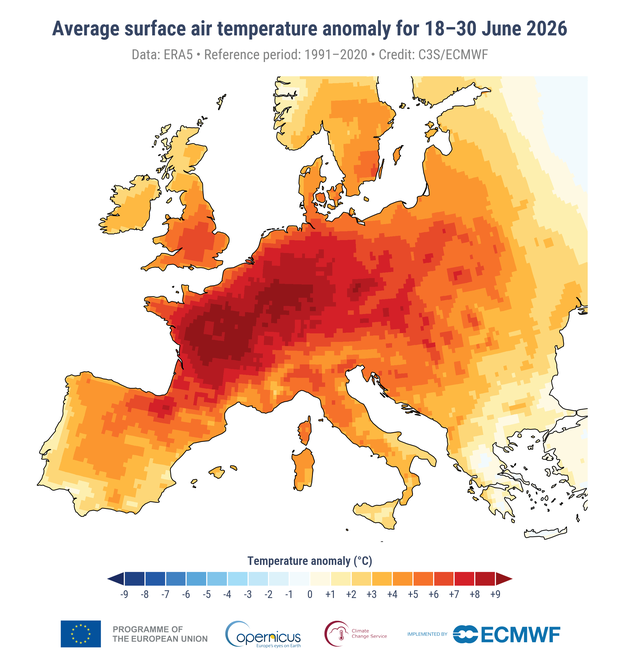
c3s-bulletin-pr-202606-map-surface-temperature-anomalies-18-30-june.png
Average temperature anomalies in Western Europe during a blistering June 2026 heat wave, relative to average temperatures for the region between 1991 and 2020.

C3S/ECMWF

Last month’s heat emerged between an initial spell of extreme warmth that rolled through the region in May and another beginning to form in July. 

“The succession of heatwaves illustrates the growing challenge posed by increasingly frequent and intense heat extremes across Europe and the globe,” the report said.

Samantha Burgess, a climate expert at the European Center for Medium-Range Weather Forecasts, said in a statement that June’s conditions “underscored how profoundly the climate is changing” and acknowledged that record temperatures on land coincided with marine heat waves spread across sections of the Mediterranean and Atlantic coasts.

“Together, these records reflect a climate system continuing to accumulate heat,” Burgess said. “The result is increasingly intense heatwaves, a persistently warm ocean, and growing risks for people, ecosystems and infrastructure across Europe and beyond.”

Drought accompanied the June heat, fueling massive wildfires in southern France that had burned through more than 11,000 acres and forced roughly 10,000 evacuations as of Monday, according to French Interior Minister Laurent Nuñez. 

French Prime Minister Sébastien Lecornu previously said dozens of people had died from drowning in France over the course of a single week in June, after desperately seeking reprieve from scorching triple-digit temperatures by swimming.

TOPSHOT-FRANCE-WEATHER-CLIMATE-HEAT
Swimmers sunbathe on the banks of Paris’ Canal Saint-Martin on June 20, 2026, as France experienced a heat wave.

ARNAUD FINISTRE /AFP via Getty Images

As the month neared its end, the World Health Organization chief announced that Europe had reported more than 1,300 heat-related deaths since June 21. Many of them happened in France, where officials told CBS News they recorded about 1,000 excess deaths, mainly in elderly residents, due to heat exposure.

France repeatedly broke its own temperature records throughout June, its national weather service said, while the United Kingdom’s Met Office confirmed the same for the United Kingdom. 

Aligned with the broader global trend, continental Europe experienced its second-highest June on record this year, according to the C3S report released early Thursday local time. Researchers found that temperatures were about 3.2 degrees Fahrenheit higher than the 1991-2020 average.

The difference was even starker in Western Europe, with the report finding that June temperatures there were nearly 5.5 degrees above average.

Sea surface temperatures remained at “exceptionally high” levels across a section of the tropical Pacific Ocean, where El Niño originates, according to the report. Known as the warmer phase of the El Niño Southern Oscillation cycle, or ENSO, El Niño is characterized by unusually warm waters that, in turn, influence weather conditions worldwide in various ways.

Forecasters have said the current El Niño could be notably intense, potentially increasing global temperatures and the risk of extreme weather in the coming months, according to the World Meteorological Organization.

The weather pattern could bring frequent and widespread flooding along both the West and East Coasts of the United States, even without the presence of storms, according to the National Oceanic and Atmospheric Administration.

In Europe, El Niño could cause warmer-than-normal autumn temperatures, with that warmth building towards spring 2027, according to the European Union’s Joint Research Centre.

People across Europe have been exposed to severe heat exceedingly often in recent years — illustrating what the scientific community generally recognizes as a consequence of human-caused climate change.

“Globally, extreme temperature events are observed to be increasing in their frequency, duration, and magnitude,” the World Health Organization said in a page on its website dedicated to heat waves. 

Estimating that the number of people exposed to heat waves increased by about 125 million between 2000 and 2016, the agency said such extreme conditions can imperil health infrastructure, strain water, energy and transportation systems, and threaten food or economic stability depending on where they happen.

Luigi Mangione in discussions about possible guilty plea, sources say

▶ Watch Video: Luigi Mangione could plead guilty in federal case Friday, sources say Luigi Mangione, accused in the 2024 killing of UnitedHealthcare CEO Brian Thompson, is in discussions about a possible plea deal on federal charges ahead of a court appearance Friday in New York City, sources familiar with the matter told CBS News.Mangione, 28, is set to appear at an 11 a.m. conference in U.S. District Court in Manhattan. That meeting is taking place after prosecutors and the defense team sent a letter to federal court Tuesday requesting Friday's conference. CBS News New York's Alice Gainer will be inside the courtroom Friday with the latest developments. Plea discussions between federal prosecutors and defense attorneys have been ongoing and it's unclear if an agreement has been reached, sources told CBS News."I expect plea negotiations to happen in every case, or certainly most cases," legal expert Richard Schoenstein said. Attorneys for Mangione have not responded to CBS News New York's request for comment. A spokesperson for the U.S. Attorney for the Southern District of New York also declined to comment. Mangione faces both federal and state charges in connection with Thompson's death. He has pleaded not guilty in both trials.The federal charges carry a potential maximum life sentence, which Mangione could still face even if a federal plea deal is reached. "In the federal system, you don't agree to a sentence as part of a plea deal. You agree to a plea and the crime, and then it has to go to a sentencing hearing in front of the judge," Schoenstein said."Maybe both parties try to, either by a binding agreement or by a suggestion to the court, say, 'We want some sort of reduced sentence, less than the life in federal prison that was the possibility here,'" CBS News legal contributor Jessica Levinson said.If a plea deal is reached, it could have an impact on his state trial, which is set to begin next month. That's because of potential double jeopardy concerns. Double jeopardy refers to a law which says "a person may not be twice prosecuted for the same offense," although a number of exceptions are listed. "I would expect the defense to make some sort of motion to preclude further prosecution of the state case on the grounds that it is double jeopardy," Schoenstein said. "I think the question of whether or not it would be double jeopardy is open and complicated and subject to debate."That's because the federal charges have to do with stalking and interstate charges, whereas the state charges are for second-degree murder, a weapons charge, and a forged instrument charge."So the weapons and forged instrument charges would not be resolved by the federal plea, and arguably the intentional killing charge would not be resolved. I do think there's a serious question as to whether this would be double jeopardy," Schoenstein said. "In New York state, there's more robust protections for defendants around the double jeopardy laws. And so that could be a real issue here, at least one that would merit litigation, if not dismissal," CBS News legal analyst Caroline Polisi said.Schoenstein said a federal plea deal would "put some pressure on state prosecutors to reach a deal of their own, or to become part of the deal that is being negotiated between the feds and the defendant, and therefore it could resolve the case on a negotiated level."Schoenstein said it could also impact the defense strategy if the state case does go forward, "because if it does go forward he no longer has to worry about a federal trial down the road."Legal experts say the case's national attention and the supporters Mangione has gained could be a factor in the feds wanting to make a deal."You have a raised possibility of what we call juror nullification, wherein a jury gets seated and there's someone in there that just, regardless of hearing any of the evidence, is never going to vote to convict Luigi Mangione," Polisi said.It was unclear what charges Mangione would plead guilty to on Friday, and he could reverse his decision at the last minute.The start of his federal trial, if it moves forward, is set for January.
Read Next Story