▶ Watch Video: U.S. designates Iran’s Revolutionary Guard Corps as foreign terrorist organization
When British Iranian journalist Pouria Zeraati first heard of the U.K.’s formal plans to ban support of Iran’s Islamic Revolutionary Guard Corps early this week, it gave him a sense of relief he had not felt in years.
It was “the happiest day of my life since I was stabbed,” he said. Zeraati’s primary concern had never been the jail time handed to the Romanian nationals who were convicted for their role in the attack on him in 2024. To him, they were simply paid mercenaries.
“In order to counter this threat, we need to counter the main cause of it, the root of it, which is the Iranian regime and specifically the IRGC,” Zeraati told CBS News. “This is a huge step that gives huge leverage to law enforcement to track, monitor, and counter the main source of the threat, which is in Tehran. Not in Eastern Europe and all the other proxies working on behalf of the regime.”
After being approved by both houses of the U.K. Parliament, the IRGC was on Friday among three state-backed groups designated as a “threat to national security.” The designation was fast-tracked by the outgoing administration of Prime Minister Keir Starmer.
Under these new powers, it is now a criminal offense in the U.K. to provide support or assistance to the IRGC, punishable by up to 14 years in prison, placing it on par with support for U.K.-designated terrorist organizations. Acts of sabotage carried out on behalf of the group could be punishable by up to life imprisonment.
Zeraati and the threats facing Iranian journalists
Persian-speaking journalists in the West and their relatives back home in Iran have long been the target of threats and intimidation from the Iranian regime.
As a high-profile TV anchor for Iran International, a network openly critical of the Islamic Republic and sympathetic to the pro-monarchy opposition, Zeraati had been no stranger to threats to his life.
His face had appeared on billboards in Iran, with extraordinary captions accusing him of being a child killer. One poster of him and his colleagues at Iran International was plastered with the words, “Wanted: Dead or Alive.” The regime’s hostility toward Iran International earned it a terrorist designation in Iran.
In February 2022, responding to “credible and immediate threats” to network staff, London’s Metropolitan Police installed concrete barriers outside Iran International’s London studios while maintaining a round-the-clock armed presence on site. Within a year, the channel was forced to suspend operations in the U.K. and temporarily relocate to Washington, D.C.
But one afternoon in March 2024, as Zeraati was walking from his home in south London toward his car, one such threat materialized.
Two men approached him, one restraining him from behind as another brandished a knife and stabbed him three times in the thigh. The two men fled the scene to a waiting car, driven by a third man, before the trio immediately left the U.K.
Zeraati was left seriously injured, bleeding and requiring emergency treatment.
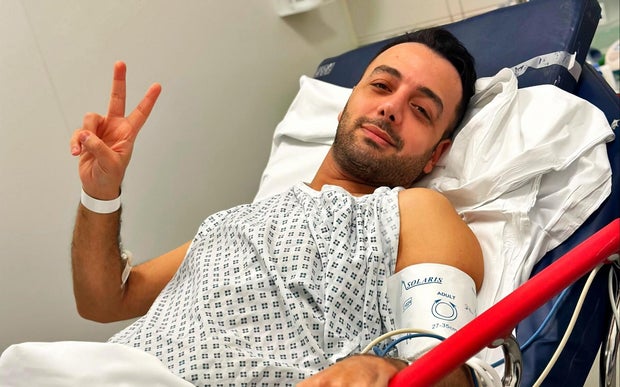
Pouria Zeraati
Within a week of being attacked, Zeraati was back to work in Iran International’s London studios.
“Of course, the goal was to silence me, first of all. But it wasn’t successful because, since that day, I am more determined to continue what I am doing,” Zeraati said. He now anchors his show remotely, living outside the U.K., over concerns for his safety.
The stabbing was the culmination of months of planning and surveillance, according to British prosecutors. At least one of the suspects had conducted hostile surveillance of Zeraati’s property a year prior. Mobile phone and communication data showed repeated contact between the suspects and a third party. There was also financial evidence that the defendants’ daily expenses were funded by third-party accounts.
Early this month, two Romanian men, Nandito Badea and George Stana, received sentences of 12 and eight years, respectively, for their role in the attack on Zeraati.
The judge agreed with British prosecutors that this was a state-sponsored attack and that the evidence overwhelmingly pointed to the fact that it was carried out in the interests of the Iranian regime.
A third man remains in Romania, facing domestic criminal proceedings in that country, according to British police.
Iran’s hostile activity on U.S. streets
In the year up to October 2025, the U.K.’s domestic spy agency, MI5, had identified at least 20 Iran-linked plots against people in the U.K.
Those plots — and other attacks targeting the Jewish community — have been driving factors in the U.K. government’s decision this week to designate the IRGC.
Closely tied to the military, the IRGC is thought to be directly answerable to Iran’s supreme leader and is central to the state’s security apparatus. With a long record of targeting dissidents and other perceived enemies abroad, the IRGC’s constituent Quds Force is dedicated to directing operations abroad — like the one targeting Zeraati.
In tandem with the proscription of the IRGC, the U.K. has also proscribed a previously shadowy group known as the Islamic Companions of the Right (IMCR). CBS News previously reported on how the group had claimed a series of attacks on U.K. and other European locations tied to Jewish communities, including a high-profile arson attack on four ambulances in London belonging to the global Jewish medical organization United Hatzalah.
In reference to the ambulance attack, the administrator of the group’s Telegram account had told CBS News it was carried out at night to avoid harming people but warned ominously that IMCR’s approach could change. In announcing the proscription this week, the British government now believes that IMCR was almost certainly directed by members of the IRGC’s Quds Force.
Designation hesitation
The United States had designated the IRGC in its entirety as a foreign terrorist organization in 2019, the first time a state entity had been classified in this way. Canada did so in 2024, and the European Union did in February this year.
But the issue of designation had been the subject of contention in U.K. political circles due to concerns about the impact on British-Iranian diplomatic ties, given the centrality of the IRGC to the Iranian state. The U.K.’s foreign ministry reportedly feared the British ambassador to Iran would be expelled in the event of such a decision, effectively closing down a critical line of contact between the two governments, according to The Guardian.
Neil Basu, a former head of U.K. Counter Terrorism Policing, sees the U.K.’s move now as “both a totemic gesture which is good for politics internally and with international allies.”
“It says we’re not worried about the diplomatic consequences of proscribing a state which probably stopped us before,” Basu told CBS News, while emphasizing that the new crimes outlined by the designation would help law enforcement tackle “the new statecraft methodology of recruiting petty criminals.”
Would-be recruits would be deterred because of the severity of punishment and because it was no longer “a regular policing issue,” according to Basu.
“It’s a national security priority of the (U.K.) government and Counter Terrorism Policing … (supported by) highly effective intelligence agencies all of whom work far more closely than ever before,” he said. “You’re more likely to be caught, which any criminologist would agree is the best deterrent.”
Zeraati agreed that the deterrence factor was likely to be effective.
“With or without this designation, I don’t think the IRGC’s activity will change … But I think the question now goes more towards the proxies,” said Zeraati. “This decision, I think, will make the criminals (think twice) about whether they want to work with this regime or not.”
On whether he now felt safe enough to return to the U.K., Zeraati expressed cautious optimism.
“This is the first step, and I think it will lead to a safer U.K. And as soon as I see myself — in terms of the transnational repression threat — safer residing in the U.K., I wouldn’t hesitate to go back,” he said.