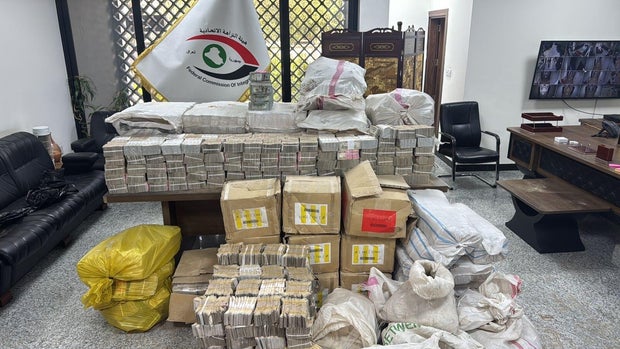
Iraq seizes mounds of gold and millions in cash in corruption crackdown

Iraqi authorities have seized more than 825 pounds of gold and ten of millions in cash in a series of anti-corruption operations that led to the arrest of at least 21 people, including dozens of government officials and several former and current members of parliament.

The seizures were connected to the arrest in May of a former deputy oil minister, Adnan Al-Jumaili, on suspicion of corruption. 

Iraqi Prime Minister Ali Al-Zaidi, who took up the role in May, has vowed to tackle graft in the country. But the mission won’t be easy, a government official who asked to remain anonymous told CBS News.
iraq-corruption-2.jpg
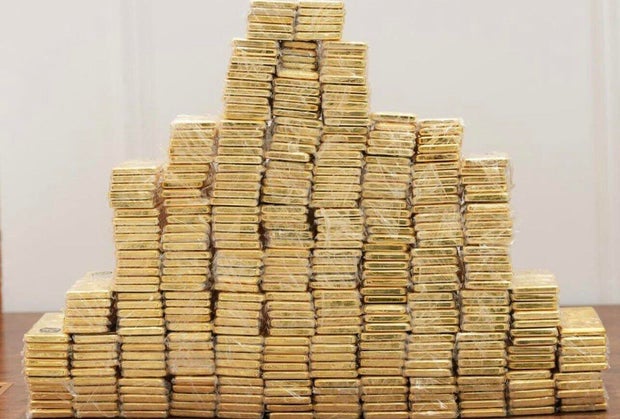
Handout photo from Iraqi authorities  on 13 July, 2026 shows gold seized during an anti-corruption investigation into the country’s oil ministry.

AFP

The number of implicated officials and the piles of confiscated gold and cash in U.S. dollars and Iraqi dinar, as well as vehicles and homes seized in the operation, shows the scale of graft in the country. And this probe only related to one sector: oil. 

“The latest campaign was unexpected,” said the official, not only because it came soon into Al-Zaidi’s tenure, but also because many previous prime ministers have paid lip-service to tackling corruption without actually doing so. 

“It came as a surprise to all involved and it will continue to include corruption cases in other sectors.”

An investigative judge at Iraq’s Central Anti-Corruption Court, Diaa Jaafar, told the Iraqi News Agency that 790 pounds of gold was recovered in one operation and 37 pounds in another. He provided no additional details of the operations.

The gold has been handed back to the country’s central bank, Jaafar added.

The seizure follows another operation related to the oil ministry last Thursday in which Iraqi dinar worth $10.6 million was found in a rainwater drainage pit

1d2325d4-5fe0-4e25-bb1b-e4103d9176b2.jpg
Handout photo from Iraqi judicial authorities on July 9, 2026 shows some of the $10.6m in Iraqi dinar found in a rainwater drainage pit during an anti-corruption drive.

AFP

A spokesperson for the Iraqi government, Haider al-Aboudi, told Qatari news outlet Al Jazeera that the total funds seized in the al-Jumaili case were worth more than $96 million, plus another $24 million in real estate, vehicles and gold.

“The Iraqi street is looking forward to punishing those who wreaked havoc with public money, and violated its sanctity, as it is the money of all Iraqis,” he said.

Al-Aboudi told Al Jazeera that Iraq has prepared legal documents to extradite several hundred suspects living abroad as part of the anti-corruption push.

Disarming Iranian-backed militias

Al Zaidi met with President Trump in the Oval Office Tuesday to discuss investment opportunities for American companies in Iraqi infrastructure and energy, as well as the Iraqi plan to disarm the country’s Iran-backed militias by Sep. 21 and the complete withdrawal of all U.S. forces from Iraq by Sep. 30. 

Ahead of the meeting, in response to a shouted question about his message for the Iraqi people, Mr. Trump responded: “We love Iraq.”
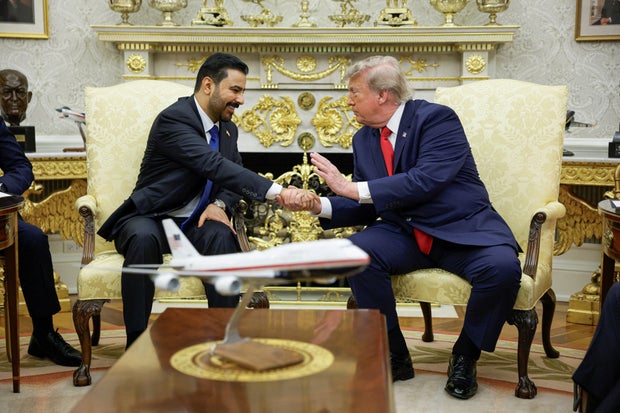
U.S. President Trump meets with Iraqi PM Ali al-Zaidi in Washington
President Trump shakes hands with Iraqi Prime Minister Ali al-Zaidi during a meeting in the Oval Office at the White House ion July 14, 2026.

Evan Vucci / REUTERS

Iranian-backed militias have been a challenge for successive Iraqi governments for over two decades.

Some of the more hardline groups have already rejected calls to lay down their arms. Several of them have targeted U.S. diplomatic missions and forces in the country and the region.

In a statement on Monday, Kuwait’s foreign ministry condemned the Iranian government and its allies in Iraqi militias for “attacks that targeted a number of border centers and an offshore drilling platform belonging to the Kuwait Oil Company, resulting in human injuries and material losses.”

Saudi Arabia and the UAE have both also made similar claims about Iraq-based militias.

Want to buy a sports team? You better hurry, and bring a ton of cash

(CNN) — The Los Angeles Lakers, the Super Bowl champion Seattle Seahawks, a chunk of the New York Yankees. Teams are turning over at a rapid pace, driving valuations to stratospheric heights.One reason for the sales boom you might expect: There are an ever-increasing number of billionaires with the resources to buy teams. More demand, plus a limited supply of teams, equals higher prices.But experts also offered a surprising reason: artificial intelligence. Sports is believed to be a relatively AI-proof investment. Teams are not likely to be upended by the game-changing technology the way other investments might be.“I’m willing to bet odds are greater that in 100 years that the Yankees will be here compared to IBM being here,” said Sal Galatioto, a leading investment banker in the field of selling sports teams.Galatioto has been negotiating deals to buy teams, or a stake in teams, for 30 years. He said he’s never been busier.“People have never bought teams for cash returns,” he said. “You bought it for long-term appreciation, and ego gratification and scarcity value. You bought it like fine art. Now it’s a hedge against technology disruption.”There are a number of other businesses that may be AI-proof or even benefit from its growth, such as electric utilities, said Victor Matheson, an economics professor at the College of the Holy Cross and an expert in sports business. But he says sports teams are much “sexier.”“No one has ever dreamed of being CEO of (electric company) National Grid,” Matheson said. “But everyone dreamed of being the owner or manager of the Yankees”The gold rush is tangibleJust this month, former Disney CEO Bob Iger and venture capitalist Josh Kushner agreed to buy a controlling interest in the Lakers, in a deal valuing the team at a record $12.5 billion. Fenway Sports Group, which also owns the Boston Red Sox, reportedly sold 40% of Premier League club Liverpool to a consortium that includes Amazon founder Jeff Bezos.And last week, Major League Baseball approved the $3.9 billion sale of the San Diego Padres to a private equity billionaire and his wife. That beats the $2.4 billion hedge fund manager Steve Cohen paid for the New York Mets in 2020. Meanwhile, the National Football League moved closer to approving a record $9.6 billion sale for the Seattle Seahawks.On Friday, the NBA’s Minnesota Timberwolves and WNBA’s Lynx were sold in a deal valued at $4.5 billion.And baseball’s most valuable team, the Yankees, agreed this month to a $2.6 billion injection from Apollo Global Management, a private equity firm, for a minority stake in the team.Private equity’s growing interest in sports teams is another sign of the buying boom, said Irwin Kirshner, the head of the sports law group at the law firm Herrick Feinstein.“Every year (valuations) seems to go up more, and so I think private equity started to recognize the value of this opportunity,” Kirshner said.Media rights, sports betting help drive growthThe value of live sports broadcasts has never been higher. In the age of on-demand viewership, sports broadcasts are one of the only things people will watch with advertisements. The entry of streaming services such as Amazon, Apple and Netflix have only increased the rights fees.“Who knows what new technology will come out to distribute the games,” said Galatioto. “If you own the content, it doesn’t matter how it’s distributed.”Sports betting, legalized in a 2018 Supreme Court decision, has growing mainstream appeal, supercharging viewership. When people have money riding on an event, they’re more likely to watch two teams they otherwise would have little interest in.“You might have as much as a billion dollars a year in total gambling money being handed over to the teams and leagues,” said Matheson, including a new pool of sponsors. “And there’s the thought that people who are gambling more are more likely to tune in, which means more butts in the seats, as well as more eyeballs on the TVs.”Lastly, sports teams are a limited commodity — there are only so many available for sale.Some, like the Padres, only go on the block when their owner passes away. But there are also teams like the NFL’s New York Giants, who have been under the control of the Mara family for more than a century, that are willing to sell off a portion of their team.Selling minority stakes in sports teams is nothing new, but the practice has become more common. And the makeup of the buyers is also becoming broader: American investors are swallowing up European soccer clubs, while North American sports clubs are getting purchased by foreign investors.Many of these owners are counting on one fact: Even if they overpay or lose money in the short term, eventually selling the team will result in a big payday.“You can afford to overpay as long as you believe that there will be people in the future willing to overpay by at least as much or more,” said Matheson.The-CNN-Wire™ & © 2026 Cable News Network, Inc., a Warner Bros. Discovery Company. All rights reserved.
Read Next Story