
Innocent bystander shot by police is one of dozens of cases nationwide

▶ Watch Video: Police shootings of innocent bystanders aren’t tracked by federal agencies, investigation finds

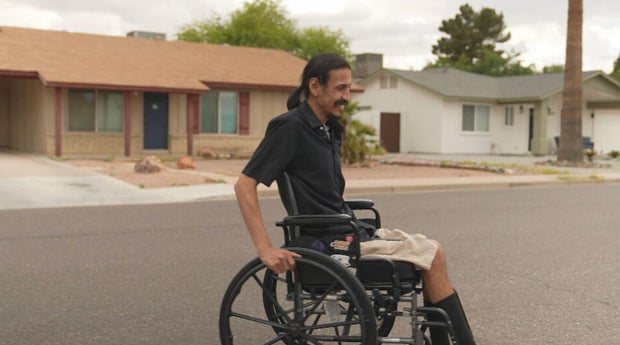
When police responded to a Chandler, Arizona, neighborhood for a call about a man armed with a gun making threats, Mark Trujillo said he went outside to warn officers his wife and young children were inside their home next door. What happened next would change his life forever. 

Body camera and Ring camera footage obtained by CBS News show a second-by-second account. Officers on one end of the street yelled for the neighbor to drop his gun and then opened fire on him. Officers on the other end never got the message the suspect was down.

“I remember making a gesture with my hand, but saying, ‘you’re gonna hit my house,’ and that’s it,” Trujillo told CBS News.

Five seconds later, Trujillo was also hit — shot by an officer who, according to Chandler Police, mistook Trujillo for the suspect.

“We have an innocent,” one officer can be heard saying on the bodycam footage. 

Trujillo’s spine was severed. The father of five will never walk again.

“I fell right there and my children and my wife saw me from that door. I was laying right here yelling for help,” he said.

Dozens of cases around the country

A CBS News review of police records, body camera footage, court documents and local news reports from around the country found more than 50 cases since 2015 of innocent bystanders shot by police. Chaotic bodycam footage from some of the incidents shows the collateral damage when bystanders are caught in the crossfire. 

Law enforcement watchdogs told CBS News the number of cases is likely higher. There’s no organization officially tracking this issue.

“The Department of Justice, our federal government, should be keeping track of these stats,” attorney Benjamin Taylor, who represents Mark Trujillo, said.

Aside from the trauma, injury or death of a loved one, in most if not all cases families have no path to get financial assistance to cover medical or funeral bills.

Because of the surgeries and medical care he’s needed, along with lost wages, Trujillo filed a lawsuit against the Chandler Police Department and city, demanding $50 million.
trujillo.jpg
Mark Trujillo was left paralyzed after being shot by police in Chandler, Arizona, when they responded to a call about his neighbor.

CBS News

Taylor told CBS News these cases are hard to win because officers are covered by what’s known as qualified immunity, which can shield government employees from civil lawsuits.

In legal filings, attorneys for the city of Chandler and its police department argue the officers were doing their jobs and were not negligent. The litigation is ongoing and has not been resolved yet.

The officers in Trujillo’s case were cleared of any criminal wrongdoing. CBS News reached out to the Chandler Police Department to request an interview with the chief about this case. A spokesperson said that because of the lawsuit, they are not granting interviews. 

Lawsuits face challenges

The Fraternal Order of Police has pushed to have qualified immunity put into law, instead of relying on Supreme Court precedent.

“This doctrine is especially important to law enforcement officers, who need this protection to perform discretionary functions fundamental to law enforcement and public safety,” the group’s president, Patrick Yoes, wrote to Congress this year.

In May, a California family was unable to seek recourse after a Los Angeles jury found the LAPD was not liable for an officer’s fatal shooting of 14-year-old Valentina Orellana-Peralta. The girl was in a changing room behind a wall inside a Burlington Coat Factory store when officers opened fire at a suspect in 2021. Her father filed the wrongful death lawsuit. 

The family’s attorney called the case “the most devastating loss” of his career.

In interviews with police officers across the country, many told CBS News the threat of being sued for using their firearms in the line of duty makes it more difficult to do their jobs. There is also genuine concern in the law enforcement community about how this may impact the ability to recruit new officers. 

“We understand that there are good officers out there, but when an officer makes a mistake, they need to be held accountable for their actions,” Taylor said.

Luigi Mangione says he will plead guilty in federal case, admits shooting Brian Thompson

▶ Watch Video: CBS News New York Luigi Mangione told a judge Friday he is prepared to plead guilty in his federal case at a court appearance in Manhattan Friday morning. Mangione, 28, faced both federal and state trials in New York for the deadly 2024 shooting of UnitedHealthcare CEO Brian Thompson outside a Midtown Manhattan hotel. He had previously pleaded not guilty in both cases.What happened in courtThompson's family arrived in the courtroom at around 10:50 a.m. The hearing, which had been set to start at 11 a.m., got started a bit late. The courtroom had filled press personnel as well as about two rows of members of the public. Mangione entered the court at around 11:10 a.m. with his feet shackled and his hands behind his back. He was wearing tan prison clothing with a white T-shirt underneath. Just before 11:15 a.m., Mangione's defense team told the judge Mangione "is prepared to plead guilty to the indictment at this time." The judge asked Mangione if that was correct. "Yes," Mangione told the judge. The judge then asked Mangione a series of questions about his background and use of medications and drugs. The judge then found Mangione to be fully competent to enter the plea. The judge then told Mangione that the maximum possible sentence is life in prison followed by supervised release. The judge added that there's no parole in the federal, although good behavior and other programs can impact how long he will spend in prison. He will be required to serve 85% of the sentence, the judge said. The judge pointed out that there's no plea agreement between the defense and prosecution, and Mangione's defense attorney said that's correct. Mangione's admission in courtMangione then told the court in his own words what he did. He told the court that he had for years endured severe pain for a boken back and had navigated the health insurance system. H e told the court he learned about the UnitedHealthcare annual investor conference in New York even though it wasn't publicized, and traveled to it. He told the court he posed as an investor to find out more information about the conference. He told the court he used a 3D printer to make parts of the gun, and traveled to New York with the gun, silencer, and magazine with "the intent to shoot Brian Thompson." He said he shot Thompson in Manhattan. About the chargesMangione initially faced four federal charges in Thompson's killing. Two of those charges against him, one of which brought the possibility of the death penalty — murder through use of a firearm and an additional firearms charge — were dismissed earlier this year, and federal prosecutors said they would not appeal that decision.That left federal stalking charges against him, which brought the possibility of life in prison without the possibility of parole.Jury selection in the federal case had been set to begin in January. Speculation about a possible plea deal had been rampant since Tuesday, when prosecutors and Mangione's defense team sent a letter to the court requesting a Friday conference regarding the federal case.What the federal plea deal means for Luigi Mangione's state trialThe plea deal will put an end to the federal trial and raises questions about Mangione's state trial, which is set to begin in September.The state case, in which he faces second-degree murder charges, among others, also carries with it the possibility of life in prison.The plea deal, however, may revive a double jeopardy argument, CBS News legal contributor Caroline Polisi said on "CBS Mornings" Thursday.Double jeopardy refers to a law stating "a person may not be twice prosecuted for the same offense," although there are a number of exceptions. "Luigi Mangione's defense team had made that argument in the state case prior, and this could revive it, because if you actually have a conviction on the federal case, it's a more robust double jeopardy protection in the New York state case. So we could see a motion there that could kick this state case back," Polisi said.Legal expert Rich Schoenstein, however, said he thinks the double jeopardy argument is "open and complicated and subject to debate." Schoenstein said that's because the federal charges Mangione is pleading guilty to are related to interstate matters and stalking, which are quite different than the second-degree murder, weapons and forged instrument charges he's facing on a state level. "So the weapons and forged instrument charges would not be resolved by the federal plea, and arguably the intentional killing charge would not be resolved. I do think there's a serious question as to whether this would be double jeopardy," Schoenstein said.The plea deal, however, may "put some pressure" on New York prosecutors to reach a deal too, "and therefore it could resolve the case on a negotiated level." Evidence in the Luigi Mangione caseKey evidence seized during Mangione's Pennsylvania arrest had been expected to be admitted in the federal trial, including a 3D-printed handgun, loaded magazine, a notebook and more.Thompson, 50, was killed on Dec. 4, 2024, as he arrived at a hotel for UnitedHealth Group's annual investor conference. The killing  of the husband and father of two was caught on surveillance video, which showed Thompson being shot in the back as he walked down the street. Police say the words "delay," "deny" and "depose" were written on the ammunition, echoing a phrase used to describe how insurers avoid paying claims.Thompson's killing set off a frantic multistate manhunt that ended with Mangione's arrest at a McDonald's in Altoona, Pennsylvania, five days later.This is a developing story. Check back soon for more information. 
Read Next Story