
Inflation fell more than expected in June as gas prices eased

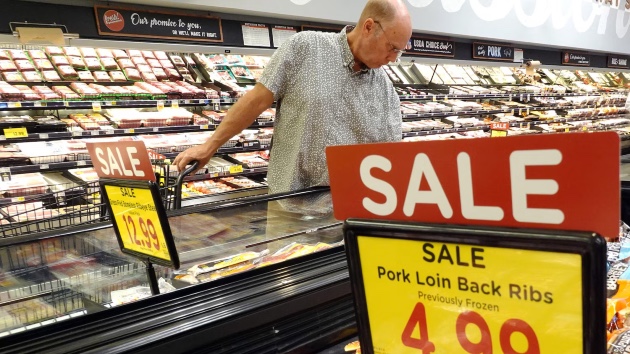
A shopper browses near ‘Sale’ signs in the meats section of a grocery store on July 7, 2026 in Pasadena, California. (Mario Tama/Getty Images)

(NEW YORK) — Inflation dropped more than expected in June as gas prices eased in response to negotiations between U.S. and Iran over the Middle East conflict.

Prices rose 3.5% in June compared to a year earlier, marking a retreat from a year-over-year inflation rate of 4.2% in the prior month, federal government data released on Tuesday morning showed.

The reading for June marks the lowest inflation since March, though the pace of price increases remains more than a percentage point higher than its pre-war level.

Last month, oil prices fell to their lowest level since before the late February outbreak of the Iran war. That drop came after a preliminary agreement included provisions aimed at resolving a global crude shortage.

A spike in oil prices over recent days amid a resumption of fighting, however, threatens to push gas prices higher, erasing some of the relief delivered last month.

Brent crude futures, the benchmark index for worldwide trading, rose to $86.90 a barrel on Tuesday. That figure stood roughly even with its level a month earlier, though it remained more than 20% higher than its pre-war level.

The inflation report on Tuesday offered some additional bright spots outside of energy prices.

Core inflation — a measure of price increases that strips out volatile food and energy prices — clocked at 2.6% over the year ending in June. That reading indicated a slight decline from the previous month, suggesting the cooldown had extended beyond gasoline.

Even after easing last month, overall inflation stands markedly higher than the Federal Reserve’s target rate of 2%.

Speaking to a House committee on Tuesday, Fed Chair Kevin Warsh vowed to address elevated inflation.

“My colleagues and I recognize that high inflation has been an undue burden on American households and businesses,” Warsh said, before noting that “volatilities and variations are inevitable, especially in an unsettled world.”

Inflation spiked in the early 2020s in response to economic disruption wrought by the COVID-19 pandemic. Price increases eased significantly by 2024, but sped up in recent months as the Iran war choked off global oil supply. Over that entire period, inflation remained above the Fed’s target rate.

“If we get policy right — and I assure you, we will — the inflation surge of the last five years will be a thing of the past,” Warsh told lawmakers.

In roughly two weeks, the central bank will issue its next decision on the level of interest rates. The Fed is widely expected to hold interest rates steady, according to the CME FedWatch Tool, a measure of market sentiment.

Copyright © 2026, ABC Audio. All rights reserved.

What the death sentence for former Syrian dictator Bashar al-Assad tells us about the future of the country

(CNN) — The judge who sentenced Syrian President Bashar al-Assad to death in absentia last week was himself sentenced to death in absentia by the same regime years earlier.Irony in its purest form.Judge Fakhr al-Din al-Aryan defected from the Ministry of Justice in 2013 joining the judicial bodies of the opposition. His reinstatement as judge after Assad was toppled and fled the country for Russia in December 2024 is an illustration of the country’s pursuit of transitional justice.Some Syrians celebrated in the streets after the death sentence handed down to al-Assad and his younger brother, Maher. Words like “historic” and “symbolic” tripped off the tongue.For the first time, after decades of brutal Assad rule – by both Bashar al-Assad and his father, Hafez al-Assad before him - the model of impunity in Syria has been broken, even if the penalty is unlikely to ever be carried out.The Syrian civil war, which started in 2011, killed hundreds of thousands of people, displaced millions more and has ravaged the country’s economy.Ibrahim al-Assil, a senior research fellow at the Harvard Kennedy School’s Middle East Initiative, said the sentences handed down last week are “significant politically and significant emotionally, but at the same time this is only one part of justice that many Syrians have waited for - and are still demanding.”For the United Nations, justice is just one of the “four pillars of transitional justice” with truth, reparation and guarantees of non-recurrence carrying equal weight.What does Assad’s sentencing mean for Syria?When Assad fled Syria for exile in Moscow in December 2024, he left behind institutions and a legal system his family had built over six decades.Al-Assil says the sentencing was “the first step to look at the new state, to ask these questions, are new rules and new institutions emerging in Syria that differentiate between justice under Assad and justice post-Assad.”Another question is whether this sentencing met the standards of credible transitional justice.Amnesty International has urged Syria to end trials in absentia and the use of the death penalty, incorporate crimes under international law into domestic legislation and reform the judiciary. The justice ministry rejected the criticism, saying the proceedings complied with Syrian law and included the participation of victims and their representatives.Fadel Abdul Ghany, founder of the Syrian Network for Human Rights which has been documenting victims of the Assad regime since 2011 says: “We need lots of cases, not only one, especially targeting the highest rank, so that the feeling of anger in between the people is reduced, so that Syria can move ahead.”Al-Assil agrees that more localized trials need to follow, bringing as many perpetrators of the former regime’s brutal system to justice as possible. “For many families, they are still looking for those who disappeared, and they want to know where they are, what happened to them…maybe for a family in Homs transitional justice looks very different to a family in Dara’a.”Few believe Russian President Vladimir Putin would ever extradite Assad from his self-imposed exile in Moscow. The death sentence complicates any extradition under Russian law, but a decision not to hand over a former close ally to face justice would be far more political than legal, experts say.What is going right in SyriaThe legalities of transitional justice may be complex, but this verdict is still seen as a landmark moment for justice.When asked what else gives him hope for Syria’s future, Abdul Ghany says; “I think what’s working is freedom of speech, freedom of criticism… Syrians can speak freely and criticize the government, authority, even the high-ranking.” He added that he frequently criticizes the new government without repercussions.Ahmed al-Sharaa, the former rebel commander who has served as Syria’s President since 2025, has been outward looking since taking power.After Assad’s ouster, Syria has bolstered ties with the United States which has lifted most of its crippling sanctions on the country. It has renewed relations with its Arab neighbors who cut ties with Damascus during Assad’s crackdown on protests and welcomed French President Emanuel Macron to Syria in July, the first Western leader to visit since 2024.Al Sharaa reached an agreement with Moscow just days ago over two key Russian outposts in Syria; the Mediterranean coastal bases will be transferred to Syrian control.Entrenched challenges remain, however, in the quest for national unity in Syria. Tensions between the Syrian Army and the Druze minority in southern Syria continue to spark deadly encounters. Al-Assil says he sees no breakthrough on the horizon yet. “The government still seems to deal with the issue as only security and military issue while it’s also a social issue.”There is also persistent friction between Arab and Kurdish communities in the northeast of the country, and the government has had to respond to pockets of violence against the religious Alawite minority along Syria’s coast.Al-Assil also insists that Syria still needs a national dialogue process “to talk about all those divisions between ethnicities and minorities but also to talk about what Syria is and what they want Syria to be and that process is still not there.”The-CNN-Wire™ & © 2026 Cable News Network, Inc., a Warner Bros. Discovery Company. All rights reserved.
Read Next Story