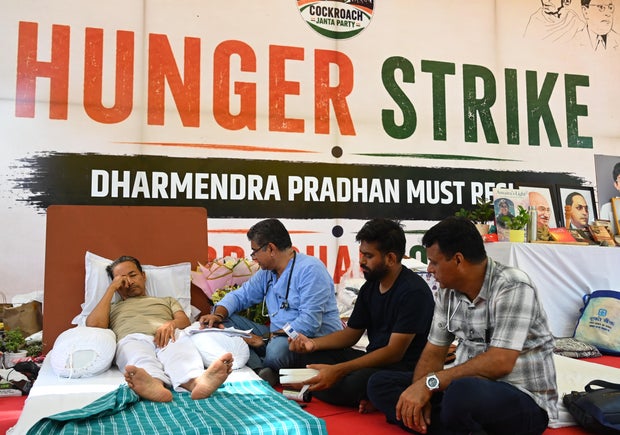
New Delhi — Calls are growing for an Indian education activist to end his 20-day hunger strike over fears for his safety. Sonam Wangchuk has survived on just salt water in the sweltering heat of India’s capital for almost three weeks after joining a sit-in protest organized by the satirical Cockroach Janta Party to demand reforms in India’s education system.
The protest, and Wangchuk’s hunger strike, were sparked by the cancellation of a key entrance exam for aspiring doctors following the leak of an exam paper, affecting millions of students.
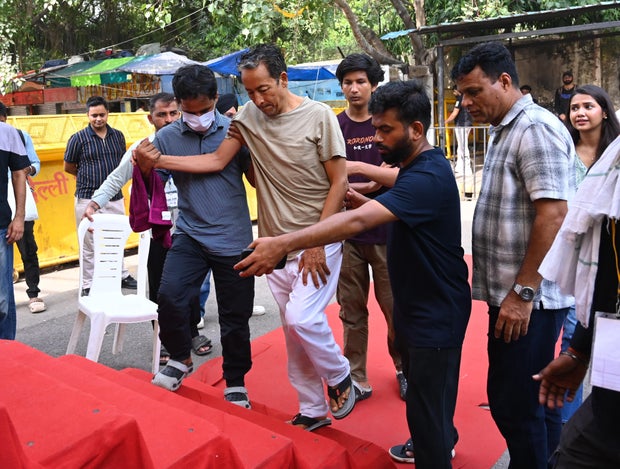
The 59-year-old activist has lost about 21 pounds, and doctors caring for him have warned that his condition has become critical, with the possibility of organ damage if he continues his strike.
The Delhi High Court on Thursday asked the government to intervene and monitor Wangchuck’s health regularly, and to administer treatment if it is deemed necessary.
Vipin Kumar/Hindustan Times/Getty
The Cockroach Janata Party started as an online satirical movement in May — a tongue-in-cheek protest against remarks by the country’s chief justice, Surya Kant, who was widely reported to have referred to India’s unemployed youth as “cockroaches” and “parasites” during a court hearing
Last month, supporters of the CJP launched their first real-world protest with the ongoing sit-in outside the Jantar Mantar, a space observatory that is Delhi’s sole designated protest site. Delhi Police have given permission to various groups to carry out demonstrations at the Jantar Mantar, but denied permits elsewhere arguing that it is necessary to restrict such gatherings to avoid road blockages and other inconveniences.
As of Friday, the government had not engaged with the protesters or responded to their demands for federal Education Minister Dharmendra Pradhan to resign, and for systemic changes in the country’s education system, including transparency in the administration of national medical and engineering exams.
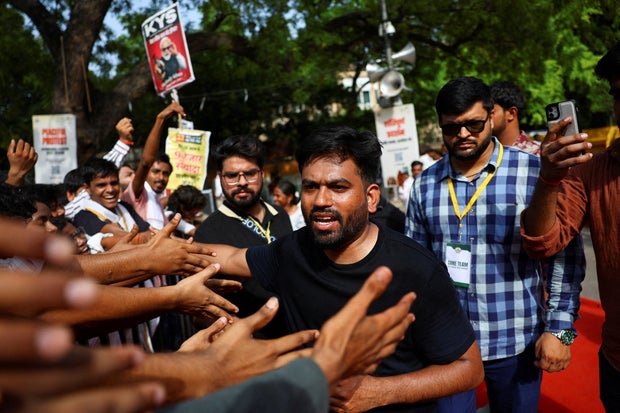
Wangchuk and Abhijeet Dipke, a Boston University student and the founder of the CJP who is leading the protest, have said they plan to march to the Indian parliament along with other protesters on July 20.
Vipin Kumar/Hindustan Times/Getty
“I am weak from the outside but very strong inside … I will stay alive till July 20 at any cost. If you don’t come and July 20 is not successful, I will come back as a ghost,” Wangchuk, who began his fast on June 28, told fellow protesters Friday.
Growing support
Political opposition leaders, Bollywood stars and other popular figures have spoken in support of Wangchuk but appealed to him to end his fast. He has refused to eat, however, saying to do so without any response from the government would send the wrong message.
Leaders of India’s main opposition party, the Indian National Congress (INC), have urged Prime Minister Narendra Modi’s government to engage with the protesters and address their demands.
Anushree Fadnavis/REUTERS
“In a democracy, peaceful protest is a constitutional right. When citizens undertake a fast to be heard, the duty of the government is to listen — not look away,” Congress leader Pawan Khera wrote Friday on X.
Another Congress party leader, Kumari Selja, said repeated incidents of exam paper leaks and alleged failures to take effective action against those responsible have undermined the confidence of students in the exam system.
“Are these reports not reaching the Prime Minister, the Home Minister, or President Droupadi Murmu? They are being insensitive,” Sanjay Raut, a Member of Parliament and leader of the Shiv Sena party, said Friday.
Bollywood actors including Aamir Khan, Sonakshi Sinha and other big stars have spoken in support of Wangchuk or voiced concern about his health.
“When is it going to be enough? Will you get up when this man dies? And whose responsibility will that be? actress Sinha said in a video shared on her Instagram account. “Why is nobody listening? Nobody cares. Nobody is open for a dialogue.”
Who is Sonam Wangchuk?
Wangchuk is a well-known engineer and climate and education activist from northern India’s Himalayan territory of Ladakh.
He’s credited with bringing artificial glaciers or “ice stupas” to the villages of his region. The cone-shaped stupas store and freeze winter precipitation to provide farmers with much-needed water for irrigation in the spring.
Group of scientists work to create artificial glaciers
04:16
Wangchuk was also instrumental in getting regional education reforms pushed through in Ladakh. He won the Ramon Magsaysay Award in 2018 for his work in education and on climate change.
This is not his first hunger strike. In 2024, he took part in two; A 21-day fast to demand special legal protection for Ladakh’s fragile ecosystem and tribal lands, and another seeking statehood for the Ladakh region, which is a federal territory, administered directly by Delhi.
In September, he was detained by police under the National Security Act (NSA) during his protest for Ladakh statehood. He was released in March after spending 170 days in jail.