
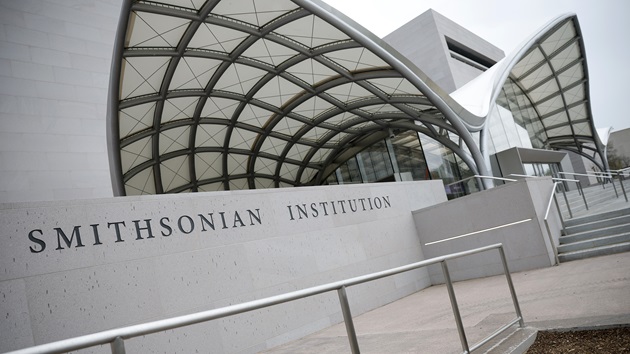
(WASHINGTON) — The White House released a scathing 162-page report accusing the Smithsonian Institution of engaging in “extreme political activism” and presenting “a radical view of American history.”
The report, which was published on Saturday, July 4, particularly took aim at the Smithsonian’s National Museum of American History (NMAH), accusing its leadership of adopting “an ideological framework that no longer treats the American story as a shared national inheritance to be taught or celebrated, but as a political instrument to divide, dispirit, and discourage our citizens.”
The report accuses the museum of “anti-White activism,” “illegal alien activism,” and “transgender activism.” It also includes many photos of materials the White House has identified as problematic.
Asked about the report, a spokesperson for the Smithsonian, which oversees 21 museums, galleries and the national zoo, told ABC News that the institution remains committed to impartial learning.
“For more than 180 years, the Smithsonian has served the American public with nonpartisan and independent scholarship, and we remain committed to doing so,” the spokesperson said on Sunday.
In his most recent public comments, Smithsonian Secretary Lonnie Bunch told NBC’s “Meet the Press” in an interview that aired Sunday morning that the institution is “in pursuit of the promise of America.”
The report, which was published by the White House’s Domestic Policy Council, comes amid an ongoing White House review of the Smithsonian as well as a separate internal review launched by the Smithsonian into its own exhibits and processes. Asked about the status of the internal review, a spokesperson for the Smithsonian did not comment.
The White House review was launched in response to President Donald Trump’s March 27, 2025 executive order, “Restoring Truth and Sanity to American History.”
The executive order directed Vice President J.D. Vance, in consultation with the president’s advisers on domestic policy, “to remove improper ideology” from Smithsonian institutions, arguing that materials that cast America in a “negative light” have no place in federal cultural institutions.
“The serious concerns raised in this report are not about a few exhibits or a few controversial labels,” the report says. “As it stands today, it would benefit most Americans, especially parents bringing their children for a tour, if the Smithsonian’s flagship history museum had a label at every entrance that reads: ‘Warning: the exhibits in this museum were prepared by people who don’t want you to love your country.'”
What’s in the report?
The report includes dozens of examples of exhibits and materials in exhibits that the White House has determined to be examples of “radical activism.”
For instance, the report highlights an exhibit titled “Many Voices, One Nation,” and claims that its contents attempt “to instill within visitors its belief that migration and immigration, including the granting of citizenship to illegal aliens, is a defining modern-day civil rights and human liberty issue.”
The report also takes issue with displays about transgender people, including an exhibit titled “Girlhood” that profiled transgender media personality and LGBTQ+ rights advocate Jazz Jennings.
“One of the clearest examples of NMAH’s radical ideology is its refusal to correctly identify or define what a woman is,” the report states — reinforcing language from Trump’s January 2025 executive order, which outlined that this administration’s policy would be to “recognize two sexes, male and female” based on biology.
Overall, the report takes issue with materials addressing “white supremacy,” “racism” and the country’s history of “slavery,” “conquest” and “exclusion.”
The report claims that the museum fails to substantially represent the founders of the United States and that the exhibits cast America as “a problematic country irredeemably conceived, founded by deeply flawed men, and still operating today as an instrument of systemic racism and oppression.”
Sarah Weicksel, executive director of the American Historical Association, previously told ABC News that the White House is seeking to create “a narrowly sanitized version of the American past” at federal cultural institutions “that fits comfortably” into Trump’s executive order.
The American Historical Association (AHC), which represents 10,000 historians across various educational and cultural institutions in the U.S., has publicly defended the Smithsonian and urged the White House to “respect and value the expertise of the historians, curators, and other museum professionals who conduct the review and revision of historical content according to the professional standards of our discipline.”
ABC News reached out to AHA for further comment.
What comes next?
The report does not specify action points related to correcting the so-called “activism,” but does reference the fact that the Smithsonian Institution is largely funded by the federal government and U.S. taxpayers.
“That means the public has a right to expect that it will operate as a faithful steward of the Nation’s historic and cultural heritage, not as a vehicle for ideological campaigns,” the report says.
According to the Smithsonian Institution, which oversees 21 museums and galleries and the national zoo, it currently receives more than $1 billion in federal funding — about 62% of its funding — and the remainder of the funds come from “trust funds or non-federal funds, including contributions from private sources” and revenues from Smithsonian enterprises.
Bunch has been leading the Smithsonian since 2019 but the institution is overseen by a 17-member governing body, known as the Board of Regents. Bunch, who met with Trump at the White House on Aug. 28, 2025, repeatedly affirmed the Smithsonian’s “independence” from political influence.
Referencing his conversations with Trump in a Sept. 3, 2025 letter to the institution’s employees, Bunch underscored the independence of the Smithsonian, saying it was “paramount.” He also told employees that the institution remains committed to telling the “American story” and “will always be, a place that welcomes all Americans and the world.”
Copyright © 2026, ABC Audio. All rights reserved.