
▶ Watch Video: How Trump admin cuts have compromised food safety
A tiny microbe has been making a lot of Americans sick. Really sick. Just ask Jessica Mallard. “I wasn’t feeling well. The pain in my stomach was, like, unbearable,” she said.
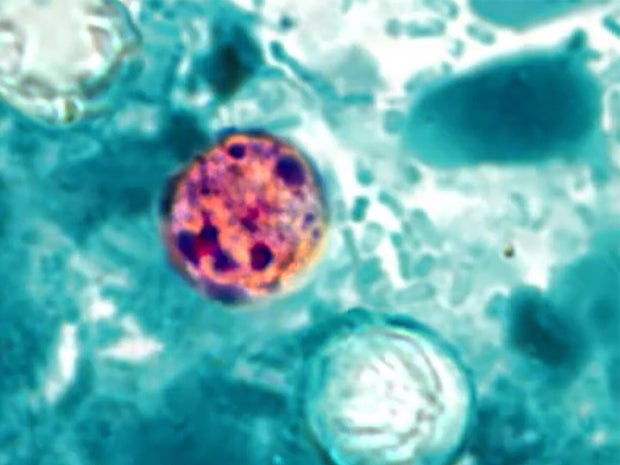
The parasite is called cyclospora, It gives you (and I’m sorry to have to say this) debilitating, explosive diarrhea that can last for weeks. Since May, more than 11,000 cases of this miserable illness have been reported in 41 states.
“I’m still fatigued,” said Mallard. “Like, I’m really, really weak.”
CDC
The FDA believes that the biggest outbreak this season, the one affecting nine states so far, came to us aboard contaminated iceberg lettuce from Mexico. That lettuce was shipped nationwide by Taylor Farms, a huge distributor that supplies thousands of groceries and restaurants.
“We’ve never seen anything like this,” said Susan Mayne, an adjunct professor at the Yale School of Public Health, who ran the food-safety department of the Food and Drug Administration from 2015 to 2023. “This is just an astonishingly large outbreak, record-setting outbreak.”
Cyclospora comes from human feces. How could that get on the lettuce? “It could be inadequate bathroom facilities, inadequate hand-washing facilities,” said Mayne. “Somehow that water is getting contaminated from some other source – sewage, some other source.”
Almost half of all food-borne illnesses comes from fruits and vegetables, in part because we usually don’t cook them before eating. These outbreaks are also financially devastating – to farmers, suppliers, and restaurants.
And so, after a 2006 spinach contamination, when the FDA warned against eating spinach, nearly every grower of spinach in the country was affected. The West Coast farming industry resolved to self-regulate.
And so, the Leafy Greens Marketing Agreement (LGMA) was born – a coalition of farmers who have agreed to adopt food-safety protocols more stringent than the government’s. “They join voluntarily, but once they join, they must follow our rules,” said LGMA’s CEO Tim York.
Jack Vessey, a fourth-generation produce farmer in southern California, said, “We have to do it. Any kind of outbreak is detrimental to our industry.”
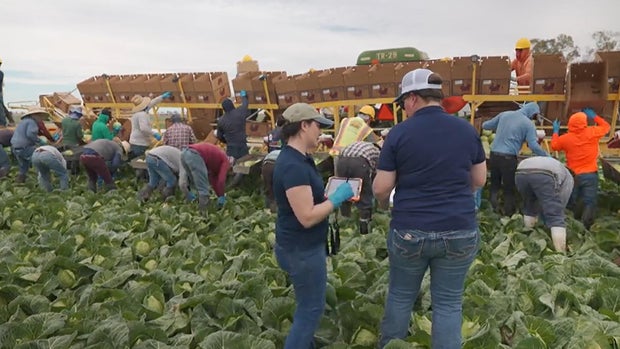
Vessey’s operation abides by the LGMA rules, which require sanitizing the irrigation water; testing it at the source and at the spraying end; hair nets and gloves; knife disinfectant; state inspections at least three times a year; and barcodes for tracing produce back to their original fields.
CBS News
But despite all of these precautions, outbreaks can still happen. “Outbreaks may occur because we are growing product outdoors,” said York. “Some bacteria just occur naturally within an environment. They just exist. And so, we control as much of the ecosystem as we can.”
Eventually, every discussion of food safety rolls around to the government. Susan Mayne acknowledged that food safety budgets have been under-resourced for decades.
But during President Trump’s second term, the FDA has lost about 20 percent of its staff; the Centers for Disease Control and Prevention is down 25%. The CDC used to have 11 scientists tracking food parasites; now it’s three.
“We had a national advisory committee, a committee that advised FDA and USDA on how to prevent microbial contamination in food,” said Mayne. “That advisory committee was disbanded. We used to convene meetings with our Mexican counterparts on how we can work together to improve food safety. That entire team was let go.”
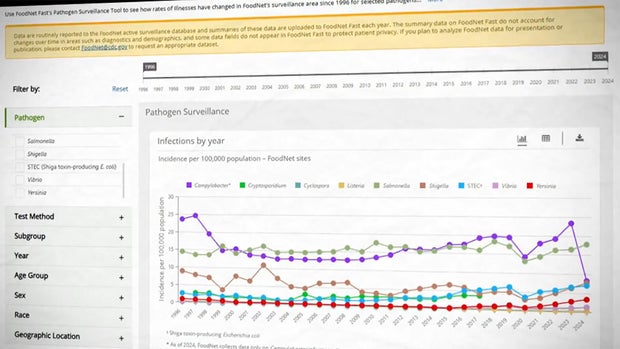
And then there’s FoodNet, a joint venture of the FDA, the CDC, and the U.S. Department of Agriculture that provided an early-warning surveillance program that used to track eight particularly nasty microbes. But now, it tracks only two – and cyclospora is not one of them.
CBS News
In 2011, Congress passed a food-safety bill that included a Traceability Rule. It said that any food-related company must keep detailed supply-chain records for vulnerable ingredients, all the way from the fields to the store. It was supposed to take effect this year. “I can tell you, having seen lettuce tracebacks, that would’ve been incredibly helpful,” said Mayne.
But the rule has been delayed until 2028.
So, if there is a cyclospora outbreak next year, we still won’t be able to trace it? “That’s correct,” replied Mayne. “Unless Congress or somebody else intervenes in the interim.”
This past week, Health and Human Services director Robert F. Kennedy Jr. told reporters that criticisms of the administration’s food safety programs were “invalid.”
“We’ve had no cuts in our surveillance program,” Kennedy said. “We did cuts in the FoodNet program, but they were for redundant surveillance.”
But Mayne says, “No, it’s not accurate. I mean, clearly there have been cuts.”
So, for now, what would be her advice for consumers? “I would avoid the bagged salads,” Mayne said. “And the reason is that a little bit of contamination can be spread more broadly through bagged salads.”
The former head of food safety says that this summer’s outbreaks are more than just another headline. “This is a national wake-up call,” Mayne said. “We want our dollars to be spent protecting public health, and protecting health. And so, I hope people will make that message clear, ’cause I haven’t talked to a single person from either party that wants to see unsafe food on our tables.”
For more info:
- Susan Mayne, Ph.D., professor adjunct of epidemiology, Yale School of Public Health
- California Leafy Greens Marketing Agreement
- Vessey & Co., Holtville, Calif.
Story produced by Wonbo Woo. Editor: Jennifer Falk.