How Trump admin cuts have compromised food safety

▶ Watch Video: How Trump admin cuts have compromised food safety

A tiny microbe has been making a lot of Americans sick. Really sick. Just ask Jessica Mallard. “I wasn’t feeling well. The pain in my stomach was, like, unbearable,” she said.

The parasite is called cyclospora, It gives you (and I’m sorry to have to say this) debilitating, explosive diarrhea that can last for weeks. Since May, more than 11,000 cases of this miserable illness have been reported in 41 states. 

“I’m still fatigued,” said Mallard. “Like, I’m really, really weak.”

The FDA believes that the biggest outbreak this season, the one affecting nine states so far, came to us aboard contaminated iceberg lettuce from Mexico. That lettuce was shipped nationwide by Taylor Farms, a huge distributor that supplies thousands of groceries and restaurants.

“We’ve never seen anything like this,” said Susan Mayne, an adjunct professor at the Yale School of Public Health, who ran the food-safety department of the Food and Drug Administration from 2015 to 2023. “This is just an astonishingly large outbreak, record-setting outbreak.”

Cyclospora comes from human feces. How could that get on the lettuce? “It could be inadequate bathroom facilities, inadequate hand-washing facilities,” said Mayne. “Somehow that water is getting contaminated from some other source – sewage, some other source.”

Almost half of all foodborne illnesses comes from fruits and vegetables, in part because we usually don’t cook them before eating. These outbreaks are also financially devastating – to farmers, suppliers, and restaurants. 

And so, after a 2006 spinach contamination, when the FDA warned against eating spinach, nearly every grower of spinach in the country was affected. The West Coast farming industry resolved to self-regulate.

And so, the Leafy Greens Marketing Agreement (LGMA) was born – a coalition of farmers who have agreed to adopt food-safety protocols more stringent than the government’s. “They join voluntarily, but once they join, they must follow our rules,” said LGMA’s CEO Tim York.

Jack Vessey, a fourth-generation produce farmer in southern California, said, “We have to do it. Any kind of outbreak is detrimental to our industry.”

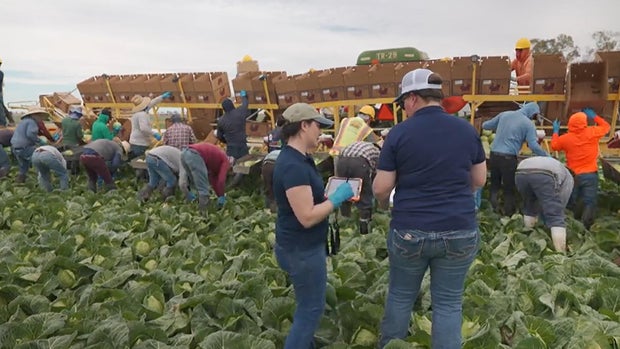
Vessey’s operation abides by the LGMA rules, which require sanitizing the irrigation water; testing it at the source and at the spraying end; hair nets and gloves; knife disinfectant; state inspections at least three times a year; and barcodes for tracing produce back to their original fields.
ca-farm-operating-under-leafy-greens-marketing-agreement.jpg
Farms participating in the Leafy Greens Marketing Agreement operate under food-safety rules that are more stringent than the government’s.

CBS News

But despite all of these precautions, outbreaks can still happen. 

“Outbreaks may occur because we are growing product outdoors,” said York. “Some bacteria just occur naturally within an environment. They just exist. And so, we control as much of the ecosystem as we can.”

Eventually, every discussion of food safety rolls around to the government. Susan Mayne acknowledged that food safety budgets have been under-resourced for decades.

But during President Trump’s second term, the FDA has lost about 20% of its staff; the Centers for Disease Control and Prevention is down 25%. The CDC used to have 11 scientists tracking food parasites; now it’s three.

“We had a national advisory committee, a committee that advised FDA and USDA on how to prevent microbial contamination in food,” said Mayne. “That advisory committee was disbanded. We used to convene meetings with our Mexican counterparts on how we can work together to improve food safety. That entire team was let go.”

And then there’s FoodNet, a joint venture of the FDA, the CDC, and the U.S. Department of Agriculture that provided an early-warning surveillance program that used to track eight particularly nasty microbes. But now, it tracks only two – and cyclospora is not one of them.

foodnet-tracking.jpg
For three decades, the Foodborne Diseases Active Surveillance Network (FoodNet), a collaboration among the CDC, FDA, USDA, and 10 state health departments, conducted surveillance for eight pathogens (including cyclospora). Since July 1, 2025, reporting on pathogens other than salmonella and e-coli has been made optional.

CBS News

In 2011, Congress passed a food-safety bill that included a Traceability Rule. It said that any food-related company must keep detailed supply-chain records for vulnerable ingredients, all the way from the fields to the store. It was supposed to take effect this year. “I can tell you, having seen lettuce tracebacks, that would’ve been incredibly helpful,” said Mayne. 

But the rule has been delayed until 2028.

So, if there is a cyclospora outbreak next year, we still won’t be able to trace it? “That’s correct,” replied Mayne. “Unless Congress or somebody else intervenes in the interim.”

This past week, Health and Human Services director Robert F. Kennedy Jr. told reporters that criticisms of the administration’s food safety programs were “invalid.”

“We’ve had no cuts in our surveillance program,” Kennedy said. “We did cuts in the FoodNet program, but they were for redundant surveillance.”

But Mayne says, “No, it’s not accurate. I mean, clearly there have been cuts.”

So, for now, what would be her advice for consumers? “I would avoid the bagged salads,” Mayne said. “And the reason is that a little bit of contamination can be spread more broadly through bagged salads.”

The former head of food safety says that this summer’s outbreaks are more than just another headline. “This is a national wake-up call,” Mayne said. “We want our dollars to be spent protecting public health, and protecting health. And so, I hope people will make that message clear, ’cause I haven’t talked to a single person from either party that wants to see unsafe food on our tables.”

      
For more info:

      
Story produced by Wonbo Woo. Editor: Jennifer Falk.

‘Aura farming’ began as a meme. Latin American youth have turned it into a competitive sport

(CNN) — A group of rowdy spectators gathers in a public square, encircling two young men facing each other with intense looks in their eyes. The crowd points their phones at the pair, who are alternating between short dances, rhythmic movements, and striking poses.This is not a scene from “Zoolander;” the crowd is attending a championship of “aura” in Costa Rica’s capital, San Jose, according to videos posted to TikTok and Instagram.Tuesday’s event at the University of Costa Rica is one of many so-called “aura battles” that have taken off in Latin American countries, including Mexico, Argentina, and Brazil. The contests appear to be designed for virality, with young competitors often demonstrating exaggerated versions of popular TikTok dance moves for the audience.Outrageousness seems to be the point of these battles, which have no apparent criteria, judges, or rules. Instead, contestants compete for crowd reaction and are rewarded with attention and, in some cases, small cash prizes.The phenomenon may have a special appeal to youth in the region due to a culture of assembling in public areas, Frederick Luis Aldama, a humanities professor at the University of Texas at Austin, told CNN.“These are definitely collective and public and person to person, and because in Latin America, we have a long history of the plaza, of the courtyard, of the gathering in the parks,” Aldama explained.They also provide a free, nonviolent space for youth to seek human connection among their peers and may reflect a desire to disconnect from technology and be present, he said.Aldama happened to witness one such “aura battle” in Mexico City’s Parque México.“What I noticed was completely against what I had been trained to think would be the winner, which is someone who was doing a more high-intensity kind of move,” he said. “I realized that the one that won was the one who just brought the kind of aura, the glow of absolute total composure.”Taking inspiration from ‘aura farming’The battle’s precursor comes from “aura farming,” a term that has taken renewed meaning online in recent years.“Aura farming” is described by the Merriam Webster dictionary as “the act of doing something to look cool, impressive, stylish, etc., especially — and importantly — without trying too hard.”The phrase first surfaced in early 2024 and has grown in popularity since, according to Know Your Meme. It reached a wider audience the following year through viral videos featuring an 11-year-old Indonesian boy named Rayyan Arkan Dikha, dancing at the front of a boat.With a steely disposition, Dikha is seen in the videos standing at the very front of a thin boat, executing a repetitive series of dance moves as a line of rowers propel them through a river. As the videos quickly gained traction, commenters and other social media users remarked on the high levels of “aura” possessed by Dikha.Since then, Dikha has accrued thousands of followers on Instagram and was named a tourism ambassador for his home province of Riau.As his performance amassed millions of views, the term “aura farming” began frequently appearing across the internet: from video edits glorifying anime characters to X posts celebrating athletes or celebrities.‘They become a character’“Aura battles” have begun appearing in public spaces across Latin American countries, often organized by local content creators and engineered for maximum virality. Videos of the competitions have received hundreds of thousands of views on social media.Victor Gabriel Tourinho Camargo, a Brazilian content creator known as Uvitinho, organized several tournaments in the city of Suzano.More than 200 people participated, Uvitinho said. Videos showed the participants packed into a park, including one dressed as a sheikh with a briefcase full of Brazilian reais.“The aura farming championship was something created with the focus of taking something popular on the internet and bringing it to reality, mixing it with childhood games and showing people and children that there is still hope for a more real life with genuine moments,” Uvitinho told CNN.“There was a mix of shy, antisocial and extroverted people… and in that moment, they all put aside all that, played together, and made friends,” he added.Mexican YouTuber Alex Crashers described encountering an aura battle in Mexico in a video shared this week. “Even though it seems silly, I got hyped every time someone pulled off a new move,” he said.Argentinian content creator Cielo, known as Cieloween, helped organize an “aura battle” in Chinatown in Buenos Aires scheduled for this Saturday after watching viral videos of a previous battle in the coastal city of Mar del Plata just days before. “The concept of ‘aura farming’ has been around for a while, but now the competition aspect has started to take off,” she told CNN.In many ways, the events resemble past versions of youth “battles” in which competitors were equipped with Pokémon cards, Beyblades or rap verses.Cieloween explained that the moves shown by participants vary widely. “It depends on the person and what they want to show. Some are more serious, while others are more humorous and entertaining. It depends on the person and the character they want to portray, because ultimately, they become a character,” she said.Cieloween said she doesn’t know how many people will attend Saturday’s event, but that the goal is to build community. “That’s what it’s all about: meeting people, being together, connecting with people who share your interests. Making friends, laughing. That’s what we’re going for,” she said.But the showcase has also attracted skeptics.The battle at the University of Costa Rica gained significant attention, with some viewers leaving comments on the videos over the spectacle.In the Brazilian city of Cuiabá, the mayor, Abílio Brunini, prohibited one such championship from taking place in the city’s main public space. “I believe that, in the future, the people who participate in this game will feel very ashamed,” he said.Still, social media videos showed individuals defiantly competing in front of the City Hall building in July.Despite some derision, the competitions have continued as participants embrace the absurdity and young people seek connection. “All this stuff that’s thrown at them, having gone through lockdown, having been like pulled away from these so-called third spaces, these plazas, these places of engagement. No wonder it’s coming back like a storm,” Aldama, the University of Texas professor, told CNN.He compares the criticism to the backlash faced by the Australian breakdancer Raygun, who was mocked for her viral Olympic performance.“There’s always going to be that negativity,” Aldama said. “But what I saw and experienced was really working-class youth, especially in Latin America, gathering to celebrate something joyful.”The-CNN-Wire™ & © 2026 Cable News Network, Inc., a Warner Bros. Discovery Company. All rights reserved.
Read Next Story