
15-year-old detained, 2nd suspect at large following deadly shooting at Seattle food festival

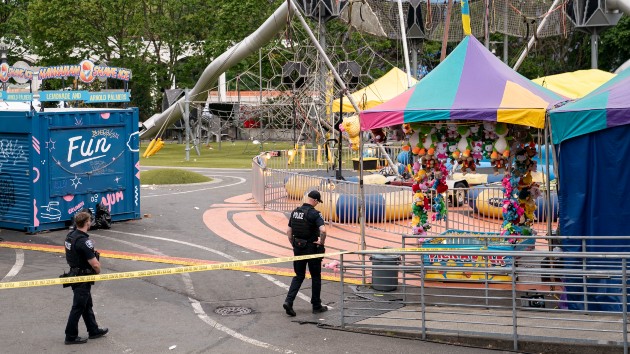
Police officers walk on patrol at the scene of a mass shooting at the Bite of Seattle food festival on July 26, 2026 in Seattle, Washington. At least two people are dead and at least five are wounded after a mass shooting at the event at Seattle Center. (Photo by David Ryder/Getty Images)

(SEATTLE) — A 15-year-old is in custody and a second suspect is at large following a shooting at the Bite of Seattle food festival that left three people dead and several wounded, officials said.

Authorities were dispatched to the scene at the Seattle Center at about 6 p.m. Sunday and found two people shooting at each other, according to the Seattle Police Department.

A 15-year-old has been detained and booked for investigation for firearms violations and first-degree assault, Mayor Katie Wilson said at a news conference on Monday.

“We believe this teenager opened fire in the crowd, but details are still under investigation,” Wilson said.

She added that no one has been arrested for investigation of homicide.

The other person alleged to be firing shots is unidentified and remains unaccounted for, police said Monday.

At least seven victims were caught in the crossfire, Wilson said.

The victims killed were identified by police as a 19-year-old man, a 44-year-old man and a 56-year-old woman.

Three injured victims — a 2-year-old boy, a 23-year-old man and a 39-year-old woman — were hospitalized, authorities said. The man and woman have since been discharged while the 2-year-old is in satisfactory condition, police said on Monday.

A fourth injured victim, a 40-year-old woman, had minor injuries and declined to be taken to the hospital, according to officials.

Police said they are also investigating a potential fifth wounded victim. A 27-year-old man with a gunshot wound went to a hospital in satisfactory condition and police said they are working to determine if this person was hurt in the shooting.

The shooting erupted during Bite of Seattle, an annual festival with food vendors and live music held at the Seattle Center.

The 15-year-old will appear in court on Monday, Wilson said.

ABC News’ Amanda Morris contributed to this report.

Copyright © 2026, ABC Audio. All rights reserved.

Trump asks Supreme Court to let him curtail mail voting

(CNN) — President Donald Trump asked the Supreme Court on Monday to allow the administration to move forward with implementing a sweeping executive order aimed at mail voting that lower courts blocked in nearly two dozen states — setting up a major elections dispute at the high court months before the midterms.Trump’s order would give the US Postal Service and the Department of Homeland Security new roles in screening state voter rolls for potential non-citizen voters.Signed in March, the president’s directive would require states to submit lists of eligible mail voters to the US Postal Service, which would be barred from sending ballots to anyone not on those lists. It would also require states to use individualized ballot tracking barcodes on ballot envelopes. And it would “prioritize” federal prosecution of state election officials who send or receive ballots to non-citizens or others ineligible to vote.Despite revelations this month that about 400 non-citizens had cast improper ballots in New Jersey elections, improper voting remains exceedingly rare, and the administration has never provided evidence of widespread fraud on a scale that could influence the outcome of an election. Trump has for years nevertheless touted conspiracy theories about voting as a way to discredit the 2020 presidential election that he lost.In its appeal to the Supreme Court on Monday, the administration framed its executive order as “general policy guidance” and stressed that the Postal Service had not finalized any regulations.Twenty-three Democratic-led states challenged the order, noting that the Constitution leaves the running of elections largely to states, not the White House. A federal district court blocked its implementation for this year’s election in the states that sued, and the Boston-based 1st US Circuit Court of Appeals upheld that decision over the weekend.Two of the three appeals court judges in that decision were appointed by former President Joe Biden. A third judge, who Trump named to the bench last year, agreed with part of the court’s decision but would have allowed some of the president’s executive order to take effect.Despite its ostensible scope to just about half the country, the ruling effectively puts the USPS directives on hold nationwide, because the agency is unable to implement Trump’s order in some states but not others, according to court filings. A dozen Republican-led states have intervened in the case to defend the executive order.In addition to the directives for USPS, another section of Trump’s order instructs Homeland Security to provide lists of state residents it believes are eligible to vote, though the government has acknowledged in court that its own databases of US citizens are incomplete.Rather than defend the merits of its executive order, the Trump administration has instead argued that the Democratic states challenging it sued prematurely because much of Trump’s effort has yet to be implemented.“The executive order is an intra-branch directive from the president to his subordinates — which, of its own force, does not change anything at all about elections in any state,” US Solicitor General D. John Sauer told the Supreme Court in the appeal. “It does not require the states to do (or refrain from doing) anything at all.”The administration asked for an immediate “administrative” order to put the lower court decisions on hold.But the 1st Circuit reasoned that local election officials have already had to devote resources away from preparing for this year’s election to figure out how to comply with the executive order. And some of them have already purchased ballot envelopes for this year’s election.“Given their limited resources, the states’ efforts have necessarily entailed a diversion of staff time and attention from other pressing election-related tasks – such as preparing public-education materials for voters and rolling out new voting technology – to coordinate the implementation of the changes articulated in the EO,” the appeals court wrote.US Circuit Judge Joshua Dunlap, a Trump appointee, agreed that the states should be allowed to sue over the envelope requirements. But he would have allowed DHS to create and send the lists of voters it believes are eligible to the states because the order technically doesn’t require state election officials to do anything with that information.Even before the March 2026 order, the Trump administration was ramping up efforts to use federal immigration data to hunt for non-citizens. However, the DHS citizenship data program that has been commonly used in that exercise is known to turn up false positives, prompting fears that eligible voters will be wrongly purged from the voter rolls.Trump’s emergency appeal marks the first time the administration has raced up to the Supreme Court with a short-fuse request since March — only the third such appeal this year. That is a marked departure from last year, when the administration filed nearly 30 emergency appeals on what critics have called the court’s “shadow docket.”The court requested a response to the administration’s appeal on August 3.The-CNN-Wire™ & © 2026 Cable News Network, Inc., a Warner Bros. Discovery Company. All rights reserved.
Read Next Story