Here’s where cyclosporiasis is spreading as cases are confirmed in 32 states

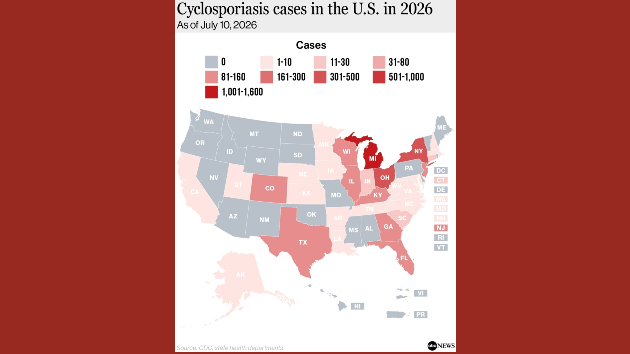
Cyclosporiasis cases in the U.S. in 2026 as of July 10, 2026 (CDC, state health departments)

(NEW YORK) — Cases of cyclosporiasis, an intestinal infection caused by a parasite, are currently being reported in nearly three dozen states, according to an ABC News tally.

As of Friday, at least 2,844 cases have been reported in 32 states, data from the Centers for Disease Control and Prevention (CDC) and state health departments show.

The CDC said the true number of people sick with cyclosporiasis is likely higher than the reported figure because some people recover without medical care and are not tested for the parasite.

Most cases are currently being reported in Michigan with 1,562 as of Friday, according to the Michigan Department of Health and Human Services (MDHHS). At least 44 people have been hospitalized in the state.

This is 31 times higher than the approximately 50 cases that Michigan sees every year, according to the health department.

Michigan health officials previously told ABC News that the working hypothesis is the outbreak is linked to food contamination but, so far, no produce, grower or supplier has been identified.

The parasite usually spreads through food or water contaminated with feces, according to the CDC.

Foodborne outbreaks of cyclosporiasis have been linked to various types of imported fresh produce, such as raspberries, basil, snow peas, mesclun lettuce and cilantro, the CDC says.

New York is reporting the second highest number of cases at 394, followed by Ohio at 364, according to data from both state health departments. Meanwhile, Illinois and Florida are each reporting more than 100 cases, according to their respective health departments.

The most common symptom of cyclosporiasis is watery diarrhea “with frequent and sometimes explosive bowel movements,” according to the CDC. Other symptoms nay include nausea, vomiting, abdominal pain or bloating.

The time between becoming infected and showing symptoms is typically about one week but can range from two days to two weeks, the CDC says. The lag can make it difficult to trace back what may have infected someone, doctors previously told ABC News.

Cyclosporiasis is treated with the oral antibiotic trimethoprim-sulfamethoxazole (TMP-SMX), commonly sold as Bactrim, Septra and Cotrim, and taken for 10 days, according to the CDC.

The agency says people can prevent infection by thoroughly washing produce, cutting away bruised or damaged parts of fruits and vegetables and refrigerating pre-prepared or pre-cut produce.

Additionally, the CDC recommends washing hands thoroughly with soap and water before handling or preparing raw fruits and vegetables.

Copyright © 2026, ABC Audio. All rights reserved.

Hawaii under a hurricane warning as Tropical Storm Lala takes aim

▶ Watch Video: What to expect as Tropical Storm Lala nears Hawaii's Big Island A hurricane warning is in effect for Hawaii's Big Island as Tropical Storm Lala approaches. The storm is expected to strengthen and bring extremely heavy rain, flooding, and life-threatening surf and rip currents to the Hawaiian Islands this weekend, forecasters say.The storm's outer bands began reaching the island on Saturday morning, the National Hurricane Center said. The center said Friday that hurricane conditions are expected to develop by Saturday. The core of Lala will pass the Big Island on Saturday, then reach south of the smaller islands on Sunday, the NHC said Saturday, though it warned the storm may have some "erratic" movements. Lala is expected to weaken as it interacts with the Big Island. Damaging, hurricane-force winds are expected on the Big Island, especially across higher terrain, and tropical-storm-force winds are expected across portions of the smaller Hawaiian islands. Flooding and mudslides are a major concern as heavy rain hits the Big Island and spreads across the rest of the state. Large, dangerous surf also brings the potential for coastal flooding and significant beach erosion. "This is a very serious storm," Hawaii Gov. Josh Green said in a news briefing Friday night. "We have not had a hurricane make landfall in quite some time. So none of us really have experienced this really in, you know, the last couple of decades."Green said Hawaii will see "an incredible amount of water," warning residents and visitors to prepare for heavy flooding and the possibility of major power outages. "We're hoping that it's going to be sufficiently far south that we just get the periphery of the storm, but, no promises, we've seen storms turn," Green said.  The last hurricane to make landfall in Hawaii was Hurricane Iniki in 1992, which struck as a powerful Category 4. Iniki was responsible for six deaths and $3 billion in damage, Green said. Maps show storm warnings, pathIn a worst-case scenario, Lala could dump 25 inches of rain onto the Big Island, forecasters at the National Hurricane Center said.What's more, Lala could produce a storm surge as high as 3 feet along the coast, along with large waves and life-threatening rip current conditions.Tropical Storm Lala is forecast to strengthen into a hurricane before it hits Hawaii this weekend. Aug. 14, 2026.  Nikki Nolan/CBS News
Read Next Story