Here’s where cyclosporiasis is spreading as cases are confirmed in 32 states

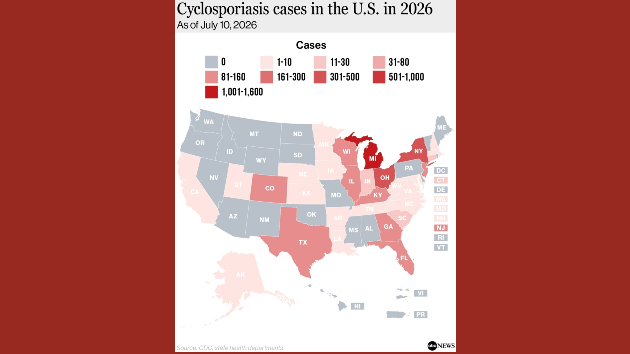
Cyclosporiasis cases in the U.S. in 2026 as of July 10, 2026 (CDC, state health departments)

(NEW YORK) — Cases of cyclosporiasis, an intestinal infection caused by a parasite, are currently being reported in nearly three dozen states, according to an ABC News tally.

As of Friday, at least 2,844 cases have been reported in 32 states, data from the Centers for Disease Control and Prevention (CDC) and state health departments show.

The CDC said the true number of people sick with cyclosporiasis is likely higher than the reported figure because some people recover without medical care and are not tested for the parasite.

Most cases are currently being reported in Michigan with 1,562 as of Friday, according to the Michigan Department of Health and Human Services (MDHHS). At least 44 people have been hospitalized in the state.

This is 31 times higher than the approximately 50 cases that Michigan sees every year, according to the health department.

Michigan health officials previously told ABC News that the working hypothesis is the outbreak is linked to food contamination but, so far, no produce, grower or supplier has been identified.

The parasite usually spreads through food or water contaminated with feces, according to the CDC.

Foodborne outbreaks of cyclosporiasis have been linked to various types of imported fresh produce, such as raspberries, basil, snow peas, mesclun lettuce and cilantro, the CDC says.

New York is reporting the second highest number of cases at 394, followed by Ohio at 364, according to data from both state health departments. Meanwhile, Illinois and Florida are each reporting more than 100 cases, according to their respective health departments.

The most common symptom of cyclosporiasis is watery diarrhea “with frequent and sometimes explosive bowel movements,” according to the CDC. Other symptoms nay include nausea, vomiting, abdominal pain or bloating.

The time between becoming infected and showing symptoms is typically about one week but can range from two days to two weeks, the CDC says. The lag can make it difficult to trace back what may have infected someone, doctors previously told ABC News.

Cyclosporiasis is treated with the oral antibiotic trimethoprim-sulfamethoxazole (TMP-SMX), commonly sold as Bactrim, Septra and Cotrim, and taken for 10 days, according to the CDC.

The agency says people can prevent infection by thoroughly washing produce, cutting away bruised or damaged parts of fruits and vegetables and refrigerating pre-prepared or pre-cut produce.

Additionally, the CDC recommends washing hands thoroughly with soap and water before handling or preparing raw fruits and vegetables.

Copyright © 2026, ABC Audio. All rights reserved.

Some meat products with jalapeños may be linked to salmonella outbreak, USDA says

▶ Watch Video: How to limit your exposure to foodborne illnesses, according to an infectious disease specialist Federal officials on Saturday issued a public health alert for meat products containing jalapeños that may be linked to a salmonella outbreak that has sickened hundreds of people across at least 27 states. The U.S. Department of Agriculture's Food Safety and Inspection Service, or FSIS, said the alert applied to red meat and poultry products containing jalapeños that may be contaminated with salmonella. The USDA said that it learned of the issue when it discovered that multiple establishments that are regulated by FSIS had received a recalled ingredient. It released a list of 18 recalled products that are impacted by the alert. Those included the brands Taylor Farms, Ready Meals, Meal Simple, Higher Harvest and Deli Kitchen. The agency said in a statement that it "expects additional downstream products will be identified as this ingredient recall progresses."The first illnesses in the salmonella outbreak were reported in mid-June, according to the U.S. Food and Drug Administration, and were linked to jalapeño peppers grown in Sinaloa, Mexico, and distributed by Coast Citrus Distributors to wholesalers, restaurants and food service companies. The USDA said that so far "there have been no confirmed reports of illness" from products regulated by FSIS that contain jalapeños that were sourced from Sinaloa. As of Aug. 5, the outbreak had sickened at least 345 people, 36 of whom have been hospitalized, the U.S. Centers for Disease Control and Prevention reports. Minnesota was particularly hard hit, with at least 110 cases confirmed in the state. Data compiled by the CDC found that of 191 patients that were interviewed about their illness, 93% reported eating at a Mexican-stye restaurant before falling sick, including popular chains Chipotle and Qdoba. Chipotle announced this week that it had pulled jalapeños from some of its restaurants, and Qdoba followed suit soon after. On Saturday, grocery giant Albertsons announced that it was voluntarily recalling four items containing jalapenos — salsa and corn salad — supplied by Taylor Farms. CBS News has reached out to Taylor Farms for comment. Symptoms of salmonella can include diarrhea, fever and abdominal cramps. Those symptoms can begin anywhere from six hours to six days after consuming the bacteria, the CDC says. 
Read Next Story