
Gracie Abrams: Now center stage

▶ Watch Video: Gracie Abrams: Now center stage

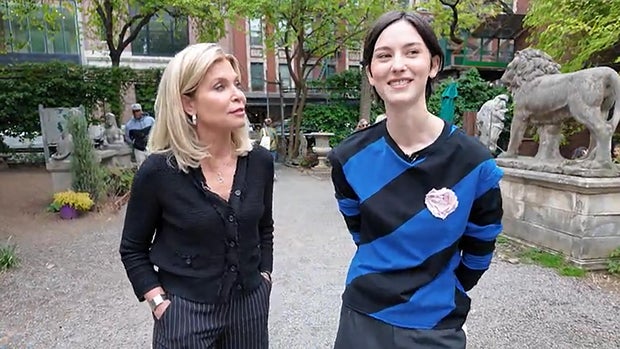
In the middle of New York City is a spot that Gracie Abrams calls a secret garden: a park where she says she can hang out unnoticed (when TV cameras aren’t around, that is). It’s a respite from a life where she’s very much front-and-center.

At 26, Abrams is a reigning queen of so-called whisper pop – her witty, intimate style praised by critics and millions of fans around the world. She’s graced the top of Billboard charts, Chanel ads, and the most recent cover of Vogue. 

Backstage on tour last summer, she told us she still seemed stunned by it all: “I’m constantly pinching myself,” she said. “And I don’t know at what point you could get to where you’re not doing that.”
gracie-abrams-with-tracy-smith.jpg
Correspondent Tracy Smith with singer-songwriter Gracie Abrams. 

CBS News

Being center-stage didn’t come naturally to Abrams. Born and raised in Los Angeles, she always had a passion for songwriting, but not necessarily performing. She says she felt fear from the idea of sharing her songs: “Like, just really physical fear … in the pit of your stomach. I felt that when I would hear footsteps coming down the hall, and I would stop playing.”

She eventually got up the nerve to post a few songs online, such as “Minor.”

“I don’t know what my goal was,” Abrams said. “I think it was probably that naïve kind of concept of the internet that it’s not real – you know what I mean? I’m like, ‘Okay.’ It was easier to hide behind.”

The gamble paid off. By 2019 Abrams had her first record deal. And thanks in part to COVID, she did her first tour on Zoom from her bedroom. “It was such a gift, because I was vomiting at the thought of performing!” she laughed. “And then I got to do it in the comfort of my own space. And it felt like this baby step.”

That baby step turned into a running leap onto the world’s largest stages. By 2022, Abrams was opening for some of the brightest stars in music: Olivia Rodrigo, and then Taylor Swift. Stepping out onto stage on Swift’s Eras Tour, Abrams said, “felt like being in some kind of, like, alternate universe. It was just the best thing.”

Night Three Of Taylor Swift | The Eras Tour - London, UK
Taylor Swift and Gracie Abrams perform on stage during “Taylor Swift | The Eras Tour,” at Wembley Stadium, June 23, 2024 in London.

Gareth Cattermole/TAS24 via Getty Images

Asked what advice she took from Swift, Abrams said, “The first thing that comes to mind when you ask that is, like, the encouragement to just never stop writing. For me, any time I had a feeling where I was like, ‘I would rather just cry about this for a while,’ [instead], just pick it up and write it down. And it serves you every time to do that.” 

And now, Abrams is selling out arenas on her own – with audiences singing her words back to her. “It just doesn’t feel like it’s remotely about me,” she said. “I love it, but it feels like even though they might be my words, they’ve adopted them and made them their own.”

Still, Abrams has had to deal with accusations of nepotism. Her mom, Katie McGrath, is an entertainment executive, and dad J.J. Abrams created hit TV shows and directed a couple of “Star Wars” films. Being blessed with successful parents means she has also heard the term “nepo baby.”

“My parents have both worked in the entertainment industry since before I was born,” she said. “And I think there is no question there are a million visible and invisible ways in which I have benefited as a result of my proximity. I am the luckiest person in the world to have grown up learning from the two of them in all of the ways. It’s been everything, of course.”
gracie-abrams-int-c-1920.jpg
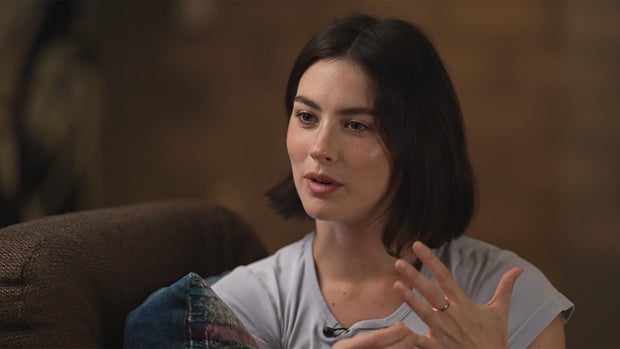
Singer-songwriter Gracie Abrams. 

CBS News

In fact, instead of avoiding talking about her parents, Abrams has leaned in. Her latest album, out Friday, is called “Daughter From Hell.” Its title track is a love song for her mom, one Abrams calls “very overdue.”

“I sent it to my mom, I was like, ‘So sorry it took me 26 years to write one that wasn’t laced with, you know, some kind of angsty anger,'” she laughed. “I’m like, ‘I want to be you now, Mom!'”

Her mother’s reaction? Abrams said it “got” her – and talking about it “got” Abrams, too: “I want more than ever to say thank you to the people that made me who I am, and who have given every ounce of love that they have. So … I’m like, it’s so weird to get emotional with my … ! But it is true.”

The first single released from the album was the emotional anthem “Hit the Wall.”

And when she goes on tour later this year, some of the lyrics fans will be screaming were written in the quiet little garden in Manhattan’s Lower East Side. “I feel very, yeah, grateful to this particular stretch of land,” Abrams said.

She is also well aware of the fleeting and fickle nature of fame. In fact, she wrote a song about it, “Look At My Life.”

How long have I got
In the hot light till the shine rusts? …

But oh well, look at my life
Bet you can’t tell but it’s kind of a bad time
A new spiral every night
Bawling my eyes out, no, but I’m so fine
Yeah, I might just shut up and drive
Hope I don’t crash and blow out the headlights
My nightmare actualized
Got what I wanted, it doesn’t sit right

Asked about the line “How long have I got in the hot light?” Abrams said, “There’s always the next girl, there’s always the next shiny object, there’s always the next great show. My hope is longevity, not like white-hot moment, you know? So, I want to do this thing for as long as, you know, the people will have me. And when they don’t want to have me anymore, I will still be hopefully here, making stuff!”


WEB EXCLUSIVE: Watch an extended interview with Gracie Abrams and producer Aaron Dessner (Video)

Extended interview: Gracie Abrams, Aaron Dessner

20:38


For more info:

Thanks to:

     
Story produced by Julie Kracov and Sara Kugel. Editor: Steven Tyler. 

‘Aura farming’ began as a meme. Latin American youth have turned it into a competitive sport

(CNN) — A group of rowdy spectators gathers in a public square, encircling two young men facing each other with intense looks in their eyes. The crowd points their phones at the pair, who are alternating between short dances, rhythmic movements, and striking poses.This is not a scene from “Zoolander;” the crowd is attending a championship of “aura” in Costa Rica’s capital, San Jose, according to videos posted to TikTok and Instagram.Tuesday’s event at the University of Costa Rica is one of many so-called “aura battles” that have taken off in Latin American countries, including Mexico, Argentina, and Brazil. The contests appear to be designed for virality, with young competitors often demonstrating exaggerated versions of popular TikTok dance moves for the audience.Outrageousness seems to be the point of these battles, which have no apparent criteria, judges, or rules. Instead, contestants compete for crowd reaction and are rewarded with attention and, in some cases, small cash prizes.The phenomenon may have a special appeal to youth in the region due to a culture of assembling in public areas, Frederick Luis Aldama, a humanities professor at the University of Texas at Austin, told CNN.“These are definitely collective and public and person to person, and because in Latin America, we have a long history of the plaza, of the courtyard, of the gathering in the parks,” Aldama explained.They also provide a free, nonviolent space for youth to seek human connection among their peers and may reflect a desire to disconnect from technology and be present, he said.Aldama happened to witness one such “aura battle” in Mexico City’s Parque México.“What I noticed was completely against what I had been trained to think would be the winner, which is someone who was doing a more high-intensity kind of move,” he said. “I realized that the one that won was the one who just brought the kind of aura, the glow of absolute total composure.”Taking inspiration from ‘aura farming’The battle’s precursor comes from “aura farming,” a term that has taken renewed meaning online in recent years.“Aura farming” is described by the Merriam Webster dictionary as “the act of doing something to look cool, impressive, stylish, etc., especially — and importantly — without trying too hard.”The phrase first surfaced in early 2024 and has grown in popularity since, according to Know Your Meme. It reached a wider audience the following year through viral videos featuring an 11-year-old Indonesian boy named Rayyan Arkan Dikha, dancing at the front of a boat.With a steely disposition, Dikha is seen in the videos standing at the very front of a thin boat, executing a repetitive series of dance moves as a line of rowers propel them through a river. As the videos quickly gained traction, commenters and other social media users remarked on the high levels of “aura” possessed by Dikha.Since then, Dikha has accrued thousands of followers on Instagram and was named a tourism ambassador for his home province of Riau.As his performance amassed millions of views, the term “aura farming” began frequently appearing across the internet: from video edits glorifying anime characters to X posts celebrating athletes or celebrities.‘They become a character’“Aura battles” have begun appearing in public spaces across Latin American countries, often organized by local content creators and engineered for maximum virality. Videos of the competitions have received hundreds of thousands of views on social media.Victor Gabriel Tourinho Camargo, a Brazilian content creator known as Uvitinho, organized several tournaments in the city of Suzano.More than 200 people participated, Uvitinho said. Videos showed the participants packed into a park, including one dressed as a sheikh with a briefcase full of Brazilian reais.“The aura farming championship was something created with the focus of taking something popular on the internet and bringing it to reality, mixing it with childhood games and showing people and children that there is still hope for a more real life with genuine moments,” Uvitinho told CNN.“There was a mix of shy, antisocial and extroverted people… and in that moment, they all put aside all that, played together, and made friends,” he added.Mexican YouTuber Alex Crashers described encountering an aura battle in Mexico in a video shared this week. “Even though it seems silly, I got hyped every time someone pulled off a new move,” he said.Argentinian content creator Cielo, known as Cieloween, helped organize an “aura battle” in Chinatown in Buenos Aires scheduled for this Saturday after watching viral videos of a previous battle in the coastal city of Mar del Plata just days before. “The concept of ‘aura farming’ has been around for a while, but now the competition aspect has started to take off,” she told CNN.In many ways, the events resemble past versions of youth “battles” in which competitors were equipped with Pokémon cards, Beyblades or rap verses.Cieloween explained that the moves shown by participants vary widely. “It depends on the person and what they want to show. Some are more serious, while others are more humorous and entertaining. It depends on the person and the character they want to portray, because ultimately, they become a character,” she said.Cieloween said she doesn’t know how many people will attend Saturday’s event, but that the goal is to build community. “That’s what it’s all about: meeting people, being together, connecting with people who share your interests. Making friends, laughing. That’s what we’re going for,” she said.But the showcase has also attracted skeptics.The battle at the University of Costa Rica gained significant attention, with some viewers leaving comments on the videos over the spectacle.In the Brazilian city of Cuiabá, the mayor, Abílio Brunini, prohibited one such championship from taking place in the city’s main public space. “I believe that, in the future, the people who participate in this game will feel very ashamed,” he said.Still, social media videos showed individuals defiantly competing in front of the City Hall building in July.Despite some derision, the competitions have continued as participants embrace the absurdity and young people seek connection. “All this stuff that’s thrown at them, having gone through lockdown, having been like pulled away from these so-called third spaces, these plazas, these places of engagement. No wonder it’s coming back like a storm,” Aldama, the University of Texas professor, told CNN.He compares the criticism to the backlash faced by the Australian breakdancer Raygun, who was mocked for her viral Olympic performance.“There’s always going to be that negativity,” Aldama said. “But what I saw and experienced was really working-class youth, especially in Latin America, gathering to celebrate something joyful.”The-CNN-Wire™ & © 2026 Cable News Network, Inc., a Warner Bros. Discovery Company. All rights reserved.
Read Next Story