
▶ Watch Video: Scientists connect the health of deep sea creature populations with global climate
Marine biologist Alan Jamieson had given up on seeing a goblin shark in its underwater home. After all, they live thousands of feet underwater in total darkness and since being discovered over 100 years ago, had only been observed when caught by fishermen and brought to the surface.
But that changed two years ago when exploring the Pacific Ocean’s Tonga Trench — the second-deepest point on Earth — with a remote, baited camera.
“The Goblin Shark is one of these deep-sea charismatic animals that I never thought we’d see alive, and then to do so was amazing, but to then learn that colleagues in Hawai’i also saw one was just incredible,” Jamieson, the founding director at Minderoo-UWA Deep-Sea Research Center, said in a press release accompanying a study released this week on not one, but two sightings of the elusive deep-sea creature.
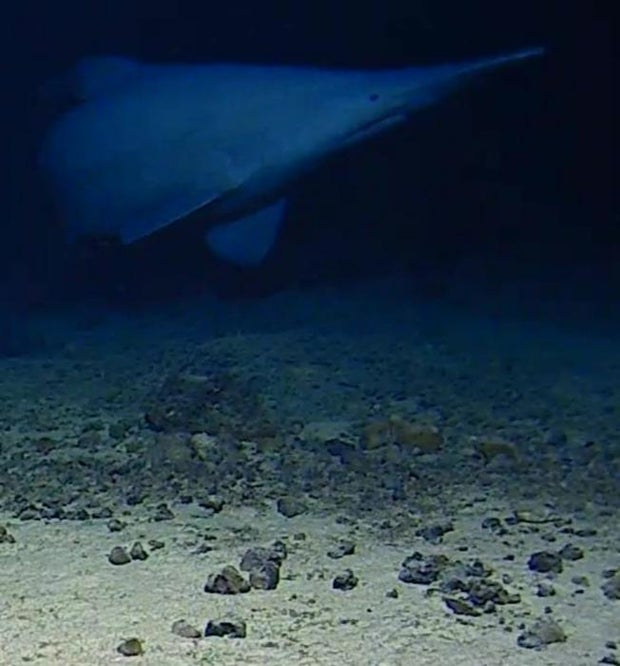
Minderoo-University of Western Australia Deep-Sea Research Center and Inkfish
The study, published in the Journal of Fish Biology, details two observations of the goblin shark on camera.
The first came in 2019, but no one even knew it at the time. In speaking with colleagues at the Deep-Sea Animal Research Center, study author Aaron Judah learned a 2019 Ocean Exploration Trust expedition on the M/V Nautilus — the underwater exploration ship owned by Robert Ballard, who found the wreck of the Titanic — might have seen a goblin shark on camera.
In looking back through the video, Judah hit the jackpot. The shark was spotted when exploring extremely remote areas of the Pacific near locations like Jarvis Island and the Palmyra Atoll.
“Seeing the most iconic of all the deep-sea sharks alive and looking healthy in its natural habitat is a unique honour,” Judah, a researcher in the Department of Oceanography at the University of Hawaii at Mānoa, said in a statement of the two discoveries. “I was also very surprised about how deep this species was found. The observation from the slope of the Tonga Trench is nearly 700 meters deeper than this species was known to live.”
In other words, the discoveries in 2019 and 2024 were not only enlightening for being the first time seeing the shark on camera, but also in helping scientists learn more about the animal’s natural habitat.
Dianne Bray/Museum Victoria
The geographic range of where the goblin shark roamed expanded considerably thanks to the mid-Pacific sighting in 2019, while the 2024 find extended how deep lamniform sharks could be found by 108 meters, according to the study.
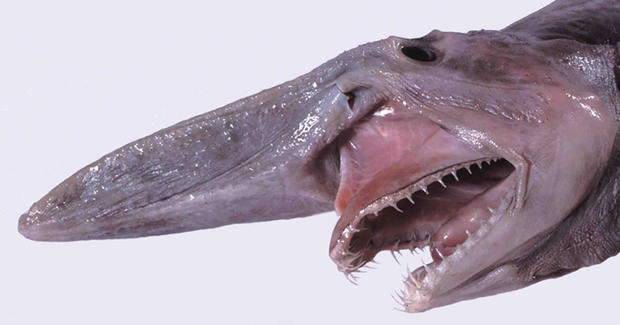
The goblin shark’s name comes from its unique, and slightly terrifying, appearance. The shark, which is about 12 feet long on average, has a pink, squishy body and comically large nose hiding a set of razor-sharp teeth underneath. Goblin sharks are one of a species known as “living fossils,” since they are the only one left living in their family (Mitsukurinidae), which goes back 125 million years, according to the U.S. Fish and Wildlife Service.
“It is really important that we still perform natural history work,” Judah said in a statement. “New discoveries like this demonstrate that there is still so much to explore in our deep ocean home. Given the newly-expanded geographic range of the goblin shark, this species can be included in regional management and a nationʻs biodiversity list, whereas, beforehand we didn’t know it was even there!”