
Gas prices are falling despite the Iran war’s impact. Will it last?

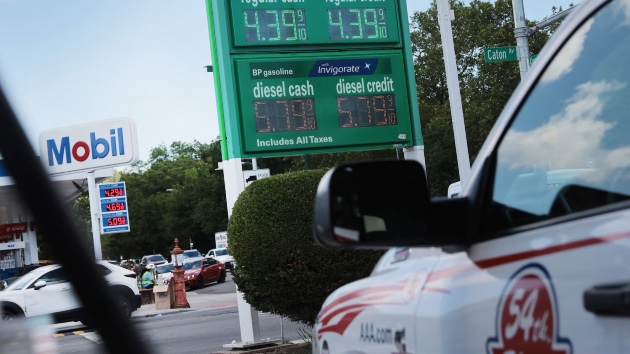
Fuel prices are displayed at a gas station in Brooklyn on June 01, 2026, in New York City. (Spencer Platt/Getty Images)

(NEW YORKI) –Drivers stung by high gas prices have enjoyed some welcome relief over the last couple of weeks, even as the impact of the Iran war continues to choke off oil supply.

The national average price of a gallon of gas stood at $4.26 on Wednesday, marking a decline of 30 cents, or 6.5%, since a recent peak on May 21.

Still, prices remain well above where they clocked in before a historic oil shock set off by the war. In late February, the average gallon of gas ran less than $3.

The dropoff in gas prices owes to a decline in oil costs over the latter part of last month, which coincided with a slump in demand following Memorial Day weekend, some analysts said.

Still, they cautioned, gas prices may rise again as oil prices jump and the war shows little sign of an imminent resolution. If the war continues, some analysts said, gas price could top $5 a gallon by next month.

“It’s so volatile,” Patrick Penfield, a professor of supply chain practice at Syracuse University, told ABC News. “If the war ended, prices would likely go down. But if it continues, you’ll see prices go up.”

In Georgia, the state with the lowest average gas prices, a gallon costs about $3.79, AAA data shows. In all, the AAA data says six states currently sell gas at or below an average price of $4 per gallon.

By contrast, the cost of a gallon of gas in California stands at $5.99, making it the state with the highest prices, AAA data shows. Even in California, however, the average price has fallen about 10 cents over the past week.

At the outset of the war, gasoline prices surged in response to Iran’s effective closure of the Strait of Hormuz, a maritime trading route that facilitates the transport of about one-fifth of global crude supply.

Oil prices began to fall in mid-May, however, as Iran and the U.S. appeared willing to strike an agreement that would reopen the strait. Crude oil is the main ingredient in auto fuel, accounting for more than half of the price paid at the pump, according to the federal U.S. Energy Information Administration.

On Friday, U.S. oil prices fell as low as about $86 a barrel, marking a drop of about 20% over a 10-day stretch.

“Gas prices have seen a big push because crude prices have dropped. Crude prices have dropped largely because the president has been indicating that we’re close to an agreement with Iran,” Ramanan Krishnamoorti, a professor of petroleum engineering at the University of Houston, told ABC News.

The U.S. is a net exporter of petroleum, meaning the country produces more oil than it consumes. But since oil prices are set on a global market, U.S. prices move in response to swings in worldwide supply and demand.

Oil prices have ticked up in recent days, but they remain below $100 a barrel. As long as oil prices remain under that benchmark, gas prices may continue to hold steady or even decline, Denton Cinquegrana, chief oil analyst at Dow Jones Energy, told ABC News.

A near-term drop in gas prices appears possible because gas sellers are holding onto unusually large profit margins, meaning they could reduce retail prices even if their input costs maintain current levels, Cinquegrana said. Over the past two years, the average margin for sellers came in at about 34 cents per gallon, he added, but it currently stands at 50 cents per gallon.

“There’s still some room for gas prices to move down,” Cinquegrana said.

Looking weeks or months into the future, however, analysts cautioned about a rise in oil and gasoline prices unless normal tariff resumes in the Strait of Hormuz.

“It’s still possible later this summer, even ahead of July 4, we could see the national average pass $5 a gallon,” Patrick De Haan, a petroleum analyst at GasBuddy, told ABC News Live on Monday.

“We could be seeing much higher gas prices in very short order if the strait doesn’t reopen,” he added.

Copyright © 2026, ABC Audio. All rights reserved.

Millions of Americans with untreated high blood pressure should be taking medication

Nearly 1 in 3 adults in the United States with untreated high blood pressure would benefit from treatment and are not getting it, according to a new study.That’s because nearly 10 million Americans now meet newly updated guidelines by the American Heart Association and American College of Cardiology that redefine an adult’s risk for cardiovascular disease.“We estimated that approximately 200,900 all-cause deaths and 162,600 cardiovascular deaths could be prevented over the next 10 years,” said lead study author Dr. Mustafa Al-Jarshawi, a cardiologist at Keele University in England.Ideally, doctors want blood pressure to fall below 120 mmHg systolic and 80 mmHg diastolic. If blood pressure is around 130/80, doctors have typically advised people to make changes to their lifestyle, such as increasing exercise.If doctors use the American Heart Association’s new PREVENT tool, which considers blood sugar, kidney function and a person’s decade-long risk for heart disease as well as blood pressure, some 81 million Americans would be eligible for blood pressure medications.“What this is saying is that people who have traditionally not been at very high risk are now eligible to be treated with medications more aggressively,” said cardiologist Dr. Andrew Freeman, director of cardiovascular prevention and wellness at National Jewish Health in Denver.“Generally, I think when people have additional risk, blood pressure is really the silent killer,” said Freeman, who was not involved with the study.Expanding treatment could save livesThe study, published July 29 in the Journal of the American Heart Association, analyzed National Health and Nutrition Examination Survey data from 2009 to 2018. Newer data is available, but the most up-to-date version of the survey hasn’t been around long enough for researchers to know participants’ cause and time of death.The study examines how death rates might be lower if the 2025 hypertension guidelines were implemented during those years, Al-Jarshawi said.Among 81 million adults with high blood pressure and no cardiovascular disease, nearly 23 million may be newly eligible under the new guidelines. Of those 23 million, 9.7 million were untreated.Becoming eligible to receive blood pressure medication was associated with a 23% lower risk of dying compared with no treatment. When it comes to the chances of dying from a heart-related issue, risk dropped by 50%. The study also found that adults with diabetes would benefit most from treatment. This is because diabetes and high blood pressure often occur together, significantly increasing cardiovascular risk, Al-Jarshawi said.Treatment is more than a medicationAny eligible person shouldn’t hesitate to start taking medication in addition to making lifestyle changes to reduce long-term risks, Al-Jarshawi said.Controlling high blood pressure is a long-term commitment to health, CNN contributor Dr. Leana Wen, an emergency physician and adjunct associate professor at George Washington University, told CNN in a previous article. She recommended looking into a key inventory of five daily habits: level of physical activity, diet, substance use including alcohol and marijuana, stress levels, and a healthy weight.“You don’t have to do everything perfectly to make a difference in your health,” Wen said. She suggests starting with small lifestyle changes. Many people can’t easily reduce stress in their lives, but maybe they can more easily start eating more fruits and vegetables.”The findings of the new study highlight the importance of controlling high blood pressure, Freeman said.“The western world is ailing from a variety of cardiometabolic, kidney diseases,” Freeman said. “High blood pressure amplifies a lot of risk, and we have to do whatever we can to get that risk down and being aggressive about blood pressure is very low-hanging fruit.”However, medication only works when it’s inside the person, and not sitting in the bottle unused, Freeman said. About half of adults in the US with high blood pressure don’t regularly take their prescribed medication, according to a July 2025 study published in the journal JAMA Cardiology.Freeman recommends trying to form a habit, such as keeping your pillbox next to an alarm or toothbrush. That way, when set an alarm for the morning or brush your teeth, you remember to also take the pills.“There’s a way to cue yourself and remind,” Freeman said. “For those people that forget, consider having a small supply in your purse or your wallet or your car, just so you can always remember to take it.”The study’s findings also highlight the need for physicians to be alert to early signs of disease and consider blood pressure treatment, even in younger people, according to Freeman.“We’re seeing a lot more young people now who have chronic disease and diabetes and other things that may be relatively mild, but still at risk, and we need to be even more aggressive,” Freeman said.The-CNN-Wire™ & © 2026 Cable News Network, Inc., a Warner Bros. Discovery Company. All rights reserved.
Read Next Story