▶ Watch Video: Argentina beats England to reach FIFA World Cup final
For the past 39 days, fans around the world have rallied behind their national teams, gathering in bars, at watch parties and inside packed stadiums for the 2026 FIFA World Cup. On Sunday, the tournament reaches its climax as Spain and Argentina battle at MetLife Stadium for soccer’s biggest prize.
Spain is looking to secure a World Cup victory for the first time in 16 years after dominating in the semifinal in a 2-0 win over France on Tuesday. Argentina enters Sunday’s final hoping to become back-to-back champions after a late comeback over bitter rival England on Wednesday, winning 2-1.
France will play England in the third-place match on Saturday at 5 p.m. ET in Miami.
The World Cup kicked off with excitement in North America last month as the biggest in history with 48 teams competing across 104 matches, hosted jointly across 16 cities in the United States, Canada and Mexico.
The tournament has been marked by major upsets, political intervention and an unprecedented Golden Boot race. Here’s a look at the tournament’s top moments and what’s in store for the final.
Trump’s call for Folarin Balogun red card review
One moment that captivated and shocked soccer fans was President Trump’s call to FIFA President Gianni Infantino to request a review of a red card that was issued to American star striker Folarin Balogun.
Balogun was given a red card in the team’s round of 32 match against Bosnia and Herzegovina on July 1. He was penalized for stepping on the right ankle of Tarik Muharemović. In World Cup tournament soccer, a red card comes with an automatic suspension for the following game.
Mr. Trump told reporters that he watched the World Cup match and asked for a review when he learned that Balogun would miss the U.S.’ Round of 16 match against Belgium.
FIFA reversed the one-match suspension, a reversal that sparked heavy criticism and a failed appeal from Belgium. Balogun was in the starting lineup against Belgium, who trounced the U.S. 4-1 in Seattle.
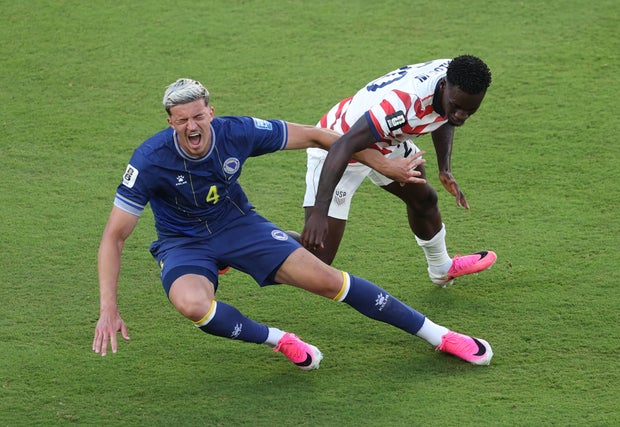
Michael Steele / Getty Images
Balogun said in an interview Tuesday with “CBS Mornings” that while he was happy to rejoin the team’s match against Belgium, he knew it was “going to cause a lot of controversy.”
“When something is not intentional … it should never be a red card,” Balogun told “CBS Mornings.” “So it was just an unfortunate situation and I think, you know, it put a lot more pressure on us than we needed.”
U.S. is last host country to get knocked out of tournament
Energy was riding high among Americans as the U.S. men’s team looked to make it to the quarterfinals for the first time in 24 years, but they ultimately fell short against Belgium in their 4-1 loss in the round of 16.
It was the fourth time in the past five World Cups that the U.S. men’s team was knocked out at this stage. The team didn’t qualify in 2018.
The U.S. impressed in the group stage with wins against Australia and Paraguay and in the round of 32 over Bosnia-Herzegovina. Enthusiasm among fans was particularly at an all-time high after Balogun’s suspension was lifted, and fans had hopes for the “golden generation” team to carry America to the quarterfinals.
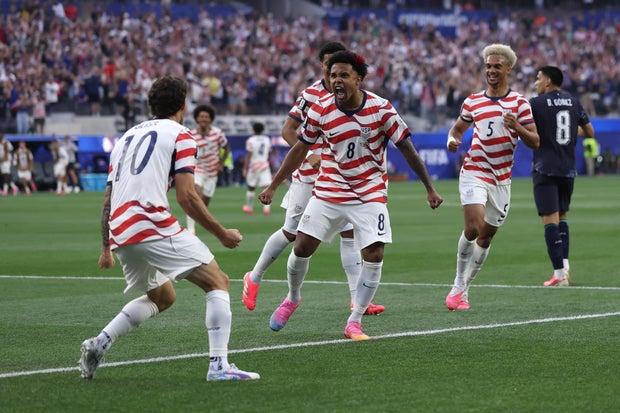
Dean Mouhtaropoulos/Getty Images
But it was the U.S. match against Belgium where things started to fall apart.
American midfielder Malik Tillman was able to even the score after the half-hour mark, but the tie lasted just about a minute before Belgium came back with another goal. In the second half, U.S. goalkeeper Matt Freese wandered a little too far off his post, and Belgium scored again. The USMNT continued to struggle, and star striker Christian Pulisic was later substituted out due to injury.
“I think we were not good enough. It wasn’t our day. We didn’t perform in the way that we’re supposed to perform or show our quality,” USMNT head coach Mauricio Pochettino said.
Despite the loss to Belgium, the final U.S. match drew an average of 30 million viewers on Fox, making it the most-watched soccer match in U.S. history.
Cape Verde’s Cinderella run
Cape Verde, the third-smallest country to qualify for the tournament, had an unexpected run in its very first World Cup appearance, captivating audiences around the globe.
In the group stage, the team shocked soccer fans in its opening match by gutting out a goalless draw against tournament favorite Spain.
Vozinha, Cape Verde’s 40-year-old goalkeeper, went from virtual anonymity to becoming a global star with more than 29 million Instagram followers thanks to his exploits in goal.
“This means everything for our country,” Cape Verde coach Pedro Leitão Brito said. “We have always said that we wanted everybody to see our country, our team and we have shown organization and braveness and this is proof of what our country is about — resilience and to try to overcome hardships.”
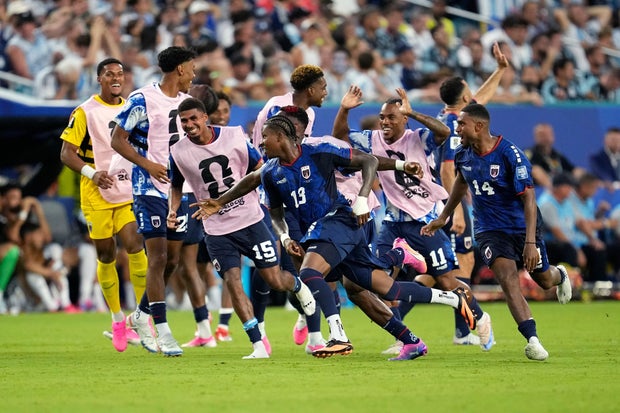
George Walker IV/AP Photo
The team went on to finish with a 2-2 comeback against two-time champion Uruguay and a 0-0 draw against Saudi Arabia.
Cape Verde almost pulled off a massive upset against three-time World Cup champion Argentina in the round of 32 after the team canceled out Argentina’s lead twice, but ultimately fell short in extra time, losing 3-2.
“Nobody has to ask where Cape Verde is now,” defender Pico Lopes said. “They know where we are.”
Cristiano Ronaldo and other soccer stars announce World Cup retirement
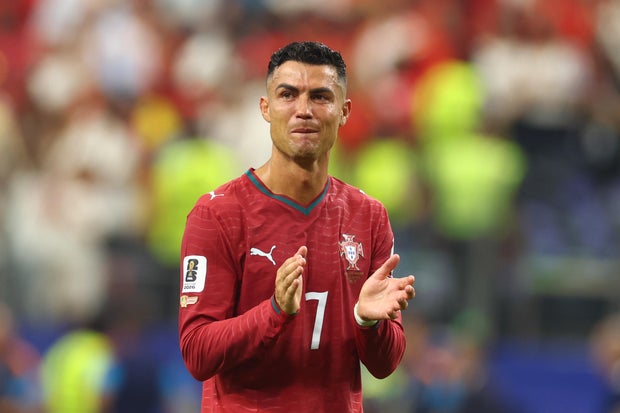
The 2026 World Cup is the last for many top soccer stars. Portugal’s Cristiano Ronaldo played his last World Cup match against Spain, where Portugal was eliminated in a 1-0 loss in the round of 16.
In his last tournament run, Ronaldo scored his first-ever World Cup knockout stage goal in the 68th minute of Portugal’s round of 32 match against Croatia.
“I’m sad to leave the World Cup this way,” he said after the match. “As I said yesterday, I gave it my all, and I leave with a clear conscience. That’s the life of a footballer. You have to move forward.”
Chris Brunskill / Fantasista / Getty Images
While Lionel Messi, 39, hasn’t officially announced that this will be his last World Cup, it’s quietly expected to be his sixth and final appearance, a World Cup record for which he is tied with Ronaldo. And the ageless wonder has continued to amaze. Heading into Sunday’s final, he has eight goals in the tournament, tied with France’s Kylian Mbappé for the lead in the Golden Boot race. Messi also set the all-time record for goals in World Cup history with 21.
Other soccer stars who have confirmed it’ll be their final World Cup include Croatia’s Luka Modrić, Neymar of Brazil, Germany’s Manuel Neuer and Belgium’s Kevin De Bruyne.
“I tried,” Neymar said. “It started here at MetLife Stadium, and I finished here. It is now over.”
2026 World Cup final to feature tournament’s first-ever halftime show
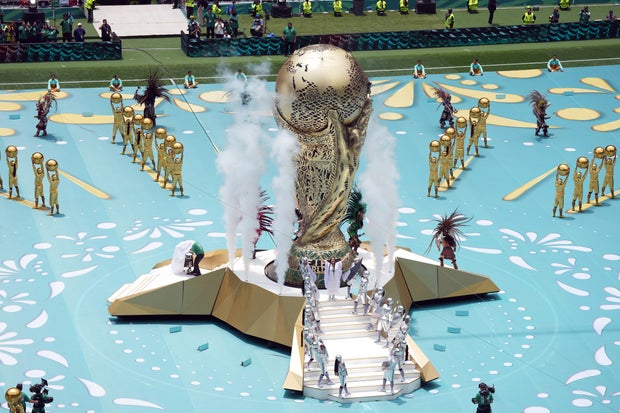
For the first time in tournament history, FIFA will stage an 11-minute halftime show during the World Cup final with Justin Bieber, Madonna, Shakira and BTS as headliners. Burna Boy, Venezuelan conductor Gustavo Dudamel and the PS22 Chorus, alongside Coldplay, will also perform.
The World Cup featured three separate opening ceremonies across the host nations for the first time this year, with performances from Shakira and Burna Boy, Michael Bublé, Jessie Reyez, Katy Perry, Future, LISA from Blackpink, Anitta, Rema and Tyla.
Nick Potts/PA Images via Getty Images
Spain and Argentina both have previous World Cup titles
A World Cup win for Spain this year would be the second in the country’s history after it claimed its first and only men’s title in 2010. The Spanish team defeated the Netherlands 1-0 in Johannesburg, South Africa. It was the only time Spain had ever reached the World Cup final.
Argentina’s road to the final has not been smooth sailing after the team needed extra time to beat Cape Verde, then made an unexpected comeback to overcome a two goal deficit to Egypt in the round of 16 and beat Switzerland 3-1 in extra time. On Wednesday, the team made another last-minute comeback, beating England 2-1.
Argentina has won the World Cup three times — 1978, 1986 and 2022. If Argentina becomes back-to-back champions, they’d be the third country to do so. Italy became repeat winners in 1938, and Brazil in 1962.