
Former model scout linked to Jeffrey Epstein found dead in his Paris home

▶ Watch Video: Epstein associate found dead in France

A model scout accused of rape and trafficking with links to the late American sex offender Jeffrey Epstein was found dead in his Paris home on Monday. 

Daniel Siad was under investigation by Paris prosecutors for accusations of rape and organizing human trafficking. The criminal investigation into Siad was launched based on complaints from women who came forward after his name appeared nearly 2,000 times in files on Epstein released by the U.S. Department of Justice.

Siad, 69, had denied all of the accusations. 

An autopsy report has not been issued to confirm his cause of death, but his lawyer said that if he died of a heart attack, it may have been due to stress caused by the ongoing investigation. 

“Daniel Siad never stopped proclaiming his innocence,” said his attorney Menya Arab-Tigrine. “If he died of a heart attack, this unbearable wait, the opprobrium cast upon him, and by extension on those close to him, the pressure and anguish with which he lived daily, will have played some part in it. We must wait for the results of the autopsy to know whether it was indeed his body that gave out. Let us not forget that he was never prosecuted, and therefore never implicated judicially.”
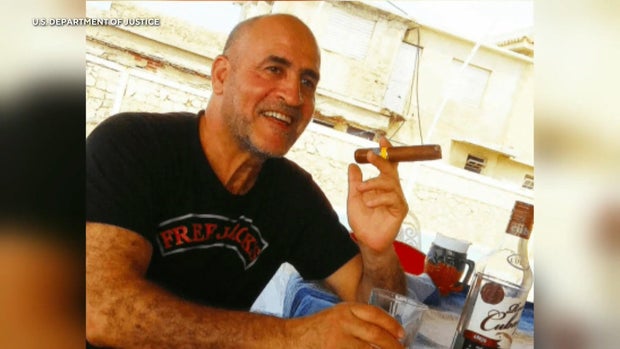
cbsn-fusion-epstein-associate-found-dead-france-thumbnail.jpg
Daniel Siad is seen in a file photo released by the U.S. Department of Justice.

U.S. Department of Justice

Siad recruited models for leading French modeling agent, Jean-Luc Brunel, who was a close associate of Epstein. 

Brunel, who denied charges of rape and human trafficking, was found hanged in a Paris prison cell in 2022 while he was awaiting trial.  

The Paris prosecutor’s office said its investigation into sex trafficking linked to Epstein, launched in February amid revelations in the documents released by U.S. authorities, “is continuing in order to identify all individuals likely to be implicated, notwithstanding the termination of the public prosecution concerning Daniel Siad.” 

Former Swedish model Ebba Karlsson, who is now in her 50s and had accused Siad of rape, told the French news agency AFP that his death was “very frustrating,” as he “was very close to be arrested. We worked so hard for this, trying to have justice.”

Just last week, six women, mostly American, filed legal complaints in France accusing another former top modeling agent, Gerard Marie, of rape and human trafficking in the 1980s and 1990s. 

Those allegations pre-date the current statute of limitations in France, which is 20 years for alleged crimes against adults and 30 years for crimes against minors, but there is a major debate in France underway about whether the country should abolish the statute of limitations for the rape of minors entirely. 

Lawmakers are expected to debate the proposal this year. 

A NASA observatory will likely reenter Earth’s atmosphere this year after rescue effort falls short

(CNN) — A satellite called LINK that recently launched to boost the orbit of a falling space observatory won’t be able to carry out its daring rescue mission after all.NASA’s decades-old Neil Gehrels Swift Observatory is steadily losing altitude and in danger of reentering Earth’s atmosphere. Designed by Arizona-based Katalyst Space Technologies to save the observatory, the LINK satellite began to encounter difficulty in late July. Just weeks after LINK lifted off on July 3, it started to spin out of control.Katalyst was able to regain control of the satellite, but the company acknowledged that the issue cost it time, which would delay LINK’s rendezvous with Swift by about a month. However, that postponement — at least initially — did not seem to be a deterrent to the mission.Now, NASA and Katalyst have announced that LINK’s mission will not capture and boost Swift to a higher orbit “due to ongoing attitude control issues,” according to statements Wednesday.Swift’s science mission will come to an end as the observatory likely burns up in Earth’s atmosphere later this year, according to NASA.“NASA should be willing to move quickly and take smart risks when the potential return is worth it, and that is exactly what we did with this mission,” NASA Administrator Jared Isaacman said in a statement.“This is not the outcome we were working toward, but it does not change why this mission was worth attempting. The team moved with extraordinary speed to give Swift a chance to carry out more science while advancing capabilities America will need for satellite servicing in the future.”But LINK’s journey isn’t over yet, and the lessons learned could be instrumental for future in-space servicing operations.Demonstrating future capabilitiesThe mission team is forging ahead with its plan for LINK to rendezvous with Swift — but as a demonstration rather than a rescue.“We are going to learn everything we can from LINK’s rendezvous attempt and put those lessons to work on the missions that follow,” Isaacman said.Originally, LINK was expected to conduct a survey of Swift to determine the best grappling points on the observatory, a step that will likely be part of the satellite’s anticipated rendezvous, though it’s currently unclear when this test will take place.Swift wasn’t designed to be serviced in space, which means that insights from the demonstration could be used for future missions.“Katalyst designed, developed, and launched an experimental spacecraft to go after an ambitious mission on an aggressive timeline,” said Ghonhee Lee, CEO of Katalyst Space Technologies, in a statement. “We took on this high-risk, high-reward challenge and are proud of the milestones we reached along the way. We have already learned a tremendous amount, and now our job is to turn those lessons into something durable — building a repeatable playbook to inform future rendezvous and proximity operations and satellite servicing.”Filling the gapThe Swift observatory, which has no established observational replacement waiting in the wings, has served as an astrophysics multitool in low-Earth orbit since it launched nearly 22 years ago, quickly pivoting to observe celestial objects and cosmic events.But atmospheric drag, intensified by solar activity, exerted its forces on the observatory, leading NASA to predict that Swift would reenter Earth’s atmosphere once it dips below an optimal altitude of about 185 miles (300 kilometers) above Earth.Katalyst designed, built, tested and launched LINK in nine months. The robotic satellite lifted off on a Northrop Grumman Pegasus XL rocket, which was released midair by the company’s modified L-1011 aircraft, Stargazer.Before the satellite’s launch, members of the Swift and LINK teams both acknowledged that the path to boosting the observatory was full of risks that could cause the mission to fail.“We were all hoping for more science from Swift,” said Shawn Domagal-Goldman, director of the Astrophysics Division at NASA headquarters in Washington, DC. “But we knew the takeaways from this mission would be worthwhile either way, and we have gained so much through the series of accomplishments up to this point.”The agency will rely on the rest of its fleet of active observatories to fill Swift’s gap and “will continue to prioritize finding new options to react rapidly to cosmic events,” according to NASA.“Building, testing, and operating this mission has already strengthened America’s space industry pipeline, advancing in-space servicing capabilities in completely new ways,” Domagal-Goldman said. “NASA is committed to supporting our commercial vendors as they take on difficult tasks with the agency, to push the boundaries of what’s possible.”The-CNN-Wire™ & © 2026 Cable News Network, Inc., a Warner Bros. Discovery Company. All rights reserved.
Read Next Story