
First major 2026 Atlantic hurricane forecast predicts below-average season

▶ Watch Video: Researchers predict slightly fewer hurricanes than usual this season

Fewer storms than usual may develop during the 2026 Atlantic hurricane season, researchers say, as climate patterns seem poised to favor below-average activity compared with a typical year.

That prediction anchors the latest annual hurricane forecast from Colorado State University’s Tropical Cyclones, Radar, Atmospheric Modeling and Software team, which was initially released in April and updated Wednesday. 

Colorado State University’s team of experts estimate that 2026 will see nine named storms develop in the Atlantic basin, including four hurricanes and one major hurricane (defined as Category 3 or higher). Those estimates were revised down from 13 named storms, six hurricanes and two major hurricanes, as the researchers originally predicted.

They could occur at any point in the season, which officially runs from June 1 to Nov. 30 and peaks between August and October. Researchers will be keeping an eye on conditions that could hint at their projected timing, since the forecast always carries some uncertainty. Phil Klotzbach, its lead author, said at a news conference unveiling the team’s April predictions that “there are curveballs that could come our way.”

This forecast will be continuously updated as hurricane season progresses. They are closely monitored each year by leaders and residents of hurricane-prone states — especially Florida and states along the Gulf Coast and Eastern Seaboard — readying themselves for the possibilities ahead.

The National Oceanic and Atmospheric Administration has also released its forecast, similarly predicting a below-average season.

“We always recommend, to coastal residents, to prepare the same way for every season,” Delián Colón-Burgos, who co-authored the forecast, told CBS News. 

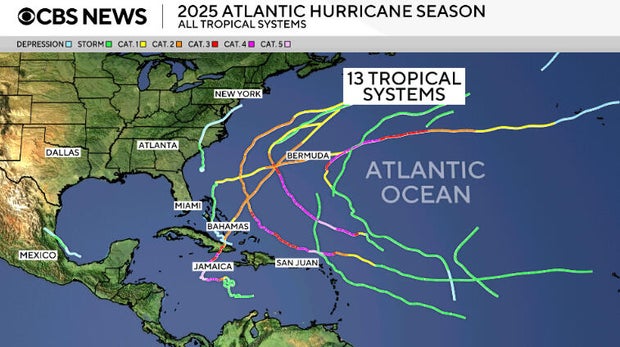
Hurricane activity this year will dip below 75% of the long-term seasonal average, according to the forecast. If accurate, that would mark a decrease from last year’s hurricane season, which brought 13 named storms, five hurricanes and four major hurricanes, although none made direct landfall in the U.S. in 2025. Federal data show an average season has 14 named storms, seven hurricanes and three major hurricanes.
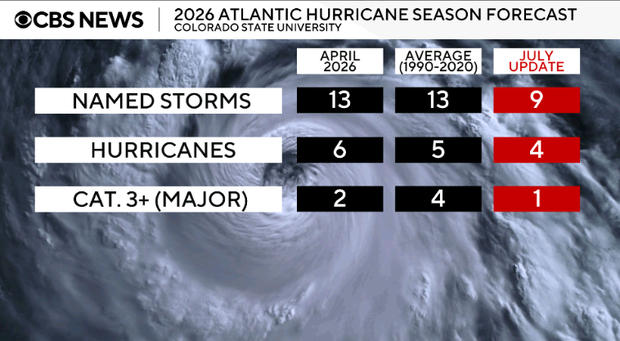
image003.png
Colorado State University’s 2026 Atlantic hurricane forecast released on July 8, 2026, compared with the university’s April forecast and the number of named storms, hurricanes and major hurricanes that develop during an average season. 

Nikki Nolan/CBS News

Colón-Burgos emphasized that communities vulnerable to the hazards of hurricane season should “take it seriously” regardless of the statistics. She said encouraging people to start preparations in advance and remain alert no matter what “is one of the most important things that we want to get across.”

An atmospheric shift

A change in atmospheric conditions that can either coax or suppress the development of Atlantic hurricanes is the main driver of researchers’ below-average forecast, Colón-Burgos said.

That’s primarily because El Niño, the warmer phase of the El Niño-Southern Oscillation, or ENSO, cycle, arrived in late spring,
according to the Climate Prediction Center. A phenomenon defined by shifting sea surface temperatures and precipitation in the Pacific Ocean, the cycle impacts weather across the United States and often foreshadows how busy a hurricane season will be.

During El Niño, Atlantic hurricanes tend to be less intense and less frequent.

The Climate Prediction Center has said El Niño may intensify in the coming months, and last until at least the end of 2026. Forecasters suggest there’s a 63% chance that El Niño will have grown so strong by the end of this year’s hurricane season that it could rank among the largest events of its kind in the historical record, which dates back to 1950.

Whether sea surface temperatures in the Atlantic Ocean rise or fall in the coming weeks is one variable creating uncertainty in hurricane forecasts. Colón-Burgos said how temperature trends shape up could affect future storm predictions.

How many storms will make landfall in 2026?

The current forecast predicts there’s a 32% chance of a major hurricane making landfall somewhere along the U.S. coastline in 2026, and a 35% chance of one making landfall in the Caribbean. While those figures may seem low, researchers note that they don’t account for less powerful storms, which can still be dangerous. 

“It takes only one storm near you to make this an active season for you,” said Michael Bell, who co-authored the forecast, in a statement.

No hurricanes struck the U.S. last year, for the first time in a decade, but some Caribbean islands were hit especially hard. Jamaica, in particular, was devastated by Hurricane Melissa, which made landfall as a formidable Category 5 storm and concluded the 2025 hurricane season.
2025-tropical-systems-map.jpg
A map of tropical systems that formed during the 2025 Atlantic hurricane season.

Nikki Nolan/CBS News

Named storms in 2026

The World Meteorological Organization prepares a list of names that will be assigned to a given year’s tropical storms and hurricanes. 

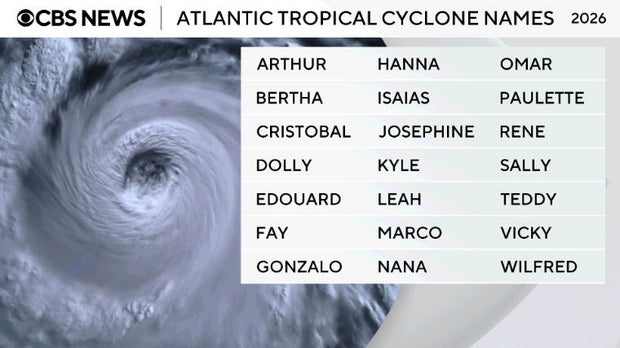
For 2026, the first named storm was called Arthur. It will be followed by Bertha, Cristobal, Dolly, Edouard and Fay. The list continues alphabetically until wrapping up with Vicky and Wilfred, although not all letters in the alphabet are represented.
2026-named-storms.jpg
Names that will be given to tropical storms and hurricanes in 2026.

Nikki Nolan/CBS News

A storm receives a name when its maximum wind speeds reach 39 mph, according to the National Hurricane Center. If winds reach 74 mph, the storm becomes a hurricane. “Major” hurricanes are those with winds of at least 111 mph, corresponding with Category 3 or above on the Saffir-Simpson Scale commonly used to rate storms. Such powerful hurricanes are capable of causing catastrophic damage.

Rather than capitulating to the US, Iran toughens its demands over the vital Strait of Hormuz

(CNN) — The list of demands from Iran can’t have surprised the White House.Hardliners have been repeating the mantra on a daily basis: the limited agreement in the works with Oman on the Strait of Hormuz is not the same as reopening the vital waterway in the way Washington wants.For that, they say, “America must correct its behavior.”Tehran has now spelled out what means, laying out a series of conditions that appear to go beyond the memorandum of understanding which was agreed in June but later suspended amid US strikes on Iran, Iranian retaliation across the Middle East and a resurgence of attacks on shipping.On Saturday, Mohammad Bagher Zolghadr, a highly influential figure in the Revolutionary Guards, reeled off a maximalist set of demands.That Iran is issuing such demands underlines the perception that Tehran believes it has the upper hand. CNN has reported on dwindling US munitions - something angrily denied by President Trump - and suggestions that his top general is looking for an “off-ramp” in the conflict.It is also likely that Iran has taken notice of how many times Trump has threatened major strikes before not following through on the threat.Zolghadr demanded the US lift its naval blockade and withdraw its military forces from around Iran.The US must also pay damages caused to Iran by the wars this year and in June last year (which was principally conducted by Israel), he said. And the US must lift sanctions and release, unconditionally, Iranian assets frozen abroad.The implication of Zolghadr’s statement was that these conditions must be fulfilled before or in tandem with concessions on the strait, which would be at odds with the formula set out in the memorandum of understanding.That held that sanctions would be fully removed once a final deal regarding Iran’s nuclear program was reached and envisaged a phased release of assets, in which the two sides “will mutually agree on the procedures related to the release of these funds.”Iran’s apparent new strategy, though, is not without risk.The fresh demands “narrows the options for the Trump administration,” according to the former Supreme Allied Commander of NATO, James Stavridis.“Iran is overplaying its hand and it appears the hardliners are in control. The likelihood of a deal in the immediate term is declining,” Stavridis posted on X Sunday.No US-Iran talks underwayThe Trump administration has not responded to the latest Iranian conditions.“What we’re really working through now is how you can actually set up a traffic scheme so that the ships that pass can pass through safely,” US Vice President JD Vance told Fox News on Saturday.But the current situation smacks of stalemate.Iranian officials, whether perceived as moderates or hardliners, are saying that renewed negotiations with the US are not in prospect.“As long as the United States has not addressed its violations of the memorandum of understanding and remedied those breaches, we see no possibility of restarting negotiations,” Foreign Minister Abbas Araghchi said Sunday.“We currently have no negotiations with America. Yes, there is an exchange of messages through intermediaries,” he added.Araghchi referred to the more limited and temporary arrangement for Hormuz being negotiated with Oman, which borders its southern shoreline.“I can say we are in the final stages, and the old routes that existed will be replaced with new routes,” he said, referring to how the thin traffic traveling through the strait is currently split between Iranian and Omani paths.“This, of course, does not mean the opening of the Strait of Hormuz,” Araghchi told reporters in Tehran, which was “subject to the fulfillment of a series of other conditions.”Other Iranian officials have indicated that an agreement with Oman would continue to give Iran considerable influence in the strait, which it did not enjoy before the war but which has become a red line as important as the nuclear issue for Tehran.Deputy Foreign Minister Kazem Gharibabadi said last week the arrangement reflects a new strategy for exercising “effective sovereignty” over the strait, while stressing that Iran does not intend to routinely close the waterway in peacetime.Iran’s Foreign Ministry spokesman Esmaeil Baghaei cautioned last week that there could be a deal with Oman “provided that certain third parties do not obstruct the process” in a far from cryptic reference to the US.Amidst the uncertainty – and sporadic attacks on ships passing through the Strait – traffic remains very limited. An average of about a dozen vessels a day have transited in the past week, according to shipping data.That’s about one-tenth of the normal pre-war traffic.Already into its sixth month, the conflict between the US and Iran shows no sign of resolution - but has instead evolved into an unpredictable cycle of escalation and pause.The-CNN-Wire™ & © 2026 Cable News Network, Inc., a Warner Bros. Discovery Company. All rights reserved.
Read Next Story