First major 2026 Atlantic hurricane forecast predicts below-average season

▶ Watch Video: Researchers predict slightly fewer hurricanes than usual this season

Fewer storms than usual may develop during the 2026 Atlantic hurricane season, researchers say, as climate patterns seem poised to favor below-average activity compared with a typical year.

That prediction anchors the latest annual hurricane forecast from Colorado State University’s Tropical Cyclones, Radar, Atmospheric Modeling and Software team, which was initially released in April and updated Wednesday. 

Colorado State University’s team of experts estimate that 2026 will see nine named storms develop in the Atlantic basin, including four hurricanes and one major hurricane (defined as Category 3 or higher). Those estimates were revised down from 13 named storms, six hurricanes and two major hurricanes, as the researchers originally predicted.

They could occur at any point in the season, which officially runs from June 1 to Nov. 30 and peaks between August and October. Researchers will be keeping an eye on conditions that could hint at their projected timing, since the forecast always carries some uncertainty. Phil Klotzbach, its lead author, said at a news conference unveiling the team’s April predictions that “there are curveballs that could come our way.”

This forecast will be continuously updated as hurricane season progresses. They are closely monitored each year by leaders and residents of hurricane-prone states — especially Florida and states along the Gulf Coast and Eastern Seaboard — readying themselves for the possibilities ahead.

The National Oceanic and Atmospheric Administration has also released its forecast, similarly predicting a below-average season.

“We always recommend, to coastal residents, to prepare the same way for every season,” Delián Colón-Burgos, who co-authored the forecast, told CBS News. 

Hurricane activity this year will dip below 75% of the long-term seasonal average, according to the forecast. If accurate, that would mark a decrease from last year’s hurricane season, which brought 13 named storms, five hurricanes and four major hurricanes, although none made direct landfall in the U.S. in 2025. Federal data show an average season has 14 named storms, seven hurricanes and three major hurricanes.
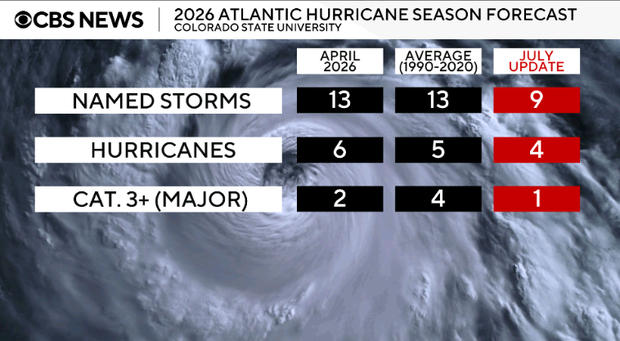
image003.png
Colorado State University’s 2026 Atlantic hurricane forecast released on July 8, 2026, compared with the university’s April forecast and the number of named storms, hurricanes and major hurricanes that develop during an average season. 

Nikki Nolan/CBS News

Colón-Burgos emphasized that communities vulnerable to the hazards of hurricane season should “take it seriously” regardless of the statistics. She said encouraging people to start preparations in advance and remain alert no matter what “is one of the most important things that we want to get across.”

An atmospheric shift

A change in atmospheric conditions that can either coax or suppress the development of Atlantic hurricanes is the main driver of researchers’ below-average forecast, Colón-Burgos said.

That’s primarily because El Niño, the warmer phase of the El Niño-Southern Oscillation, or ENSO, cycle, arrived in late spring,
according to the Climate Prediction Center. A phenomenon defined by shifting sea surface temperatures and precipitation in the Pacific Ocean, the cycle impacts weather across the United States and often foreshadows how busy a hurricane season will be.

During El Niño, Atlantic hurricanes tend to be less intense and less frequent.

The Climate Prediction Center has said El Niño may intensify in the coming months, and last until at least the end of 2026. Forecasters suggest there’s a 63% chance that El Niño will have grown so strong by the end of this year’s hurricane season that it could rank among the largest events of its kind in the historical record, which dates back to 1950.

Whether sea surface temperatures in the Atlantic Ocean rise or fall in the coming weeks is one variable creating uncertainty in hurricane forecasts. Colón-Burgos said how temperature trends shape up could affect future storm predictions.

How many storms will make landfall in 2026?

The current forecast predicts there’s a 32% chance of a major hurricane making landfall somewhere along the U.S. coastline in 2026, and a 35% chance of one making landfall in the Caribbean. While those figures may seem low, researchers note that they don’t account for less powerful storms, which can still be dangerous. 

“It takes only one storm near you to make this an active season for you,” said Michael Bell, who co-authored the forecast, in a statement.

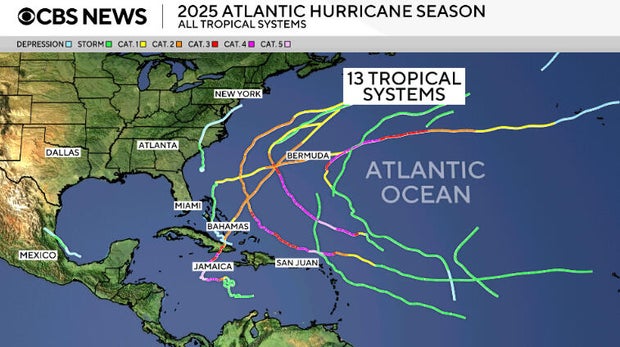
No hurricanes struck the U.S. last year, for the first time in a decade, but some Caribbean islands were hit especially hard. Jamaica, in particular, was devastated by Hurricane Melissa, which made landfall as a formidable Category 5 storm and concluded the 2025 hurricane season.
2025-tropical-systems-map.jpg
A map of tropical systems that formed during the 2025 Atlantic hurricane season.

Nikki Nolan/CBS News

Named storms in 2026

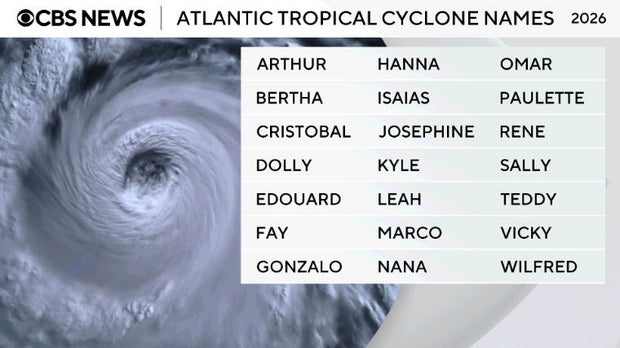
The World Meteorological Organization prepares a list of names that will be assigned to a given year’s tropical storms and hurricanes. 

For 2026, the first named storm was called Arthur. It will be followed by Bertha, Cristobal, Dolly, Edouard and Fay. The list continues alphabetically until wrapping up with Vicky and Wilfred, although not all letters in the alphabet are represented.
2026-named-storms.jpg
Names that will be given to tropical storms and hurricanes in 2026.

Nikki Nolan/CBS News

A storm receives a name when its maximum wind speeds reach 39 mph, according to the National Hurricane Center. If winds reach 74 mph, the storm becomes a hurricane. “Major” hurricanes are those with winds of at least 111 mph, corresponding with Category 3 or above on the Saffir-Simpson Scale commonly used to rate storms. Such powerful hurricanes are capable of causing catastrophic damage.


What the death sentence for former Syrian dictator Bashar al-Assad tells us about the future of the country

(CNN) — The judge who sentenced Syrian President Bashar al-Assad to death in absentia last week was himself sentenced to death in absentia by the same regime years earlier.Irony in its purest form.Judge Fakhr al-Din al-Aryan defected from the Ministry of Justice in 2013 joining the judicial bodies of the opposition. His reinstatement as judge after Assad was toppled and fled the country for Russia in December 2024 is an illustration of the country’s pursuit of transitional justice.Some Syrians celebrated in the streets after the death sentence handed down to al-Assad and his younger brother, Maher. Words like “historic” and “symbolic” tripped off the tongue.For the first time, after decades of brutal Assad rule – by both Bashar al-Assad and his father, Hafez al-Assad before him - the model of impunity in Syria has been broken, even if the penalty is unlikely to ever be carried out.The Syrian civil war, which started in 2011, killed hundreds of thousands of people, displaced millions more and has ravaged the country’s economy.Ibrahim al-Assil, a senior research fellow at the Harvard Kennedy School’s Middle East Initiative, said the sentences handed down last week are “significant politically and significant emotionally, but at the same time this is only one part of justice that many Syrians have waited for - and are still demanding.”For the United Nations, justice is just one of the “four pillars of transitional justice” with truth, reparation and guarantees of non-recurrence carrying equal weight.What does Assad’s sentencing mean for Syria?When Assad fled Syria for exile in Moscow in December 2024, he left behind institutions and a legal system his family had built over six decades.Al-Assil says the sentencing was “the first step to look at the new state, to ask these questions, are new rules and new institutions emerging in Syria that differentiate between justice under Assad and justice post-Assad.”Another question is whether this sentencing met the standards of credible transitional justice.Amnesty International has urged Syria to end trials in absentia and the use of the death penalty, incorporate crimes under international law into domestic legislation and reform the judiciary. The justice ministry rejected the criticism, saying the proceedings complied with Syrian law and included the participation of victims and their representatives.Fadel Abdul Ghany, founder of the Syrian Network for Human Rights which has been documenting victims of the Assad regime since 2011 says: “We need lots of cases, not only one, especially targeting the highest rank, so that the feeling of anger in between the people is reduced, so that Syria can move ahead.”Al-Assil agrees that more localized trials need to follow, bringing as many perpetrators of the former regime’s brutal system to justice as possible. “For many families, they are still looking for those who disappeared, and they want to know where they are, what happened to them…maybe for a family in Homs transitional justice looks very different to a family in Dara’a.”Few believe Russian President Vladimir Putin would ever extradite Assad from his self-imposed exile in Moscow. The death sentence complicates any extradition under Russian law, but a decision not to hand over a former close ally to face justice would be far more political than legal, experts say.What is going right in SyriaThe legalities of transitional justice may be complex, but this verdict is still seen as a landmark moment for justice.When asked what else gives him hope for Syria’s future, Abdul Ghany says; “I think what’s working is freedom of speech, freedom of criticism… Syrians can speak freely and criticize the government, authority, even the high-ranking.” He added that he frequently criticizes the new government without repercussions.Ahmed al-Sharaa, the former rebel commander who has served as Syria’s President since 2025, has been outward looking since taking power.After Assad’s ouster, Syria has bolstered ties with the United States which has lifted most of its crippling sanctions on the country. It has renewed relations with its Arab neighbors who cut ties with Damascus during Assad’s crackdown on protests and welcomed French President Emanuel Macron to Syria in July, the first Western leader to visit since 2024.Al Sharaa reached an agreement with Moscow just days ago over two key Russian outposts in Syria; the Mediterranean coastal bases will be transferred to Syrian control.Entrenched challenges remain, however, in the quest for national unity in Syria. Tensions between the Syrian Army and the Druze minority in southern Syria continue to spark deadly encounters. Al-Assil says he sees no breakthrough on the horizon yet. “The government still seems to deal with the issue as only security and military issue while it’s also a social issue.”There is also persistent friction between Arab and Kurdish communities in the northeast of the country, and the government has had to respond to pockets of violence against the religious Alawite minority along Syria’s coast.Al-Assil also insists that Syria still needs a national dialogue process “to talk about all those divisions between ethnicities and minorities but also to talk about what Syria is and what they want Syria to be and that process is still not there.”The-CNN-Wire™ & © 2026 Cable News Network, Inc., a Warner Bros. Discovery Company. All rights reserved.
Read Next Story