
First major 2026 Atlantic hurricane forecast predicts below-average season

▶ Watch Video: Researchers predict slightly fewer hurricanes than usual this season

Fewer storms than usual may develop during the 2026 Atlantic hurricane season, researchers say, as climate patterns seem poised to favor below-average activity compared with a typical year.

That prediction anchors the latest annual hurricane forecast from Colorado State University’s Tropical Cyclones, Radar, Atmospheric Modeling and Software team, which was initially released in April and updated Wednesday. 

Colorado State University’s team of experts estimate that 2026 will see nine named storms develop in the Atlantic basin, including four hurricanes and one major hurricane (defined as Category 3 or higher). Those estimates were revised down from 13 named storms, six hurricanes and two major hurricanes, as the researchers originally predicted.

They could occur at any point in the season, which officially runs from June 1 to Nov. 30 and peaks between August and October. Researchers will be keeping an eye on conditions that could hint at their projected timing, since the forecast always carries some uncertainty. Phil Klotzbach, its lead author, said at a news conference unveiling the team’s April predictions that “there are curveballs that could come our way.”

This forecast will be continuously updated as hurricane season progresses. They are closely monitored each year by leaders and residents of hurricane-prone states — especially Florida and states along the Gulf Coast and Eastern Seaboard — readying themselves for the possibilities ahead.

The National Oceanic and Atmospheric Administration has also released its forecast, similarly predicting a below-average season.

“We always recommend, to coastal residents, to prepare the same way for every season,” Delián Colón-Burgos, who co-authored the forecast, told CBS News. 

Hurricane activity this year will dip below 75% of the long-term seasonal average, according to the forecast. If accurate, that would mark a decrease from last year’s hurricane season, which brought 13 named storms, five hurricanes and four major hurricanes, although none made direct landfall in the U.S. in 2025. Federal data show an average season has 14 named storms, seven hurricanes and three major hurricanes.
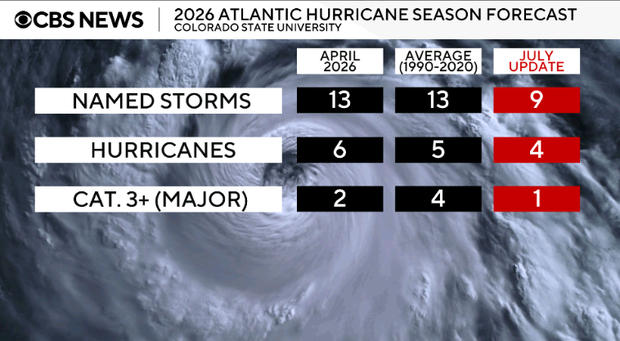
image003.png
Colorado State University’s 2026 Atlantic hurricane forecast released on July 8, 2026, compared with the university’s April forecast and the number of named storms, hurricanes and major hurricanes that develop during an average season. 

Nikki Nolan/CBS News

Colón-Burgos emphasized that communities vulnerable to the hazards of hurricane season should “take it seriously” regardless of the statistics. She said encouraging people to start preparations in advance and remain alert no matter what “is one of the most important things that we want to get across.”

An atmospheric shift

A change in atmospheric conditions that can either coax or suppress the development of Atlantic hurricanes is the main driver of researchers’ below-average forecast, Colón-Burgos said.

That’s primarily because El Niño, the warmer phase of the El Niño-Southern Oscillation, or ENSO, cycle, arrived in late spring,
according to the Climate Prediction Center. A phenomenon defined by shifting sea surface temperatures and precipitation in the Pacific Ocean, the cycle impacts weather across the United States and often foreshadows how busy a hurricane season will be.

During El Niño, Atlantic hurricanes tend to be less intense and less frequent.

The Climate Prediction Center has said El Niño may intensify in the coming months, and last until at least the end of 2026. Forecasters suggest there’s a 63% chance that El Niño will have grown so strong by the end of this year’s hurricane season that it could rank among the largest events of its kind in the historical record, which dates back to 1950.

Whether sea surface temperatures in the Atlantic Ocean rise or fall in the coming weeks is one variable creating uncertainty in hurricane forecasts. Colón-Burgos said how temperature trends shape up could affect future storm predictions.

How many storms will make landfall in 2026?

The current forecast predicts there’s a 32% chance of a major hurricane making landfall somewhere along the U.S. coastline in 2026, and a 35% chance of one making landfall in the Caribbean. While those figures may seem low, researchers note that they don’t account for less powerful storms, which can still be dangerous. 

“It takes only one storm near you to make this an active season for you,” said Michael Bell, who co-authored the forecast, in a statement.

No hurricanes struck the U.S. last year, for the first time in a decade, but some Caribbean islands were hit especially hard. Jamaica, in particular, was devastated by Hurricane Melissa, which made landfall as a formidable Category 5 storm and concluded the 2025 hurricane season.
2025-tropical-systems-map.jpg
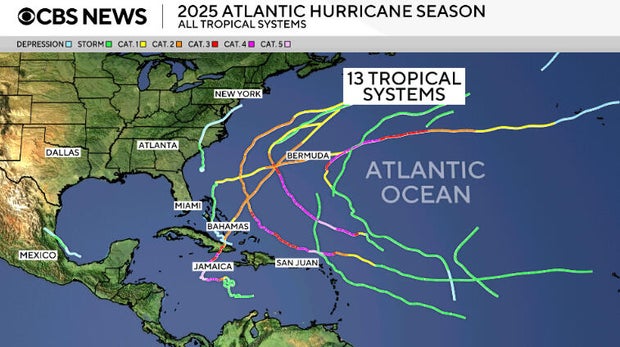
A map of tropical systems that formed during the 2025 Atlantic hurricane season.

Nikki Nolan/CBS News

Named storms in 2026

The World Meteorological Organization prepares a list of names that will be assigned to a given year’s tropical storms and hurricanes. 

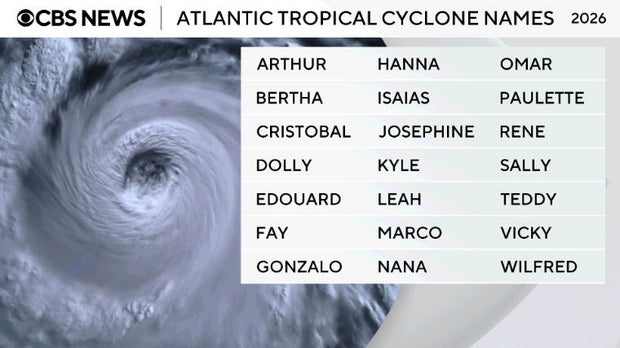
For 2026, the first named storm was called Arthur. It will be followed by Bertha, Cristobal, Dolly, Edouard and Fay. The list continues alphabetically until wrapping up with Vicky and Wilfred, although not all letters in the alphabet are represented.
2026-named-storms.jpg
Names that will be given to tropical storms and hurricanes in 2026.

Nikki Nolan/CBS News

A storm receives a name when its maximum wind speeds reach 39 mph, according to the National Hurricane Center. If winds reach 74 mph, the storm becomes a hurricane. “Major” hurricanes are those with winds of at least 111 mph, corresponding with Category 3 or above on the Saffir-Simpson Scale commonly used to rate storms. Such powerful hurricanes are capable of causing catastrophic damage.

Why Karoline Leavitt might be impossible for Trump to replace

(CNN) — Donald Trump hardly needs anyone else to serve as his mouthpiece.The most clamorous president in modern history always gets his message out — in a daily riot of online posts, interviews and rancor with reporters.The departure of a press secretary therefore might seem like a trifle to the messenger in chief. But the exit of Karoline Leavitt, announced Wednesday, represents a significant personal and political loss. The vacuum she’ll leave will emphasize her role as a vital member of the president’s brain trust.But she is far more than a spokesperson. Leavitt understands the Trump id. She’s been a leader in his second-term assault on Washington institutions of accountability — in this case, the Beltway press. Just like the boss, she broke the mold of her position. And with relentless trolling of reporters, she’s exposed the fractures of traditional journalism in the social media age.Leavitt said on social media on Wednesday that since the birth of her second child, a daughter, on May 1, she’d realized she couldn’t be the mom her kids deserve while devoting the “constant time, energy, and attention,” her job requires. Trump, perhaps softening the blow to himself of the departure of a 28-year-old he praised as one of his “most trusted aides” announced that Leavitt will continue to serve as an outside adviser.A Herculean assignmentBeing Trump’s press secretary is no easy ride. The term “message discipline” is an oxymoron in this administration. No one, including himself, knows what the president will say from one minute to the next. He changes policy on a dime, contradicting his top officials and himself.And Trump is a master media manipulator. He’s demonized, flattered and played reporters for decades. He relished the role of 1980s New York tabloid villain as he built his brand as a real estate tycoon and celebrity. He intuits the media’s craving for constantly evolving headlines and uses it as a tool of distraction.Trump’s zeal for conflict, disdain for etiquette and willingness to say outrageous things forged alchemy when his political ascent coincided with the explosion of social media. He used the new technology to inject his volcanic personality into the nation’s political bloodstream, bypassing the traditional media used as a conduit by his predecessors.So maybe he doesn’t even need another press secretary.He’ll struggle to replace Leavitt’s combination of skills. She speaks MAGA more fluently on camera than anyone but the president. Her briefings are less attempts to explain policy or to deliver coded messages to foreign leaders than demonstrations of Trumpian defiance.The president’s supporters dearly love Leavitt. Her blasts at famous reporters recall the rebel yells of Trump’s first campaign. She rarely answers a question straight — preferring to attack the motives or mindsets of reporters thrust into the role of extras in the Trump show.Last month, Leavitt sat by the president’s side at the White House Correspondents’ Association Dinner that was rescheduled after a gunman tried to rush into the annual event in April. That evening, which Trump spent insulting journalists in vicious and personal terms, will now serve as a valedictory metaphor for her tenure.It’s also somehow fitting that Leavitt announced her resignation in the middle of a storm over whether the White House used reporters on Air Force One as a decoy during the president’s secret flight from Turkey during a security scare last month.Grave questions about press freedomsLeavitt’s tenure will be remembered as devastating to the quaint notion that the press has a vital role in holding presidents to account.Her operation took over control of the pool system long administered by the independent correspondents’ association. She decided who got into presidential events and flew on Air Force One. She added streaming services, local conservative radio hosts, and podcasters and MAGA personalities to the permanent press corps.Critics saw an attempt to introduce propagandists who’d go soft on Trump. His supporters cheered what they saw as an overdue dilution of what they regard as the liberal elite media.In one enormous controversy epitomizing the administration’s contempt for regular media, Leavitt — under Trump’s direction — banned the Associated Press from certain White House press events, and an agency reporter was excluded from Air Force One. AP, which has thousands of clients in the US and worldwide, had declined to change its style guide to mirror Trump’s executive order renaming the Gulf of Mexico to the “Gulf of America.”Leavitt’s briefings soon made the “alternative facts” pioneered by Trump’s first-term media team appear tame by comparison. She opened briefings with highly torqued monologues hyperbolically lauding Trump’s achievements. The performances were reminiscent of prime time shows on conservative TV — a world in which she’d surely find a lucrative future once her kids grow up.Tensions develop between every administration and the media. Relations between President George W. Bush’s team and reporters were often brittle. Acrimony between reporters and President Barack Obama’s aides belied conservative notions that journalists were in the tank. And President Joe Biden’s press shop was especially prickly. But Trump has threatened the constitutional role of the press in the republic as never before.Democratic Rep. James Walkinshaw said on CNN’s “The Arena” on Wednesday that he didn’t doubt Leavitt’s sincerity in citing family reasons for her departure. But he added: “It’s a tough job. It’s a job where, to be Donald Trump’s spokesman, you have to willfully deny reality on a daily basis.” The Virginia lawmaker added: “I think her legacy will be one of further degrading the relationship between the White House and the press.”While Leavitt’s briefings are made-for-TV showdowns, she’s often more collegial with media members away from the cameras. She’s usually available to reporters, and her bond of trust with Trump means she’s in the room with the commander in chief at pivotal moments. This privilege is important to journalists and builds credibility for top spokespeople. And there are fears that with Leavitt gone, they will find it even more difficult to report on the decision-making of an erratic and nearly unchecked president.Unless the president picks a replacement who is already deep in his inner circle, Leavitt’s successor may lack the authenticity that made her an authoritative voice for the administration. Most White Houses groom one or more deputy press secretaries for the top job, which typically grinds down incumbents within a few years. The lack of a visible succession plan for Leavitt will fuel speculation that Trump may just take on the entire task himself.Leavitt will always be a heroine to Trump’s base. And her influence may outlast the second Trump administration, since West Wing teams often build on the techniques of those who came before. A future president, Democratic or Republican, might balk at voluntarily handing back power to the press.In his second term, Trump often looks like he’s wielding power to ensure nothing can ever be the same again.He had a loyal and effective partner in Leavitt.The-CNN-Wire™ & © 2026 Cable News Network, Inc., a Warner Bros. Discovery Company. All rights reserved.
Read Next Story