
First major 2026 Atlantic hurricane forecast predicts below-average season

▶ Watch Video: Researchers predict slightly fewer hurricanes than usual this season

Fewer storms than usual may develop during the 2026 Atlantic hurricane season, researchers say, as climate patterns seem poised to favor below-average activity compared with a typical year.

That prediction anchors the latest annual hurricane forecast from Colorado State University’s Tropical Cyclones, Radar, Atmospheric Modeling and Software team, which was initially released in April and updated Wednesday. 

Colorado State University’s team of experts estimate that 2026 will see nine named storms develop in the Atlantic basin, including four hurricanes and one major hurricane (defined as Category 3 or higher). Those estimates were revised down from 13 named storms, six hurricanes and two major hurricanes, as the researchers originally predicted.

They could occur at any point in the season, which officially runs from June 1 to Nov. 30 and peaks between August and October. Researchers will be keeping an eye on conditions that could hint at their projected timing, since the forecast always carries some uncertainty. Phil Klotzbach, its lead author, said at a news conference unveiling the team’s April predictions that “there are curveballs that could come our way.”

This forecast will be continuously updated as hurricane season progresses. They are closely monitored each year by leaders and residents of hurricane-prone states — especially Florida and states along the Gulf Coast and Eastern Seaboard — readying themselves for the possibilities ahead.

The National Oceanic and Atmospheric Administration has also released its forecast, similarly predicting a below-average season.

“We always recommend, to coastal residents, to prepare the same way for every season,” Delián Colón-Burgos, who co-authored the forecast, told CBS News. 

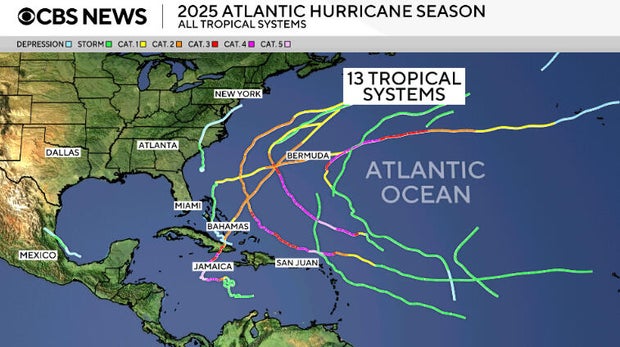
Hurricane activity this year will dip below 75% of the long-term seasonal average, according to the forecast. If accurate, that would mark a decrease from last year’s hurricane season, which brought 13 named storms, five hurricanes and four major hurricanes, although none made direct landfall in the U.S. in 2025. Federal data show an average season has 14 named storms, seven hurricanes and three major hurricanes.
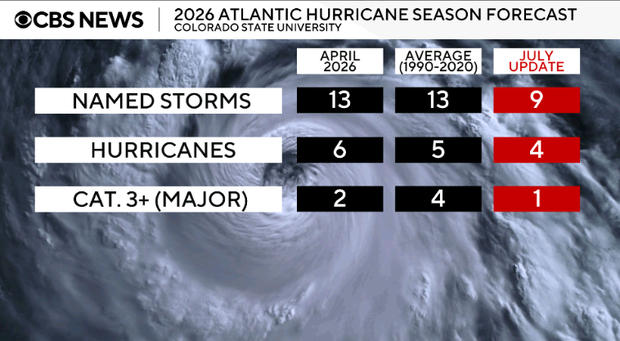
image003.png
Colorado State University’s 2026 Atlantic hurricane forecast released on July 8, 2026, compared with the university’s April forecast and the number of named storms, hurricanes and major hurricanes that develop during an average season. 

Nikki Nolan/CBS News

Colón-Burgos emphasized that communities vulnerable to the hazards of hurricane season should “take it seriously” regardless of the statistics. She said encouraging people to start preparations in advance and remain alert no matter what “is one of the most important things that we want to get across.”

An atmospheric shift

A change in atmospheric conditions that can either coax or suppress the development of Atlantic hurricanes is the main driver of researchers’ below-average forecast, Colón-Burgos said.

That’s primarily because El Niño, the warmer phase of the El Niño-Southern Oscillation, or ENSO, cycle, arrived in late spring,
according to the Climate Prediction Center. A phenomenon defined by shifting sea surface temperatures and precipitation in the Pacific Ocean, the cycle impacts weather across the United States and often foreshadows how busy a hurricane season will be.

During El Niño, Atlantic hurricanes tend to be less intense and less frequent.

The Climate Prediction Center has said El Niño may intensify in the coming months, and last until at least the end of 2026. Forecasters suggest there’s a 63% chance that El Niño will have grown so strong by the end of this year’s hurricane season that it could rank among the largest events of its kind in the historical record, which dates back to 1950.

Whether sea surface temperatures in the Atlantic Ocean rise or fall in the coming weeks is one variable creating uncertainty in hurricane forecasts. Colón-Burgos said how temperature trends shape up could affect future storm predictions.

How many storms will make landfall in 2026?

The current forecast predicts there’s a 32% chance of a major hurricane making landfall somewhere along the U.S. coastline in 2026, and a 35% chance of one making landfall in the Caribbean. While those figures may seem low, researchers note that they don’t account for less powerful storms, which can still be dangerous. 

“It takes only one storm near you to make this an active season for you,” said Michael Bell, who co-authored the forecast, in a statement.

No hurricanes struck the U.S. last year, for the first time in a decade, but some Caribbean islands were hit especially hard. Jamaica, in particular, was devastated by Hurricane Melissa, which made landfall as a formidable Category 5 storm and concluded the 2025 hurricane season.
2025-tropical-systems-map.jpg
A map of tropical systems that formed during the 2025 Atlantic hurricane season.

Nikki Nolan/CBS News

Named storms in 2026

The World Meteorological Organization prepares a list of names that will be assigned to a given year’s tropical storms and hurricanes. 

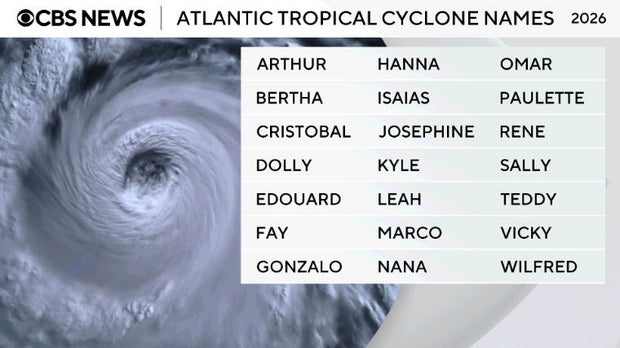
For 2026, the first named storm was called Arthur. It will be followed by Bertha, Cristobal, Dolly, Edouard and Fay. The list continues alphabetically until wrapping up with Vicky and Wilfred, although not all letters in the alphabet are represented.
2026-named-storms.jpg
Names that will be given to tropical storms and hurricanes in 2026.

Nikki Nolan/CBS News

A storm receives a name when its maximum wind speeds reach 39 mph, according to the National Hurricane Center. If winds reach 74 mph, the storm becomes a hurricane. “Major” hurricanes are those with winds of at least 111 mph, corresponding with Category 3 or above on the Saffir-Simpson Scale commonly used to rate storms. Such powerful hurricanes are capable of causing catastrophic damage.

Alexander Lukashenko Fast Facts

(CNN) — Here is a look at the life of Belarusian President Alexander Lukashenko.PersonalBirth date: August 30, 1954 (some sources say August 31)Birth place: Kopys, BelarusFull name: Alexander Grigorievich LukashenkoFather: name unavailable publicly Mother: Yekaterina Lukashenko, milkmaidMarriage: Galina (Zhelnerovich) Lukashenko (1975-present)Children: with Galina (Zhelnerovich) Lukashenko: Viktor and Dmitry; with Irina Abelskaya: Nikolai “Kolya”Education: Mogilev Pedagogical Institute (now Mogilev State A. Kuleshov University), history, 1975; Belarusian Agricultural Academy, economics, 1985Military service: Soviet ArmyReligion: has called himself an “Orthodox atheist”Other FactsHas ruled Belarus, a small country between Russia and European Union member Poland and an essential east-west trade route, for more than a quarter of a century.Was elected president in Belarus’ first democratic election in 1994, but subsequent elections have been marred by allegations of strong-arm tactics and voting irregularities and were won by suspiciously wide margins.Has been described as “Europe’s last dictator.” Lukashenko has maintained his country’s close political ties to Russia, restricted opposition movements and censored media.Timeline1975-1977 - Drafted into the military and serves as an instructor in the border guard along the western border of Belarus.1980-1982 - Serves in the Soviet Army.1987-1994 - Head of the Gorodets state farm in the Mogilev region.1990-1994 - Member of the Belarusian Soviet Socialist Republic Supreme Council, where he becomes a deputy and later founds a faction called Communists for Democracy.1991 - Only member of the Belarusian parliament to vote against the agreement that leads to the dissolution of the Soviet Union.July 10, 1994 - Is elected president of Belarus with 80% of the vote, defeating Prime Minister Vyacheslav Kebich in the country’s first presidential election.May 1995 - Is behind a referendum that increases integration with Russia, including making the Russian language equal to Belarusian and replacing the national flag and state symbols with ones similar to those of the former Soviet Union. The referendum also gives Lukashenko the right to dissolve the parliament.November 1996 - Is behind a referendum that revises the Constitution to give more authority to the presidency, including limiting the authority of the Constitutional Court and extending Lukashenko’s presidential term. An impeachment effort fails, and Lukashenko signs a new constitution.1997-2021 - Head of the Belarusian Olympic Committee.1999 - Signs a treaty making Belarus a “union state” with Russia.September 9, 2001 - Is reelected president with 75% of the vote.October 2004 - A referendum is passed to eliminate presidential term limits.April 20, 2005 - US Secretary of State Condoleezza Rice refers to Belarus as “the last remaining true dictatorship in the heart of Europe,” in an interview with CNN.March 2006 - Is reelected president with over 80% of the vote.December 2010 - Is reelected president with almost 80% of the vote.October 2015 - Is reelected president with 83.5% of the vote. March 28, 2020 - Speaks about coronavirus after playing ice hockey in front of a packed stadium in Minsk, Belarus. Specifying no scientific evidence, he says the “fridge” like area is a “real anti-viral cure.”March 29, 2020 - Recommends that people not only drink vodka but wash their hands with it and take saunas to combat the coronavirus. August 9, 2020 - Lukashenko is reelected with 80% of the vote. His main opposition candidate, Svetlana Tikhanovskaya, receives about 10%.August 10, 2020 - Demonstrations over the presidential election result in dozens of people being injured during clashes with police, the interior ministry says in a statement seen by state-run news agency Belta. Tikhanovskaya rejects the preliminary election results and files a complaint with Belarus’ central elections committee demanding a recount of the votes. She leaves for Lithuania soon afterwards.August 16, 2020 - Lukashenko gives a speech claiming Belarus is being threatened by foreign interference.August 17, 2020 - Visits a factory in Minsk, Belarus, according to videos posted online by local news outlets and addresses the election. “You talk about dishonest elections and want to hold new elections,” he tells protesting workers. “We held the elections and until you kill me, there won’t be any new elections.” September 23, 2020 - Lukashenko is inaugurated for a sixth consecutive term as president in an unannounced ceremony in Minsk, according to state media reports. Opposition politicians describe the ceremony as a “thieves’ meeting” and a “farce.” The United States and a number of European Union countries issue statements rejecting the legitimacy of Lukashenko’s win.September 24, 2020 - The European Union releases a statement regarding the Belarus presidential election. “The European Union does not recognise their falsified results. On this basis, the so-called ‘inauguration’ of 23 September 2020 and the new mandate claimed by Aleksandr Lukashenko lack any democratic legitimacy.”December 7, 2020 - Following an investigation “Concerning athletes, officials and sports in Belarus,” the International Olympic Committee (IOC) suspends the Executive Board of the National Olympic Committee of Belarus “from all IOC events and activities, including the Olympic Games.” Lukashenko’s election of his son Viktor Lukashenko to be replace him as president of the Belarusian NOC is not recognized, according to a March 8, 2021, IOC statement.May 23, 2021 - A Ryanair flight traveling from Athens to the Lithuanian capital Vilnius is intercepted and forced to land in Minsk. When it lands, prominent opposition activist Roman Protasevich and his Russian partner Sofia Sapega, who are on the flight, are detained. Protasevich is one of dozens of journalists and activists campaigning in exile against Lukashenko’s 26-year rule. Lukashenko later claims that the flight was diverted because of a bomb threat that had originated in Switzerland, allegations that Swiss authorities refute. Lithuanian President Gitanas Nausėda later tells CNN that the email indicating a bomb threat was sent 30 minutes after Lithuanian officials received the signal from Minsk to land the plane.May 24, 2021 - The European Union calls on airlines to avoid Belarus’ airspace, responding to the forced landing of the Ryanair flight. European Commission President Ursula von der Leyen says the bloc is “closing our airspace to planes from Belarus” and calls on EU airlines not to fly over the country.May 24, 2021 - The US National Security Council releases a readout of a call between national security adviser Jake Sullivan and democratic opposition leader Tikhanovskaya. Sullivan “strongly condemned the brazen and dangerous grounding of a Ryanair flight between two EU member states on May 23 and the subsequent removal and detention of journalist Raman Pratasevich.” He demands Protasevich’s immediate release, fair elections and states “that the United States, in coordination with the EU and other allies and partners, will hold the Lukashenka regime to account.”May 27, 2021 - The International Civil Aviation Organization says it will carry out an investigation into the diversion of the flight, while at least two European carriers say they were refused permission to fly to Moscow by Russian authorities after they requested to fly an alternative route bypassing Belarusian airspace.May 28, 2021 - Russian President Vladimir Putin cements his support of Lukashenko in a meeting, saying the West’s reaction to the interception and forced landing of a passenger jet “was an outburst of emotion.” The same day, US aviation authorities warn airlines “to exercise extreme caution” when flying over Belarus.August 9, 2021 - While answering questions from local and foreign media, Lukashenko denies that state repression exists in Belarus. In response to a question on repression and the imprisonment of political opponents, Lukashenko accuses the US of “lawlessness,” citing the January 6 insurrection and invoking false claims about the US presidential election result.March 15, 2022 - The US sanctions Lukashenka and his wife for gross human right abuses, and playing a key role in aiding Russia’s attack on Ukraine. The US previously applied sanctions to members of Lukashenko’s family in December after a migrant crisis on Belarus’s border with Poland, which also led to accusations of human rights abuses.May 28, 2023 - An on-camera interview is released in which Lukashenko claims that nations who are willing “to join the Union State of Russia and Belarus” will be given nuclear weapons, days after confirming the transfer of some tactical nuclear weapons from Moscow to Minsk had begun.January 27, 2025 - Lukashenko extends his 31-year rule in Belarus after being declared the winner of a presidential election that his exiled opponents and Western countries have denounced as a sham.The-CNN-Wire™ & © 2026 Cable News Network, Inc., a Warner Bros. Discovery Company. All rights reserved.
Read Next Story