
FIFA criticized for lifting U.S. star’s red card suspension after Trump phone call

▶ Watch Video: U.S. lead scorer Folarin Balogun’s red card suspension lifted, FIFA faces criticism

FIFA is being criticized over its decision to lift the red card suspension for leading U.S. Men’s National Team scorer Folarin Balogun, allowing him to play against Belgium on Monday night.

The Union of European Football Associations, Europe’s soccer governing body, said FIFA “crossed a red line,” and expressed its “disbelief” at a decision it called “unprecedented, incomprehensible and unjustifiable.”

“When the certainty of rules is no longer guaranteed by its guardians, the integrity of the game is at stake and the credibility of a competition is undermined,” the governing body said in a statement. “[Soccer] is the most loved sport in the world because it is a beautiful game and is trusted because it is played everywhere with the same laws.”

In a statement Monday, FIFA said that under Article 27 of its Disciplinary Code, “the FIFA Disciplinary Committee has the discretion to suspend the implementation of any disciplinary measures so long as they do not relate to match manipulation—which, of course, did not occur here.” 

“It should be added that employment of art. 27 FDC is not unprecedented, as similar decisions have previously been issued during the FIFA World Cup 2026 qualifiers,” FIFA said.

The organization maintained that sanctions against Balogun were not lifted, saying that the FIFA Disciplinary Committee imposed a $40,000 fine against the U.S. Soccer Federation. The committee’s move to suspend the one-match ban was “decided considering all of the specific circumstances surrounding the incident and evidence available,” FIFA said, but did not go into details.

“Reviewing the legal consequences of red cards in football is nothing new in the modern game,” the statement said. “Suspending the effects of a red card based on an explicit provision of the applicable regulations is a much more balanced measure.”

Sources familiar with the matter had told CBS News that Balogun’s reinstatement came after President Trump called FIFA President Gianni Infantino on Thursday and spoke about the suspension, which would have kept the 25-year-old striker from playing in the round of 16 World Cup match.  

Mr. Trump on Monday said he asked for a review by FIFA “because I didn’t think it was a foul.”

“When they take your best player, or just about, they have some great players … and they say you can’t play, that’s very unfair,” the president said in remarks in the Oval Office.

“If they wouldn’t allow a top player, maybe among the best on the team, I think it would have left a big stain,” he said.

Andrew Giuliani, executive director of the White House’s World Cup task force, also spoke to Infantino about the situation, and Secretary of Commerce Howard Lutnick was in communication with FIFA.

Spokespeople for the White House, Lutnick and Giuliani did not immediately respond to CBS News’ request for comment.
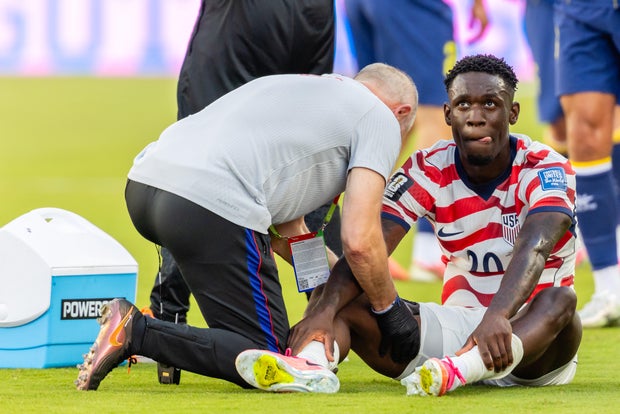
SOCCER: JUL 01 FIFA World Cup 26 Round of 32 - USA v Bosnia and Herzegovina
Folarin Balogun of United States of America gets medical attention during the FIFA World Cup match beon July 1, 2026.

Matthew Huang/Icon Sportswire via Getty Images

The Royal Belgian Football Association said it was “astonished” by FIFA’s decision, and added it contradicts FIFA’s own rules.

“We express our disbelief at such an unprecedented, incomprehensible and unjustifiable decision,” the body said in a statement. 

Prominent British commentators expressed similar condemnation.

Wayne Rooney, a former player for Manchester United and England’s national team, called the decision an “absolute disgrace.”

“Infantino should be ashamed of this because I think the sportsmanship of the game is in question here,” Rooney told the BBC on Sunday.

Prominent commentator and former England player Gary Neville said Sunday the decision “absolutely stinks.”

“There should be a review process in place,” he told ITV Sports. “Are we surprised? No, not with this lot,” Neville added.

The European Union’s Commissioner for Sport said he also believed it was the “wrong decision.”

“Decisions on sporting rules and sporting matters belong to sporting bodies, not politicians. Influencing sporting decisions would undermine the autonomy of sport,” Glenn Micallef said in a social media post.

Infantino said Monday in a statement that “FIFA’s judicial bodies are independent.” 

“Yes, I regularly discuss matters related to the FIFA World Cup with the president of the United States, and on this matter, I did receive a call from President Donald Trump, just as I receive calls from heads of state, government officials, football stakeholders and business executives from around the world on many different issues,” Infantino said. 

“During our conversation, I explained that there was an ongoing legal process involving FIFA’s independent judicial bodies and that the case would be decided in due course by the competent bodies,” he said. “That is how FIFA’s system works, and it is a principle that I will always uphold.”

The Royal Belgian Football Association said it sent a letter to FIFA requesting a copy of the decision to let Balogun play and an explanation of the process that was followed. In the letter, the association also expressed “its position regarding the applicable regulations.”

FIFA considered the request “an appeal,” which it then deemed inadmissible, the association said.

In a statement, the FIFA Appeal Committee said, “The request was rendered inadmissible on the grounds that the RBFA is not a party to the proceedings and, as such, has no standing to appeal the decision.”

“For an appeal to be admissible, FIFA’s own regulations state that the reasoned decision must first have been communicated to the appellant,” the Royal Belgian Football Association said. “While the RBFA was merely seeking legitimate explanations, FIFA itself created an appeal and immediately ensured that it would be declared inadmissible.”

The association added later that it “has informed the United States Soccer Federation that it contests the eligibility of the player, should the player be listed on the referee’s team sheet.”

A European Commission spokesperson, Eva Hrncirova, told reporters Monday that the EU supports “the principle of fair play and transparency in the competition.”

The U.S. wound up losing to Belgium 4-1 in the World Cup round of 16 knockout match in Seattle. That ended the Americans’ hopes of reaching the quarterfinals for the first time in 24 years.
La convocatoria de elecciones en tiempos de guerra en Ucrania aumenta la presión para Zelensky justo cuando menos lo necesita

Es el mayor desafío para el presidente de Ucrania, Volodomyr Zelensky, hasta ahora, desde dentro. Pero, probablemente, prácticamente, no llevará a nada.El llamado del ministro de Defensa destituido, Mykhailo Fedorov, a las elecciones presidenciales en tiempo de guerra, apunta al corazón de las vulnerabilidades de Zelensky. Su popularidad descendente, la vacilación en decisiones clave de personal y la implicación en acusaciones de corrupción han afectado sus calificaciones en las encuestas. Este miércoles se anunció una investigación sobre altos funcionarios en la oficina de Zelensky. Además, un presidente en tiempo de guerra durante seis años ininterrumpidos debe tomar muchas decisiones impopulares.Ahora la cara juvenil de un reformador: Fedorov, el mago de la tecnología, exministro de defensa que fue expulsado por intentar luchar contra las formas arcaicas y corruptas de la vieja guardia, está exigiendo algo puro y democrático: un voto. “La democracia no puede ser rehén de Rusia. Estamos luchando precisamente porque queremos permanecer un Estado europeo libre”, dijo, en un notable discurso de nueve minutos que llegó momentos después de que se confirmó un nuevo ministro de defensa, no él, de vuelta en el antiguo trabajo que quería. Pero como muchas cosas en tiempo de guerra, simplemente no es tan simple.Un voto es, en cambio, prácticamente imposible. La mayoría de los expertos electorales coinciden en que, incluso en tiempos de paz, Ucrania requeriría seis meses para implementar reformas legislativas y tener la tecnología necesaria para llevar a cabo una votación que cumpla con los estándares europeos. Pero no hay alto al fuego ni fin a los combates a la vista. Mantener una votación incompleta, o uno que se incline hacia cualquier narrativa de que el ganador es ilegítimo, sería un gran regalo para Moscú. Ciego a su propio proceso electoral montado, el Kremlin presionó repetidamente la idea de que la prohibición de la ley marcial sobre las elecciones de Ucrania durante la guerra significa que Zelensky es ilegítimo.Un voto también podría paralizar totalmente a Kyiv: la parte perdedora podría retrasar la reforma legislativa, y socavar la presidencia en cada turno. Significaría una derrota desde dentro.Fedorov se hizo un nombre como un innovador genio. ¿Podrían habilidades similares transformar el proceso electoral y hacer posible la votación remota en tiempo de guerra? Posiblemente. Pero incluso una votación digital que de alguna manera incluyera a todas las tropas de primera línea que sirven, y recuerden que hay miles de ucranianos desaparecidos, cuyo estatus no está resuelto, requeriría un mecanismo que seguramente excluiría a los millones de pensionistas ucranianos que viven fuera de línea.¿Qué les dirías a los ucranianos que viven en áreas ocupadas, o a los millones que viven en el extranjero como refugiados? ¿Cómo podrías celebrar encuestas a prueba de agua en decenas de consulados en Europa y más allá? ¿Tiene un soldado de primera línea atrapado con malas comunicaciones en una zanja suficiente tiempo para estudiar las opciones y emitir un voto? ¿O deberían estar ocupados defendiendo su patria?Sería un completo desastre. Cualquier encuesta realizada en tiempo de guerra probablemente sería un regalo para Rusia, y su práctica desinformación y guerra de interrupción en torno a las elecciones. Europa se quedaría con un resultado electoral que fuera o un respaldo apresurado de Zelensky, o bien un traspaso de poderes chapucero e incompleto a otra persona.Los probables ganadores, según las encuestas, son el antiguo líder militar Valery Zalyuzhni, o el propio Fedorov. Ambos probablemente mantendrían a Ucrania moviéndose en una dirección similar. Pero ambos depurarían al círculo de asesores alrededor de Zelensky, quienes muchos de los críticos del presidente ucraniano creen que son responsables de malas decisiones, y del olor a corrupción. (Un rápido recordatorio: la corrupción es una desafortunada compañera de cada guerra librada).¿Qué significa el llamado de Fedorov? Ahora hay una nueva columna en la política de Ucrania que es joven, tiene experiencia en el poder y en la reforma, y busca recordar constantemente a Ucrania que su presidente se ha desviado de su mandato electoral original. Es una posición fácil de asumir, ya que está respaldada por hechos, y aprovecha el creciente descontento con la guerra. A medida que crece la movilización forzada para llenar las filas disminuyentes de Ucrania, también crecerá la ira hacia la presidencia y los militares.La llamada de Fedorov también enfatiza una pregunta clave que nadie puede responder. Si una votación no puede ocurrir en guerra, ¿cuándo termina esa guerra? Se avecina un invierno espantoso, en el cual la supremacía de Moscú en misiles balísticos parece destinada a explotar aún más la falta de interceptores Patriot en Ucrania. Rusia se acerca lentamente a su objetivo territorial de tomar el Donbás, aunque mediante la renderización del terreno restante sostenido por Ucrania inhabitable a través de horribles ataques de drones a todos los signos de vida civil y militar.La inminente crisis invernal se alimentará del proceso de paz deslucido y miope que la Casa Blanca de Trump está intentando reiniciar. Incrementará las exigencias a Zelensky de conceder territorio, cualquier cosa para que la lucha cese. Deja claro, más recientemente en una entrevista conmigo, que lo que Ucrania busca son garantías de seguridad, para saber que cualquier alto al fuego es permanente. Descartó ceder tierra. Tiene claro que el invierno que se avecina es malo, tanto en el cielo como en el frente.Cuando se trató de su futuro personal, se veía atónito cuando sugerí que la intriga política de Kyiv, las acusaciones de corrupción en torno a su antiguo círculo interno y las maquinaciones de la política de guerra, podrían encadenarlo al trabajo después de que la guerra haya terminado, solo para mantener a los críticos de la guerra acosando a su equipo. Parecía horrorizado y se rió, como si hubiera perdido la cabeza, y solo habló de ver a sus hijos y la playa una vez que terminada la guerra. No parecía un hombre que ansiara el poder indefinidamente. Más bien lo contrario.Pero no existe un mecanismo correcto para que Zelensky sea reemplazado por un sucesor popular y genuino, a menos que renuncie y deje que el presidente del parlamento asuma el mando (una idea muy mala, en términos de mandato electoral). El efecto final del llamamiento de Fedorov a la bondad de todos es que Zelensky sale debilitado, se amplifican las dudas sobre su legitimidad electoral y se refuerza el llamado para que termine la guerra. Moscú aprovechará la polémica y, sin duda, Trump —en esos momentos en los que el péndulo se inclina y Ucrania se convierte de repente en el malo— volverá a tildar a Zelensky de “dictador” (que no lo es).El llamado de Fedorov parte de una buena intención, para no dejar que la guerra destruya los valores democráticos de Ucrania. Pero ignora lo lejos que Ucrania tenía que avanzar hacia las normas europeas antes de la guerra, y las dificultades que el conflicto impone a estos procesos esenciales bajo el bombardeo nocturno ruso. Las guerras no se pueden pelear solo con ideología, una verdad que quizás llevó a la partida del exministro de Defensa incendiario, después de meses de enfrentamientos y de negarse a tratar con el alto mando de las Fuerzas Armadas, como Zelensky lo describe.Ucrania añadió ahora a su inmensa lista de desafíos: una crisis de mano de obra, interceptores, una posible oleada de fuerzas rusas a través de la movilización, y un invierno sombrío. La discusión sobre si su presidente de tiempos de guerra sigue siendo legítimo. Fedorov tiene razón al decir que los ideales no deben morir en la guerra, o ¿por qué más pelear? Pero a la inversa, los ucranianos no deben morir en la guerra porque sus líderes se ven minados en la búsqueda de valores inalcanzables por sí solos.The-CNN-Wire™ & © 2026 Cable News Network, Inc., a Warner Bros. Discovery Company. All rights reserved.
Read Next Story