FBI investigating legitimacy of Nancy Guthrie ransom notes

▶ Watch Video: Stunning information emerges about Nancy Guthrie ransom notes

Who is behind the ransom notes tied to Nancy Guthrie’s kidnapping? That question continues to plague investigators working the case in Arizona, five months after the 84-year-old grandmother and mother of “Today” show co-host Savannah Guthrie was kidnapped in the middle of the night.

The notes fall into three categories: the two notes sent within the first week of her disappearance that investigators believe are likely legitimate, those that could be legitimate but that don’t have any clues suggesting they are, and those that authorities say are money grabs from would-be extortionists.

“The FBI and its task force partners have received several ransom notes over the course of this investigation,” an FBI official said Wednesday in a statement to CBS News. “Some have been deemed to be extortion attempts without legitimacy. Other ransom demands may potentially be legitimate and are still being investigated as such.”

The FBI official said the agency is assisting local authorities, namely the Pima County Sheriff’s Department, which is the lead agency on the case. Law enforcement sources have told CBS News that the FBI has been handling the digital forensic work on the ransom notes. Pima County Sheriff Chris Nanos has directed all questions about ransom notes to the FBI. 

“This case continues to be investigated as a kidnapping for ransom case,” the FBI official said Wednesday.
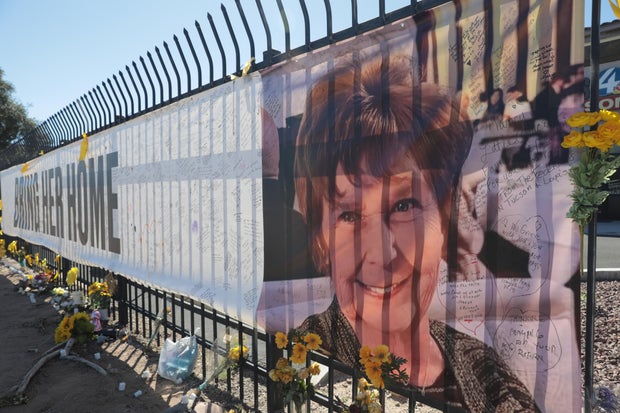
Nancy Guthrie home 30 days after disappearance
A banner in support of Nancy Guthrie is displayed at KVOA in Tucson, Arizona, on March 3, 2026.

Grace Hie Yoon/Anadolu via Getty Images

The first note, sent on Feb. 2, one day after Nancy Guthrie was reported missing from her home in Tucson, included details about Guthrie’s home that led investigators to take it seriously. One of the details described the placement of Guthrie’s Apple Watch with a white wrist band that was left on the floor next to her bed. Another detail noted that a floodlight on the back porch was out. The note demanded an initial $4 million in bitcoin within a few days’ time, and then upped the ante by $2 million more in bitcoin if the first deadline was missed.  

The ransom message was sent via tip lines to two local news stations and TMZ. A Gmail address was entered as the contact email and addressed to Savannah Guthrie, multiple sources familiar with the note have told CBS News. The family worked with the FBI to craft a response, but there was no email back.

Then on Feb. 6, four days after the first communication came in, another one came through the tip lines. The FBI later determined it came from the same IP address as the first note, law enforcement sources told CBS News. This note indicated that Nancy Guthrie had died

Savannah Guthrie and her siblings responded with a video message at the time, saying: “We received your message and we understand… This is very valuable to us and we will pay.” But they never heard from the potential kidnappers again.

“There are a lot of different notes, I think, that came,” Savannah Guthrie told Hoda Kotb in an interview in March. “And I think most of them, it’s my understanding, are not real. … But I believe the two notes that we received that we responded to, I tend to believe those are real.”

TMZ’s Harvey Levin on messages passed on to FBI

As the days went on, TMZ continued to receive tips that the outlet passed on to the FBI. One note caught the eye of TMZ founder Harvey Levin. It demanded 1 bitcoin, or about $60,000, for information about the kidnappers.

“A month ago, I called the FBI and I said, ‘Look, I just have this sense this guy might be real,'” Levin told CBS News in an interview last week.

The messages continued to come in, and Levin said he shared them all with the FBI, about a dozen messages in total. At one point, Levin said, the FBI indicated they believed the sender might be female. 

Levin said he told the FBI, “What if we do a documentary, and we put that money in the bitcoin address and follow the path and where it goes? And we’d obviously not do anything without you, but just because we have this sense it’s real, what if we do this?” 

“I had made six calls and I felt they were ghosting us,” Levin said. But the FBI eventually got back to him, Levin said, asking that he not follow through on the documentary idea because they felt they were close to identifying the sender.

In the most recent message Levin received from the individual last week, Levin said the sender wrote that a video of Nancy Guthrie was on a cellphone in a secure place, and the sender again demanded 1 bitcoin in exchange for information.

There is no indication the messages sent to TMZ are legitimate, and it is unclear how close the FBI is to identifying the sender. In response to CBS News’ request for comment on Levin’s statements, an FBI spokesperson referred to the official statement released Wednesday.  

In an early instance of what authorities believe to have been an extortion attempt, federal prosecutors charged a California man with sending a fake ransom note via text message to Savannah Guthrie’s family. Derrick Callella allegedly texted them, “Did you get the bitcoin were [sic] waiting on our end for the transaction,” according to the charging documents. On Thursday, July 2, Callella pleaded guilty to two counts of harassment related to the messages.

The Guthrie family is offering a $1 million reward for any information that leads to the whereabouts of Nancy Guthrie. The FBI is also offering a $100,000 reward and encouraging anyone with information to call 1-800-CALL-FBI (1-800-225-5324).
Voters weigh a DeSantis successor and other key races to watch in Florida, Alaska and Wyoming

(CNN) — Florida Republicans are set to choose their nominee in the race to replace term-limited Gov. Ron DeSantis on Tuesday in a contest that has in some ways turned into a bitter intra-party feud — even though there is little drama about its likely outcome.Naples-area Rep. Byron Donalds, who is endorsed by President Donald Trump, is the favorite in the GOP gubernatorial primary. DeSantis has not endorsed him in the race and, CNN reported last month, shared his concerns about Donalds privately with Trump. But DeSantis also hasn’t backed any other candidate in a field that includes his lieutenant governor.It’s led to a vacuum that has left space for the emergence of James Fishback, a race-baiting 31-year-old who has called Donalds, who is Black, a “slave to his donors” and a “DEI Republican” who would “turn Florida into a Section 8 ghetto.”Tuesday’s contests also mark the first time voters will head to the polls under a new congressional map, designed by DeSantis to help Republicans net an additional four seats, that set off a scramble in down-ballot races.As Democrats settle a series of their own primaries in the redrawn districts, the races will also test whether democratic socialists can continue to make gains and where voters stand on issues related to Israel. Republican voters also have tough choices ahead of them, with several contentious House primaries featuring controversial candidates.Florida is the headliner on a day of primaries that also includes Alaska and Wyoming. Voters in California, meanwhile, will fill a House vacancy in a special election runoff.Here’s what to watch in Tuesday’s contests:How strong does Donalds look?Despite DeSantis’ apparent concerns with Donalds, Republicans have won every governor’s race in Florida in the last 30 years. Whoever wins on Tuesday — likely Donalds — will emerge Wednesday morning as the clear favorite to win in November.However, Democrats came close to winning the governor’s office in 2018 — the last time midterms were held with Trump in office. A relatively weak showing by Donalds on Tuesday could indicate Democrats could have an opening to make the governor’s race competitive.In addition to Fishback, other candidates in the GOP primary are Lt. Gov. Jay Collins, who has framed his campaign around a pledge to protect the DeSantis legacy even though the governor has not endorsed his own No. 2, and former state House Speaker Paul Renner.Democrats are expected to nominate party-switching former Rep. David Jolly in the race for governor. Jolly, a prominent critic of Trump, left the GOP in 2018 and last year officially became a Democrat.Slew of Florida GOP House primariesWhen Trump posted a list of Florida Republicans with his endorsement on social media earlier this month ahead of the primary, there was a notable omission: 7th District Rep. Cory Mills – whom the president endorsed in February. And when DeSantis was asked whether he supports Mills last week, the governor said no.The two-term congressman is being investigated by the House Ethics Committee for potential campaign finance violations, an accusation of a revenge porn threat and an assault allegation. Mills has repeatedly denied wrongdoing. He faces a primary challenge from former news anchor Ryan Elijah and two other candidates. Two other members of Florida’s House Republican delegation, Reps. Anna Paulina Luna and Mike Haridopolos, endorsed Elijah.Mills is not the only Republican facing a challenge on Tuesday. 6th District Rep. Randy Fine, a strident supporter of Israel who has drawn criticism for his anti-Muslim rhetoric, faces social media personality Dan Bilzerian, who has called Fine a “fat disgusting Jew” and run an openly antisemitic campaign.Meanwhile, the 19th District race to replace Donalds is among the wildest Florida primaries, with two former members of Congress from other states — North Carolina’s Madison Cawthorn and New York’s Chris Collins — both in the running, as well as a former Illinois state senator, Jim Oberweis. Trump has endorsed Catalina Lauf, a 33-year-old former Commerce Department staffer, in the race.Florida Democrats look for signs of lifeThe governor’s race and a Senate contest this fall will give down-and-out Florida Democrats, who have watched their state’s former battleground status erode as it has shifted rapidly rightward over the last decade, a chance to show they can still compete in statewide races.The primary to take on Republican Sen. Ashley Moody pits retired Army Lt. Col. Alex Vindman, a key witness in Trump’s first impeachment inquiry, against state Rep. Angie Nixon, a democratic socialist who has called for the United States to end its military support for Israel.That nominee, as well as the winner of the gubernatorial primary, will attempt to reverse a rapid rightward shift in Florida. Among the factors contributing to that change: GOP gains with Hispanic voters, an influx of new conservative residents and a state Democratic Party that has been in disarray.Early this century, Florida was perhaps the nation’s most critical swing state — decisive in the 2000 presidential election and a battleground through 2016. But Trump won the state on his way to losing the election in 2020, and then he cruised to a 13-point win there in 2024. Likewise, DeSantis, who won the governor’s office by less than half a percentage point in 2018, demolished his Democratic foe in 2022, winning by nearly 20 points.Democrats are also settling intra-party squabbles in House primaries taking place in newly redrawn districts.Among those races is the 25th District on South Florida’s east coast, where democratic socialists are looking to pick off another Democratic incumbent in Rep. Jared Moskowitz, who is backed by pro-Israel and artificial intelligence forces. Their candidate is Oliver Larkin, a 34-year-old activist and union organizer.Another Democratic primary to watch comes in the 20th District, where longtime Rep. Debbie Wasserman Schultz is taking on former Rep. Sheila Cherfilus-McCormick, who resigned from her seat in April to prevent an Ethics Committee vote on whether she should be forced out of Congress. The panel previously found her guilty of a slew of ethics violations, including accusations that she stole millions in pandemic relief funds and used it to bolster her 2021 campaign. Cherfilus-McCormick also faces separate criminal charges and has pleaded not guilty.Wasserman Schultz, however, has faced allegations of carpetbagging in the primary, as she shifted over to run in the historically Black district, which has long had a Black representative in Congress, after her current seat was redrawn to be more Republican friendly.Will AIPAC get its way in California?California is holding its special election to replace former Rep. Eric Swalwell for the rest of this year on Tuesday, and the American Israel Public Affairs Committee has spent millions to try to steer voters away from state Sen. Aisha Wahab and toward its preferred candidate — Bay Area Rapid Transit Board President Melissa Hernandez.Wahab, an outspoken critic of Israel’s military campaign in Gaza, earned nearly 43% of the votes in the June 16 special primary — well ahead of Hernandez, who finished second with nearly 17% support in the crowded race. Both candidates vying to represent the East Bay’s 14th District are Democrats.The candidates will also square off again in the fall as they vie for a full two-year term.Because of California’s mid-decade redistricting, the voters within the 14th District in November will be slightly different. The special election is taking place under the current district boundaries, while the new ones will be in effect for the general election.Two Dan Sullivans on the ballot in AlaskaDemocratic leadership believes former Rep. Mary Peltola can give her party a fighting chance at flipping the Alaska Senate seat held by Republican Dan Sullivan.But in the state’s unusual primary system — in which the top four finishers, regardless of party, advance to the general election — the bigger question might be whether another Dan Sullivan makes the cut.Republicans failed in their efforts to get a second Sullivan — a former teacher who shares the incumbent’s first and last name — booted from the ballot.The senator appears on ballots as Dan S. Sullivan and is listed as a registered Republican and the incumbent. The other Sullivan is identified as Daniel J. Sullivan Jr., and he is not listed with a party affiliation, even though he filed to run as a Republican.It’s a quirk that isn’t expected to seriously threaten the incumbent, at least not in Tuesday’s primary, but could make a difference in a razor-tight general election if even a small number of voters are confused.Alaska voters are also selecting general election opponents to take on at-large Rep. Nick Begich III, as well as candidates to replace term-limited Gov. Mike Dunleavy. Both seats are expected to remain in Republican hands in November.Trump’s influence tested in WyomingThere’s little drama about which party will win in November in Wyoming, one of the nation’s most reliably Republican states.But the state is set to see a major political shakeup, with open seats for governor, Senate and House this fall.The primary to replace term-limited Gov. Mark Gordon will test Trump’s influence, as the candidate he endorsed — state Superintendent of Public Instruction Megan Degenfelder — takes on three other viable contenders: professional bull rider Curt Blake, state Sen. Eric Barlow and Brent Bien, a former Marine Corps colonel.Degenfelder, 37, is an advocate for charter schools and vouchers who has broadly backed Trump’s education policies, including downsizing the Department of Education.Sen. Cynthia Lummis is retiring, and Rep. Harriet Hageman, who won her seat by ousting former Rep. Liz Cheney in 2022, is backed by Trump and favored to emerge from a five-person field as the senator’s Republican heir apparent.Nine candidates are vying for the House seat Hageman is vacating, though the president has not waded into that contest.The-CNN-Wire™ & © 2026 Cable News Network, Inc., a Warner Bros. Discovery Company. All rights reserved.
Read Next Story