
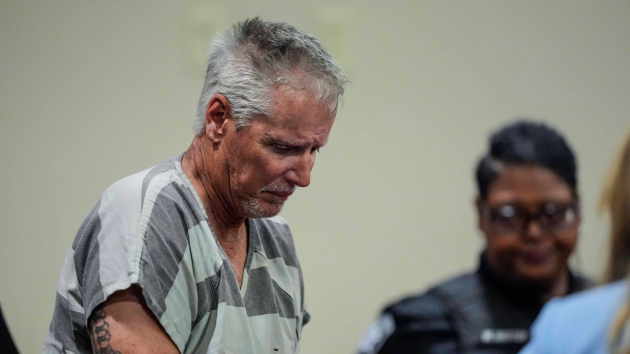
Father to be sentenced for murder in Georgia high school shooting carried out by teenage son

Colin Gray, 54, the father of Apalachee High School shooting suspect Colt Gray, 14, enters the Barrow County courthouse for his first appearance, on September 6, 2024, in Winder, Georgia. (Photo by Brynn Anderson-Pool/Getty Images)

(ATLANTA) — The father of a Georgia teenager who carried out a deadly mass shooting at his high school is set to be sentenced on more than two dozen charges, including second-degree murder, after a jury found him criminally culpable for the attack.

Colin Gray, 56, admitted to providing the assault rifle used by his then-14-year-old son in the September 2024 shooting at Apalachee High School, which killed two students and two teachers.

His son, 16-year-old Colt Gray, pleaded guilty to all 55 counts against him, including murder and aggravated assault. Judge Nicholas Primm sentenced him to life in prison without parole on Tuesday.

The teen’s father will appear in the Barrow County Courthouse before the same judge on Thursday to learn his fate. He faces more than 100 years in prison after being found guilty of 27 counts, including second-degree murder, involuntary manslaughter, cruelty to children in the second degree, and reckless conduct. The jury deliberated for fewer than two hours before returning the guilty verdicts in March.

Colin Gray marks the latest parent charged and convicted in the U.S. in connection with a mass shooting carried out by his child.

During the two-week trial, prosecutors presented evidence that Colin Gray had been warned that his son had an affinity for mass shooters and was aware that the teen kept a shrine in his bedroom dedicated to the shooter in the 2018 massacre at Marjory Stoneman Douglas High School in Parkland, Florida.

Instead of getting his son psychological help, Colin Gray gave the boy an AR-15-style weapon as a Christmas present that the teen ultimately used to carry out the mass shooting at Apalachee High School, prosecutors said.

Colin Gray testified in his own defense during the trial, breaking down while being questioned about whether he noticed any “red flags” that would have led him to believe the boy was capable of committing a mass shooting.

“I struggle with it every day,” Colin Gray testified. “He’s a good kid, you know? He wasn’t perfect, but to do something, uh, that heinous, like I don’t, I don’t know if anybody would see that type of evil.”

During his testimony, Colin Gray confirmed that he gave his son the AR-15-style rifle as a Christmas present, telling jurors the gift came with rules.

“This is a weapon that I want you to shoot when we go to the range, and if you keep doing really good in school, going to school and doing all the things you should, you graduate and you’re 18, this will be your gun,” Colin Gray said he told his son.

Following the verdict, Barrow County District Attorney Brad Smith said that evidence showed that there were “multiple warnings over a lengthy period of time.”

“You just had to do one thing — take that rifle away — and this would have been prevented,” Smith told reporters.

Several other parents have been convicted in the U.S. in connection with a mass shooting carried out by their children.

In 2024, Jennifer and James Crumbley were convicted of charges stemming from a deadly mass shooting at a Michigan high school committed by their then-15-year-old son, Ethan Crumbley. The parents were found guilty of involuntary manslaughter in separate trials after prosecutors presented evidence of an unsecured gun at their home and their indifference toward their son’s mental health. They were each sentenced to 10 to 15 years in prison.

Their son pleaded guilty in October 2022 to murdering four students and injuring several others in the November 2021 shooting at Oxford High School and was sentenced to life in prison without parole.

In 2023, Robert Crimo Jr. pleaded guilty to seven counts of misdemeanor reckless conduct — one count for each person killed by his son, Robert Crimo III, during a mass shooting at a 2022 Fourth of July Parade in the Chicago suburb of Highland Park. As part of a plea deal, Crimo Jr. was sentenced to 60 days in jail and two years of probation.

His son, who was 19 at the time of the shooting, pleaded guilty to multiple counts of murder and attempted murder last year and was sentenced to life in prison without parole.

In an ongoing case, the father of a 15-year-old girl who shot and killed a student and teacher at a Wisconsin school in 2024 faces charges alleging he allowed his daughter access to guns used in the deadly shooting.

The father, Jeffrey Rupnow, was charged with two counts of intentionally giving a dangerous weapon to a minor and one count of contributing to the delinquency of a minor in connection with the shooting at the Abundant Life Christian School in Madison. His case is set to go to trial next year.

Copyright © 2026, ABC Audio. All rights reserved.

Luigi Mangione pleads guilty in federal case, admits shooting Brian Thompson

▶ Watch Video: CBS News New York Luigi Mangione entered a guilty plea in his federal case at a court appearance in Manhattan Friday morning, admitting to the judge that he shot and killed UnitedHealthcare CEO Brian Thompson outside a Midtown hotel in 2024.Mangione, 28, faced both federal and state trials in New York for the deadly shooting. He had previously pleaded not guilty in both cases.Sentencing in the federal case will take place on Dec. 18, with Mangione facing a maximum possible sentence of life in prison.His state trial is currently set to begin in September. What happened in courtThompson's family arrived in the courtroom at around 10:50 a.m. The hearing, which had been set to start at 11 a.m., got started a bit late. The courtroom had filled press personnel as well as about two rows of members of the public. Mangione entered the court at around 11:10 a.m. with his feet shackled and his hands behind his back. He was wearing tan prison clothing with a white T-shirt underneath. Just before 11:15 a.m., Mangione's defense team told the judge Mangione "is prepared to plead guilty to the indictment at this time." The judge asked Mangione if that was correct. "Yes," Mangione told the judge. The judge then asked Mangione a series of questions about his background and use of medications and drugs. The judge then found Mangione to be fully competent to enter the plea. The judge told Mangione that the maximum possible sentence is life in prison followed by supervised release. The judge added that there's no parole in the federal system, although good behavior and other programs can impact how long he will spend in prison. He will be required to serve 85% of the sentence, the judge said. The judge pointed out that there's no plea agreement between the defense and prosecution, and Mangione's defense attorney said that's correct. Mangione's admission in courtMangione then told the court in his own words what he did. He told the court that he had for years endured severe pain for a boken back and had navigated the health insurance system. He told the court he learned about the UnitedHealthcare annual investor conference in New York even though it wasn't publicized, and traveled to it. He told the court he posed as an investor to find out more information about the conference. He told the court he used a 3D printer to make parts of the gun, and traveled to New York with the gun, silencer, and magazine with "the intent to shoot Brian Thompson." He said he shot Thompson in Manhattan knowing it would place him in fear of death or serious bodily injury. Prosecutors then spoke in court, reviewing the evidence against Mangione. They pointed to video capturing the shooting, as well as Mangione fleeing the scene on the bicycle, his arrest in Altoona, Pennsylvania, the recovered pistol and shell casings, as well as DNA found at the crime scene. Prosecutors said entries in Mangione's notebook expressed his desire to kill a health care executive. "Mr. Mangione, how do you now plead to counts one and two of the indictment," the judge asked. "Guilty," Mangione said. "I will accept your guilty plea," the judge said. About the chargesMangione initially faced four federal charges in Thompson's killing. Two of those charges against him, one of which brought the possibility of the death penalty — murder through use of a firearm and an additional firearms charge — were dismissed earlier this year, and federal prosecutors said they would not appeal that decision.That left federal stalking charges against him, which brought the possibility of life in prison without the possibility of parole.Jury selection in the federal case had been set to begin in January. Speculation about a possible plea deal had been rampant since Tuesday, when prosecutors and Mangione's defense team sent a letter to the court requesting a Friday conference regarding the federal case.What the federal plea deal means for Luigi Mangione's state trialThe plea deal will put an end to the federal trial and raises questions about Mangione's state trial, which is set to begin in September.The state case, in which he faces second-degree murder charges, among others, also carries with it the possibility of life in prison.The plea deal, however, may revive a double jeopardy argument, CBS News legal contributor Caroline Polisi said on "CBS Mornings" Thursday.Double jeopardy refers to a law stating "a person may not be twice prosecuted for the same offense," although there are a number of exceptions. "Luigi Mangione's defense team had made that argument in the state case prior, and this could revive it, because if you actually have a conviction on the federal case, it's a more robust double jeopardy protection in the New York state case. So we could see a motion there that could kick this state case back," Polisi said.Legal expert Rich Schoenstein, however, said he thinks the double jeopardy argument is "open and complicated and subject to debate." Schoenstein said that's because the federal charges Mangione is pleading guilty to are related to interstate matters and stalking, which are quite different than the second-degree murder, weapons and forged instrument charges he's facing on a state level. "So the weapons and forged instrument charges would not be resolved by the federal plea, and arguably the intentional killing charge would not be resolved. I do think there's a serious question as to whether this would be double jeopardy," Schoenstein said.The plea deal, however, may "put some pressure" on New York prosecutors to reach a deal too, "and therefore it could resolve the case on a negotiated level." Evidence in the Luigi Mangione caseKey evidence seized during Mangione's Pennsylvania arrest had been expected to be admitted in the federal trial, including a 3D-printed handgun, loaded magazine, a notebook and more.Thompson, 50, was killed on Dec. 4, 2024, as he arrived at a hotel for UnitedHealth Group's annual investor conference. The killing  of the husband and father of two was caught on surveillance video, which showed Thompson being shot in the back as he walked down the street. Police say the words "delay," "deny" and "depose" were written on the ammunition, echoing a phrase used to describe how insurers avoid paying claims.Thompson's killing set off a frantic multistate manhunt that ended with Mangione's arrest at a McDonald's in Altoona, Pennsylvania, five days later.This is a developing story. Check back soon for more information. 
Read Next Story