
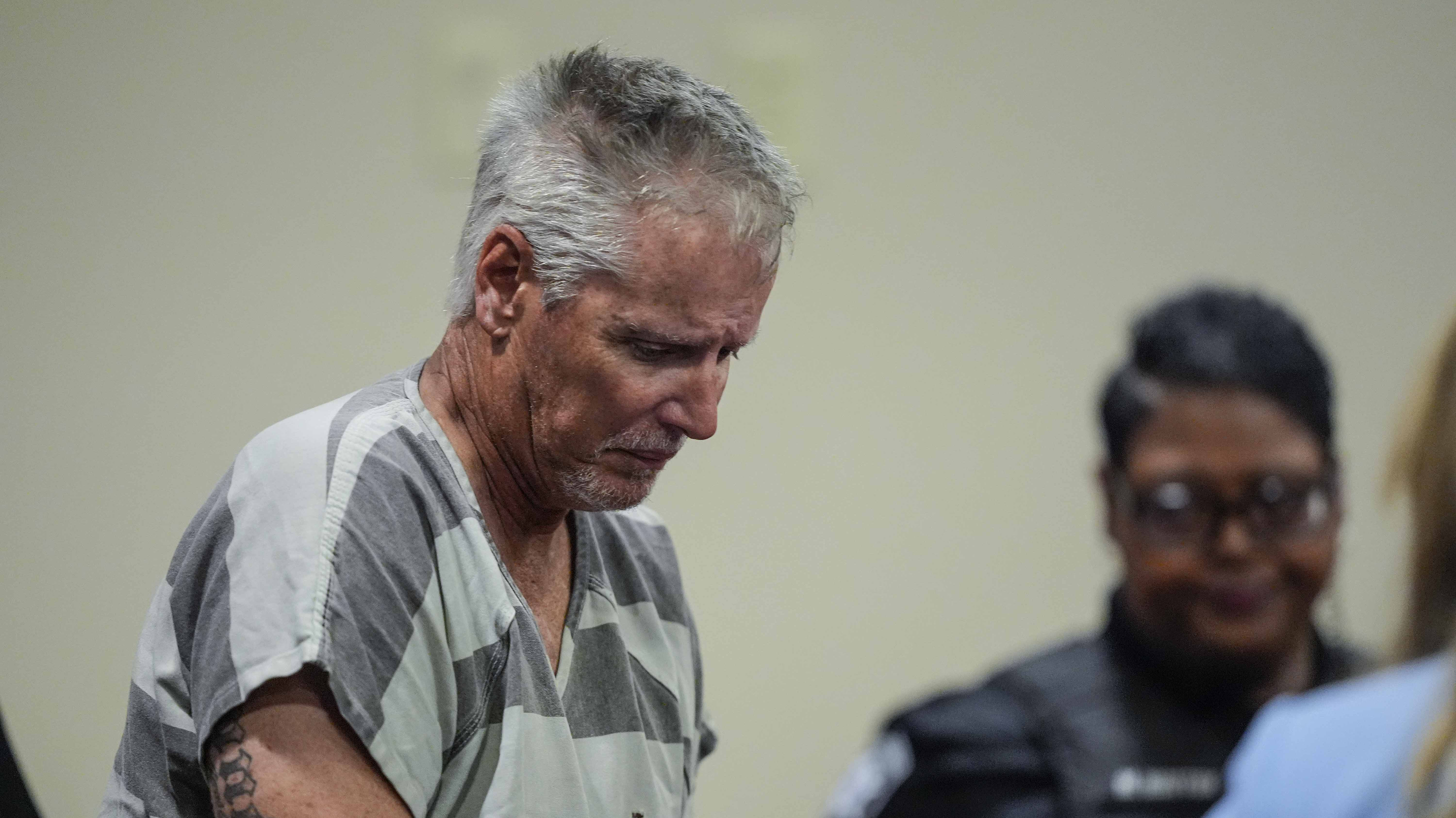
(NEW YORK) — The father of a Georgia teenager who carried out a deadly mass shooting at his high school was sentenced to 15 years in prison for second-degree murder and other charges after a jury found him criminally culpable for the attack.
Colin Gray, 55, admitted to providing the assault rifle used by his then-14-year-old son in the September 2024 shooting at Apalachee High School, which killed two students and two teachers.
His son, 16-year-old Colt Gray, pleaded guilty to all 55 counts against him, including murder and aggravated assault. Judge Nicholas Primm sentenced him to life in prison without parole on Tuesday.
The teen’s father appeared in the Barrow County Courthouse before the same judge on Thursday to learn his fate. He faced more than 100 years in prison after being found guilty of 27 counts, including second-degree murder, involuntary manslaughter, cruelty to children in the second degree, and reckless conduct. The jury deliberated for fewer than two hours before returning the guilty verdicts in March.
Colin Gray is the latest parent to be charged and convicted in the U.S. in connection with a mass shooting carried out by their child. Judge Primm noted the novelty of the school shooting case, saying it’s the first of its kind in Georgia and the second he’s aware of in the nation.
“What we’re really referencing is this new phenomenon of parents being charged in conjunction with crimes that their children are committing,” Primm said. “It’s a divisive case.”
Primm said the father was convicted because “the warning lights were flashing brighter and brighter” and he didn’t get his son help or remove his access to guns.
“No parent thinks that their child is going to be the next school shooter, but it became more and more obvious that something bad was going to happen,” Primm said.
The judge told Colin Gray that if he had used gun locks or removed the ammunition from his house, “you wouldn’t be here today.”
Primm sentenced the father to 15 years confinement for each second-degree murder count. Those and lesser sentences on his other counts will run concurrent with one another, for a total 15-year prison sentence, the judge said.
“You didn’t intend to commit these crimes that you’ve been convicted of, but the loss here is profound,” Primm said while handing down the sentence. “But I still have to distinguish your acts from the malignant heart and the acts that Colt Gray committed upon the Apalachee school.”
The defense asked for 10 years in prison in what attorney Chris Hobbs called the first case of its kind tried in Georgia, arguing that Colin Gray knew his son was struggling but misjudged the warning signs.
“We understand the gravity of this situation. Four people are gone, and nothing the court can do today can change that. But the question today is narrower, and in some ways harder — what does justice require when a father’s negligence and a son’s concealed intent meet on a single morning?” Hobbs said.
Prosecutors asked the judge that Colin Gray be sentenced to 80 years in prison, saying that he gave Colt Gray a gun months after law enforcement asked him to restrict his son’s access to guns, and that the risk was “staring him in the face every day” in the form of a shrine to the shooter in the Parkland high school massacre in his son’s bedroom.
“This was the risk he was ignoring, that there would be a mass shooting of children at a school, and he gave his son the exact tool he would need to accomplish this,” Barrow County District Attorney Brad Smith said during the sentencing hearing Thursday. “He is the reason four people are dead, seven are injured and countless others traumatized. And he is the reason a 16-year-old boy was sentenced two days ago to the rest of his life in prison.”
Several of the family members of those killed in the school shooting addressed the court on Thursday, speaking to the pain they continue to endure.
Colin Gray declined to address the court prior to his sentence.
During the two-week trial, prosecutors presented evidence that Colin Gray had been warned that his son had an affinity for mass shooters and was aware that the teen kept a shrine on his bedroom wall dedicated to the shooter in the 2018 massacre at Marjory Stoneman Douglas High School in Parkland, Florida.
Instead of getting his son psychological help, Colin Gray gave the boy an AR-15-style weapon as a Christmas present that the teen ultimately used to carry out the mass shooting at Apalachee High School, prosecutors said.
Colin Gray testified in his own defense during the trial, breaking down while being questioned about whether he noticed any “red flags” that would have led him to believe the boy was capable of committing a mass shooting.
“I struggle with it every day,” Colin Gray testified. “He’s a good kid, you know? He wasn’t perfect, but to do something, uh, that heinous, like I don’t, I don’t know if anybody would see that type of evil.”
During his testimony, Colin Gray confirmed that he gave his son the AR-15-style rifle as a Christmas present, telling jurors the gift came with rules.
“This is a weapon that I want you to shoot when we go to the range, and if you keep doing really good in school, going to school and doing all the things you should, you graduate and you’re 18, this will be your gun,” Colin Gray said he told his son.
Following the verdict, Smith said that evidence showed that there were “multiple warnings over a lengthy period of time.”
“You just had to do one thing — take that rifle away — and this would have been prevented,” Smith told reporters.
Several other parents have been convicted in the U.S. in connection with a mass shooting carried out by their children.
In 2024, Jennifer and James Crumbley were convicted of charges stemming from a deadly mass shooting at a Michigan high school committed by their then-15-year-old son, Ethan Crumbley. The parents were found guilty of involuntary manslaughter in separate trials after prosecutors presented evidence of an unsecured gun at their home and their indifference toward their son’s mental health. They were each sentenced to 10 to 15 years in prison.
Their son pleaded guilty in October 2022 to murdering four students and injuring several others in the November 2021 shooting at Oxford High School and was sentenced to life in prison without parole.
In 2023, Robert Crimo Jr. pleaded guilty to seven counts of misdemeanor reckless conduct — one count for each person killed by his son, Robert Crimo III, during a mass shooting at a 2022 Fourth of July Parade in the Chicago suburb of Highland Park. As part of a plea deal, Crimo Jr. was sentenced to 60 days in jail and two years of probation.
His son, who was 19 at the time of the shooting, pleaded guilty to multiple counts of murder and attempted murder last year and was sentenced to life in prison without parole.
In an ongoing case, the father of a 15-year-old girl who shot and killed a student and teacher at a Wisconsin school in 2024 faces charges alleging he allowed his daughter access to guns used in the deadly shooting.
The father, Jeffrey Rupnow, was charged with two counts of intentionally giving a dangerous weapon to a minor and one count of contributing to the delinquency of a minor in connection with the shooting at the Abundant Life Christian School in Madison. His case is set to go to trial next year.
ABC News’ Bill Hutchinson contributed to this report.
Copyright © 2026, ABC Audio. All rights reserved.