
Europeans sanction Russia over alleged ‘sabotage and espionage’ attacks

▶ Watch Video: Trump administration to support heavy tariffs on Russian oil in bid to end Ukraine war, sources say

France’s foreign minister said Monday that Russia’s ambassador in Paris would be summoned over “a vast cyber campaign” across Europe. 

“We will also impose sanctions on nine individuals and four entities responsible for this cyber campaign, which was orchestrated by the FSB,” Russia’s primary national intelligence and security service, Foreign Minister Jean-Noel Barrot, said in an interview with BFMTV/RMC.

He made the announcement as the European Union and United Kingdom announced similar sanctions.

The Russian attacks, which allegedly targeted companies, government ministries and service operators, were attempts at “sabotage and espionage in a dozen European countries,” Barrot said.

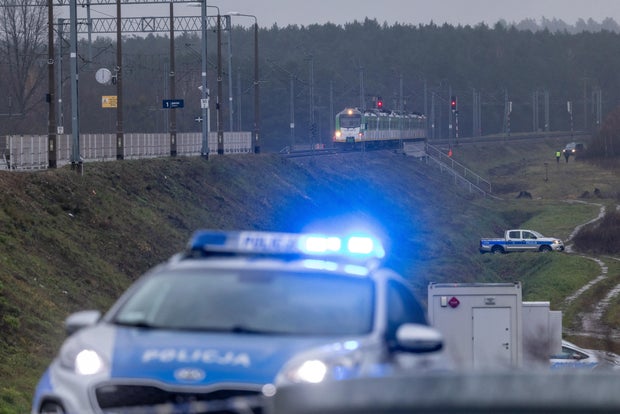
The goal was either “capturing information or sabotaging operations, for example rail infrastructure, as was the case in Poland,” he said. Poland’s top diplomat accused Russia of an “act of state terror” in November last year after two Ukrainian nationals allegedly working closely with Russian secret services were accused of blowing up a railway line in the country. 
POLAND-UKRAINE-RUSSIA-POLITICS-DEFENCE-CONFLICT-TRANSPORT
Police cars are seen close to railways damaged in an explosion in Mika, next to Garwolin, central Poland, after the line was targeted in a sabotage attack, Nov. 17, 2025.

Wojtek RADWANSKI/AFP/Getty

Barrot said Monday that France was able to “detect these attacks,” having “significantly strengthened our defenses against these cyber attacks.”

The EU denounced “Russia’s malicious cyber ecosystem” on Monday, meanwhile, for targeting the bloc and its member countries. 

In a statement, the EU condemned Russia for the “leveraging of a cyber ecosystem encompassing state and non-state actors, ranging from intelligence services to cybercriminals groups, hacktivists and private companies.”

The EU accused the FSB of controlling a “variety of cyber threat groups” and said its activities included “infiltration of governmental networks and sabotage of critical infrastructure.”

France, Germany, Poland, Cyprus, the Netherlands, Austria, Slovakia, Romania and Finland have been targeted, among other nations, causing “disruptions and financial losses,” the bloc said.

The EU said it was sanctioning nine individuals and four entities, including officers with the Russian military intelligence agency GRU, “as well as cybercriminals, self-proclaimed hacktivists and private companies.”

The U.K. government said it was sanctioning 24 individuals and entities for “cyber and hybrid operations.”

The new measures and accusations came as France prepared to host a summit of the “Coalition of the Willing” – a group of Ukraine’s allies – in Paris on Monday. 

Kremlin spokesman Dmitry Peskov called the group “a coalition of warmongers,” adding: “These are the countries that are undertaking hostile actions against Russia, so we will be watching very closely.”

In April, Sweden revealed it had foiled a Russian cyberattack targeting a thermal power plant the previous year. The announcement came after Poland, Norway, Denmark and Latvia warned that Russia was targeting critical infrastructure across Europe.

In addition to the November 2025 attack on the Polish railway line, an alleged FSB plot to attack Poland’s energy grid a month later “could have caused 500,000 civilians to lose electricity” had it succeeded, according to the U.K. government. 

A spate of mysterious drone sightings near airports and military bases across Western Europe has also widely been attributed to Russia, in addition to more blatant incursions into NATO airspace by Russian warplanes. 

Some of America’s allies have said for months that Europe is in a gray zone between peace and war with Russia — accusing Moscow of escalating “hybrid warfare.”

Vance, Caine raised munitions stockpile concern, source says, as US pauses consecutive nights of strikes in Iran

(CNN) — Vice President JD Vance and Chairman of the Joint Chiefs of Staff Gen. Dan Caine both raised concerns about the US munitions stockpile to President Donald Trump as he weighed potentially escalating the war with Iran during a White House meeting on Friday, a US official told CNN.On Friday night, the US appeared to pause its bombing campaign on Iran after nearly two weeks of consecutive nights of strikes. Operations are “on a hold,” a Department of Defense source told CNN on Saturday.It’s currently unclear if the stockpile concern was the primary reason why the US paused consecutive nights of strikes or whether it will continue to do so.“President Trump has always been consistent in saying he prefers a diplomatic solution, but he continues to retain all options if Iran continues terrorist activities in the (Strait) of Hormuz or against allies,” White House Communications Director Steven Cheung said in a statement.“Combined with successful sanctions that have crippled Iran’s economy and 13 straight days of strikes against military targets in response to their repeated aggression, it would be wise for Iran to work towards a negotiated deal. Otherwise, they know what will happen.”CNN has also reached out to Vance’s office for comment.This comes as key US weapons stockpiles remain significantly depleted and could come under more pressure if strikes on Iran continue, as CNN has previously reported.Speaking to reporters after the Friday meeting with Cabinet members and top advisors, Trump stressed that the US officials were actively negotiating with Iran, though he also said it was possible the military could continue its bombing campaign or “make it a heavier dose.” He claimed Iran seemed to be getting “more serious” in ongoing talks.As of Friday afternoon, the Trump administration was still deliberating over what a potential escalation would look like, according to a source familiar. Gulf countries have urged restraint in recent conversations with administration officials but acknowledged the US has unique capabilities it could use to escalate the conflict if it chooses to do so, the source said.Even after Trump said he was considering a massive attack against Iran this week, he had privately directed his negotiators to “keep talking,” according to a source familiar with the matter, underscoring how the president has been grappling with the reality of limited escalatory military operations short of putting US troops on the ground.Few within Trump’s inner circle, or inside the Pentagon, believed the president’s options for escalating would yield the results he was looking for, according to multiple sources.CNN has also reported that before the war began, Caine and other military leaders had warned Trump that a protracted military campaign could impact US weapons stockpiles.“America’s military is the most powerful in the world and has everything it needs to execute at the time and place of the President’s choosing,” Chief Pentagon Spokesman Sean Parnell said in a statement to CNN.“We have executed multiple successful operations across combatant commands while ensuring the U.S. military possesses a deep arsenal of capabilities to protect our people and our interests.”The-CNN-Wire™ & © 2026 Cable News Network, Inc., a Warner Bros. Discovery Company. All rights reserved.
Read Next Story