
England-Argentina World Cup semifinal reignites painful historic rivalry

▶ Watch Video: Argentina beats England to reach FIFA World Cup final

London — The semifinal clash between England and Argentina in the 2026 FIFA World Cup on Wednesday saw two bitter rivals face off in one of the most emotionally charged matches of the tournament. 

The contest saw Lionel Messi, considered by many to be one of the best soccer players in the world, play against England for the first time in his long and storied career — and rack up a win, with 2-1 victory sending Argentina to the final. On the other side were England’s all-time top goal scorer Harry Kane, and one of the stars of the tournament, Jude Bellingham. 
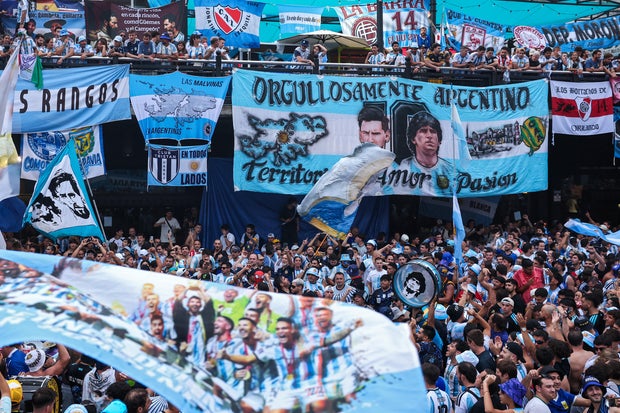
Around FIFA World Cup 2026
Argentina fans gather a day ahead of the FIFA World Cup 2026 semifinal match against England, July 14, 2026, in Atlanta, Georgia, with flags bearing the Falklands/Malvinas islands.

Patrick Smith/FIFA/Getty

Previous matches between the two countries have produced some of the sport’s most iconic moments. But this rivalry goes well beyond the soccer field.

The Falklands War

Diplomatic relations between England and Argentina remain strained to this day over two small islands off Argentina’s Atlantic coast. To the U.K., they are the Falklands, but Argentina calls them the Malvinas.

In the 18th century, France, Spain and Britain all tried to lay claim to the islands, establishing early colonial settlements. France agreed to leave the islands in 1766, leaving Spanish settlers to force out the British, who withdrew in 1774. 

The Spanish then left in the early 19th century, leaving a newly independent government in Buenos Aires to claim the islands 300 miles off the country’s coast as Argentina’s own.

The sovereignty dispute reignited in 1833, however, when British forces arrived to reclaim the islands, expelling the Argentinian population and replacing it with Britons.

In 1982, an Argentinian military junta launched an attack on the islands and quickly captured the territory, sparking a 10-week war that killed 907 people, more than a third of whom were Argentinian sailors on the ARA General Belgrano cruiser that was sunk by a British submarine in a highly controversial attack.
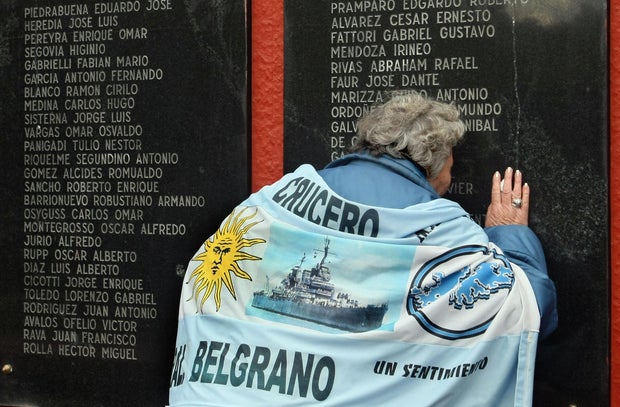
Wrapped in an Argentine flag with the pi
Wrapped in an Argentine flag with a picture of the cruiser General Belgrano, the mother of Sixto Javier Fajardo, who was killed during the conflict, kisses a plaque bearing his name during a ceremony on June 14, 2007, in Buenos Aires.

DANIEL GARCIA/AFP/Getty

Facing superior military force, Argentina surrendered the islands, which remain dominated more than three decades later by a British population.

Las Malvinas remain a bitter point of contention for the South American nation.

“The Hand of God”

Only four years after the conflict, Argentina and England faced off in a World Cup quarterfinal in Mexico City’s gargantuan Azteca Stadium, which was packed with 114,000 people.

Early in the second half, the ball looped fortuitously to Diego Maradona, one of the sport’s greatest players of all time, who leapt into the air and hit the ball with his fist into the back of the net.

The referee didn’t register the hand contact, and the goal stood. 
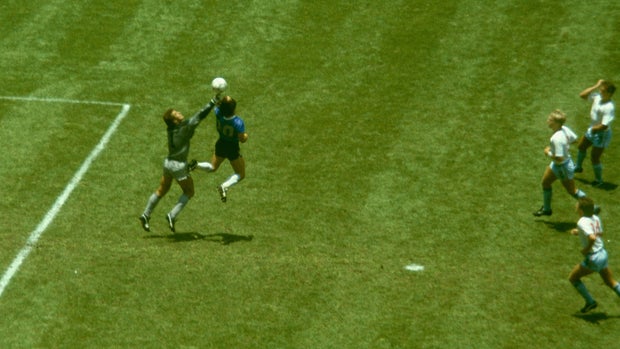
Diego Maradona Hand of God Goal Argentina v England 1986
Argentina player Diego Maradona outjumps England goalkeeper Peter Shilton to score his ‘Hand of God’ goal during the 1986 FIFA World Cup quarterfinal at the Azteca stadium on June 22, 1986 in Mexico City.

Allsport/Getty

“A few minutes later, Maradona then scored possibly the greatest goal in the history of the World Cup,” soccer journalist Joey D’urso told CBS News. It sealed Argentina’s fate — the match finished 2-1.

Asked afterward if he had scored his first goal legally, Maradona replied that it was “a little with the head of Maradona, and a little with the hand of God.”

In a 2019 documentary, he described it as “like some sort of symbolic revenge against the English” for their invasion of the Malvinas. 

A year later, on the occasion of his 60th birthday, he told France Football magazine: “I dream to score another goal against the English, this time with the right hand.”

In 1998, Argentina beat England on penalty shots in a game that saw David Beckham red carded and which then-England captain Alan Shearer said on Wednesday “still hurts now.

In 2002, Beckham scored a penalty to help England beat Argentina 1-0 in a World Cup group match — the two teams’ last competitive fixture.

“For Malvinas, for Diego”

The Wednesday night rematch in Atlanta set the stage for Sunday’s final against Spain for World Cup glory. But the historical significance of the game is inescapable.

After beating Switzerland 3-1 on Saturday, Messi — who is often compared to Maradona — and his teammates sang “The Fourth Star,” the country’s alternative World Cup anthem. 

“For Malvinas, for Diego,” they chanted.
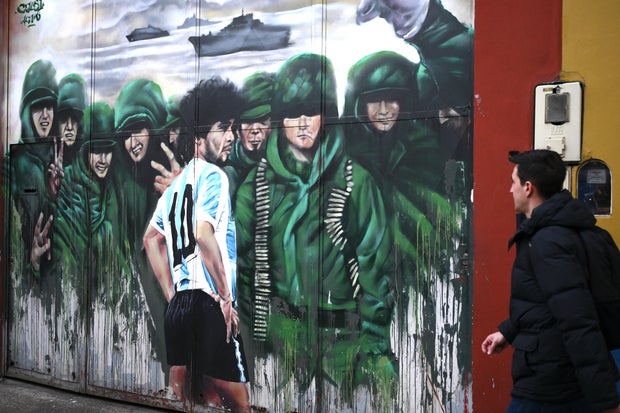
ARGENTINA-FBL-WC-2026
A man walks past a mural depicting late Argentine football legend Diego Maradona and Argentine soldiers from the Falklands/Malvinas War, in Buenos Aires, on July 14, 2026.

Luis ROBAYO /AFP via Getty Images

Gary Linekar, who scored England’s consolation goal in the 1986 game and is now a well-known soccer commentator in the U.K., said Tuesday that he wants “revenge this time round” for the loss.

Ahead of Wednesday’s clash, Argentina’s coach Lionel Scaloni has tried to play down the historical significance. 

“It is a football game and that is all,” he said. 

But Argentina forward Jose Lopez has promised that he and his teammates would “leave our lives on the field.” 

“Obviously, inside and outside the four lines of the pitch it’s a match that has a lot of history there, a lot of pain and a lot of things behind it,” he said.

England coach Thomas Tuchel said in the run-up to the game that Argentina’s players “are fueled by history, it means a lot to them. … But we are also emotional. We have the grit. We have the mentality that it takes to go up against it, and we are ready for it.”
British ministers arrive at 10 Downing Street for Starmer's final cabinet meeting
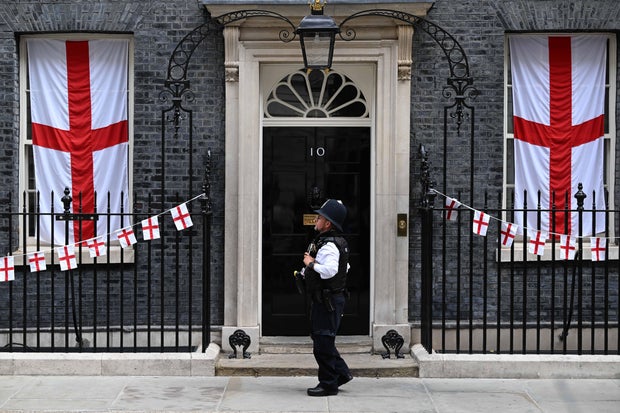
England flags hang on the windows of 10 Downing Street, the U.K. prime minister’s residence, ahead of England’s FIFA World Cup semifinal clash against Argentina, July 15, 2026.

Rasid Necati Aslim/Anadolu/Getty

“Argentina versus England has become a classic,” Víctor Hugo Morales, a Uruguayan journalist whose commentary on the 1986 match has been immortalized in Argentina, told The Guardian recently. “Before 1986, it was just another match. Since then, it has carried a political and emotional weight that goes far beyond football.”
Once peruanos murieron combatiendo por Rusia y otros 114 están desaparecidos, dicen autoridades de Perú

Once peruanos han muerto, 114 están desaparecidos y tres fueron capturados por el Ejército ucraniano después de enlistarse en las fuerzas armadas rusas, informó el Ministerio de Relaciones Exteriores de Perú. La Cancillería señaló que, oficialmente, 459 ciudadanos peruanos se han enlistado en las fuerzas armadas rusas.El nuevo balance fue difundido mientras el Gobierno anunciaba la repatriación de dos jóvenes peruanos que, según la Cancillería, escaparon del reclutamiento forzado al que fueron sometidos para prestar servicios en la guerra contra Ucrania.El consulado de Perú en Rusia “asistió y gestionó la repatriación de dos jóvenes peruanos en situación de vulnerabilidad, que fugaron del reclutamiento forzado del que fueron víctimas”, señaló la cancillería en un comunicado.“Todos ellos arribaron al Perú y se encuentran con sus familias”, añadió.Los jóvenes se suman a otros dos peruanos atendidos a finales de julio por la sección consular de la Embajada del Perú en Rusia. En total, la Cancillería informó que 31 peruanos han sido evacuados: 28 regresaron al Perú y tres permanecen en Europa por “decisión propia”.El Ministerio también pidió a los ciudadanos tener cuidado con las ofertas de trabajo en el extranjero. “Se alerta a la ciudadanía a no dejarse engañar por falsas ofertas laborales, pues podrían caer en redes delictivas de trata”, señaló la Cancillería. El Gobierno recordó además que prestar servicio militar para un Estado extranjero requiere autorización previa.El anuncio llega después de meses de reclamos de familias que buscan información sobre sus parientes. CNN habló recientemente con 12 familias peruanas que han participado en protestas y vigilias frente a la Embajada de Rusia en Lima y ante el Ministerio de Relaciones Exteriores.Los testimonios recogidos muestran que algunos hombres viajaron a Rusia después de recibir ofertas de trabajo como cocineros, guardias de seguridad u otros empleos de civiles. Sus familiares dijeron que no esperaban que terminaran vinculados a las fuerzas rusas y, en algunos casos, enviados al frente.Pedro Bravo, director de Comunidades Peruanas en el Exterior de la Cancillería, dijo a CNN que muchos de los reclutas provienen de entornos empobrecidos y con una necesidad urgente de dinero, lo que puede hacerlos más vulnerables a este tipo de ofertas. “Es mucho más fácil engañarlos”, dijo.Una de las madres entrevistadas por CNN, identificada como Norma, contó que su hijo de 31 años viajó a Rusia después de aceptar un supuesto trabajo como cocinero para el Ejército ruso. Poco después comenzó a enviarle fotografías y videos en los que aparecía con equipo militar, cavando trincheras y construyendo refugios.A principios de abril dejó de enviar mensajes.“Tengo esta luz de esperanza de que está en algún lugar, escondido en una trinchera, pero realmente no lo sé”, dijo Norma a CNN.Ante las denuncias, la Fiscalía peruana anunció en mayo que investiga el reclutamiento ruso por posibles casos de “trata de personas”.Percy Salinas, un abogado que representa a algunas familias de los reclutas, entregó a CNN una copia de una orden fiscal que describe el alcance del caso judicial.Las autoridades están investigando 36 denuncias de ciudadanos peruanos que afirman que sus familiares o amigos fueron engañados “mediante ofertas de trabajo falsas en el extranjero —específicamente en la Federación Rusa— con el propósito de transportarlos fuera del país y someterlos a… participación forzada en un conflicto armado entre Rusia y Ucrania”, según la orden.La fiscalía declinó hacer comentarios sobre el caso cuando fue contactada por CNN.Bravo, del Ministerio de Relaciones Exteriores de Perú, dijo a CNN que el Gobierno había realizado al menos 247 solicitudes a Moscú para obtener información sobre peruanos incorporados a las fuerzas rusas y ha exigido “el regreso inmediato y seguro de nuestros compatriotas a su país de origen, dado que salieron sin la debida autorización”.Rusia ha dicho que “respeta profundamente la decisión de ciudadanos extranjeros de participar en la defensa de la soberanía y seguridad (rusas)”.“La embajada reafirma su permanente disposición a tomar todas las medidas necesarias para obtener información lo más rápido posible en base a solicitudes presentadas formalmente”, dijo la Embajada de Rusia en Lima en un comunicado de abril sobre las “preocupaciones de las familias peruanas”.The-CNN-Wire™ & © 2026 Cable News Network, Inc., a Warner Bros. Discovery Company. All rights reserved.
Read Next Story