
Eligible seniors can get GLP-1s for $50 a month for weight loss alone

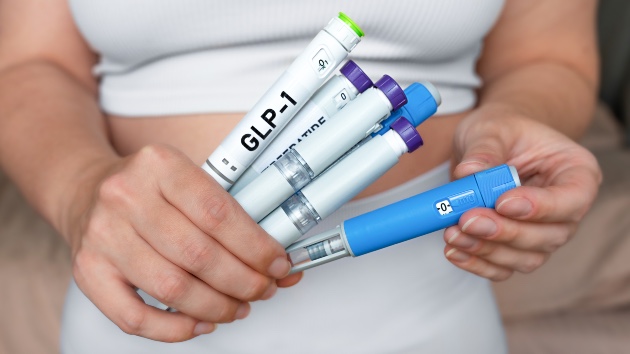
Close-up of a woman holding several GLP-1 injection pens used for weight loss and diabetes treatment. Modern injectable medication concept for obesity management, healthcare and pharmaceutical therapy. (Kateryna Borodina/Getty Images)

(NEW YORK) — For the first time, Medicare will cover GLP-1s for obesity-related weight loss, without any other medical conditions.

Starting Wednesday, eligible Medicare beneficiaries can receive GLP-1s for obesity for $50 per month by prescription. Medicare is the primary federal health insurance program in the U.S. for individuals 65 and older.

Federal rules ban Medicare Part D — which helps cover prescription drug costs — from covering drugs solely to treat obesity, but a new federal pilot bridge program approved by Health and Human Services Secretary Robert F. Kennedy Jr. will be in effect until Dec. 31, 2027.

This move could dramatically expand access to Eli Lilly’s Foundayo and Zepbound and Novo Nordisk’s Wegovy for seniors 65 and older as well as other eligible Medicare enrollees.

Foundayo and Wegovy Pill are daily tablets. Wegovy and Zepbound are weekly injections that require refrigeration.

A month supply of Wegovy will come in four pre-filled pens while Zepbound will be delivered in a KwikPen, which holds four weekly doses in a single device.

Single-dose Zepbound pens and Zepbound vials will not be covered by the bridge program.

“These treatments are a major medical advancement, but too many seniors are currently unable to access them due to high cost,” Dr. Mehmet Oz, administrator of the Centers for Medicare and Medicaid, said in a statement last month. “The Medicare GLP-1 Bridge changes that by making these medications more affordable and accessible, while advancing our broader goal of helping Americans live healthier lives.”

An estimated 3.8 million beneficiaries could be eligible for the program, according to a KFF analysis of 2023 Part D enrollment data that was published Monday.

The government negotiated with the manufacturers to reduce the price the government will pay to $250 for a month’s supply and in return the companies will have access to the larger patient population. Each patient will pay a $50 copay towards the cost of the medication, but that co-pay will not go toward an individual’s annual deductible.

Patients will first need prior authorization — prescribing clinicians will submit documentation proving the patient meets strict body mass index (BMI) and health condition requirements. That means patients will need to wait for the prescription to be approved before it can be filled.

Patients must have Body Mass Index (BMI) of 35 or higher. If their BMI is 30-35, they must have certain types of heart failure, hard to control blood or chronic kidney disease.

If their BMI is 27-30, they must have prediabetes, history of heart attack or stroke or blocked arteries in the arms or legs.

These requirements are more restrictive than the FDA approval language or what private insurance companies require, which is a BMI of 30 or over.

Patients must also not have type 2 diabetes, moderate-to-severe sleep apnea, or fatty liver disease because their Medicare plan may already cover GLP-1s.

“GLP-1s can be life-changing for patients managing obesity and related conditions,” Chris Klomp, director of Medicare and chief counselor at the U.S. Department of Health and Human Services, said in a statement last month.

“This demonstration is designed to make accessing those medications simpler, more predictable, and more consistent across the Medicare program, which means better quality of life for seniors and better value across the health care system,” the statement continued.

​Individuals will be able to fill their pre-approved prescriptions at local retail pharmacies and directly through Novo Nordisk or Ely Lilly’s direct to consumer mail order pharmacies.  

Copyright © 2026, ABC Audio. All rights reserved.

Vance, Caine raised munitions stockpile concern, source says, as US pauses consecutive nights of strikes in Iran

(CNN) — Vice President JD Vance and Chairman of the Joint Chiefs of Staff Gen. Dan Caine both raised concerns about the US munitions stockpile to President Donald Trump as he weighed potentially escalating the war with Iran during a White House meeting on Friday, a US official told CNN.On Friday night, the US appeared to pause its bombing campaign on Iran after nearly two weeks of consecutive nights of strikes. Operations are “on a hold,” a Department of Defense source told CNN on Saturday.It’s currently unclear if the stockpile concern was the primary reason why the US paused consecutive nights of strikes or whether it will continue to do so.“President Trump has always been consistent in saying he prefers a diplomatic solution, but he continues to retain all options if Iran continues terrorist activities in the (Strait) of Hormuz or against allies,” White House Communications Director Steven Cheung said in a statement.“Combined with successful sanctions that have crippled Iran’s economy and 13 straight days of strikes against military targets in response to their repeated aggression, it would be wise for Iran to work towards a negotiated deal. Otherwise, they know what will happen.”CNN has also reached out to Vance’s office for comment.This comes as key US weapons stockpiles remain significantly depleted and could come under more pressure if strikes on Iran continue, as CNN has previously reported.Speaking to reporters after the Friday meeting with Cabinet members and top advisors, Trump stressed that the US officials were actively negotiating with Iran, though he also said it was possible the military could continue its bombing campaign or “make it a heavier dose.” He claimed Iran seemed to be getting “more serious” in ongoing talks.As of Friday afternoon, the Trump administration was still deliberating over what a potential escalation would look like, according to a source familiar. Gulf countries have urged restraint in recent conversations with administration officials but acknowledged the US has unique capabilities it could use to escalate the conflict if it chooses to do so, the source said.Even after Trump said he was considering a massive attack against Iran this week, he had privately directed his negotiators to “keep talking,” according to a source familiar with the matter, underscoring how the president has been grappling with the reality of limited escalatory military operations short of putting US troops on the ground.Few within Trump’s inner circle, or inside the Pentagon, believed the president’s options for escalating would yield the results he was looking for, according to multiple sources.CNN has also reported that before the war began, Caine and other military leaders had warned Trump that a protracted military campaign could impact US weapons stockpiles.“America’s military is the most powerful in the world and has everything it needs to execute at the time and place of the President’s choosing,” Chief Pentagon Spokesman Sean Parnell said in a statement to CNN.“We have executed multiple successful operations across combatant commands while ensuring the U.S. military possesses a deep arsenal of capabilities to protect our people and our interests.”The-CNN-Wire™ & © 2026 Cable News Network, Inc., a Warner Bros. Discovery Company. All rights reserved.
Read Next Story