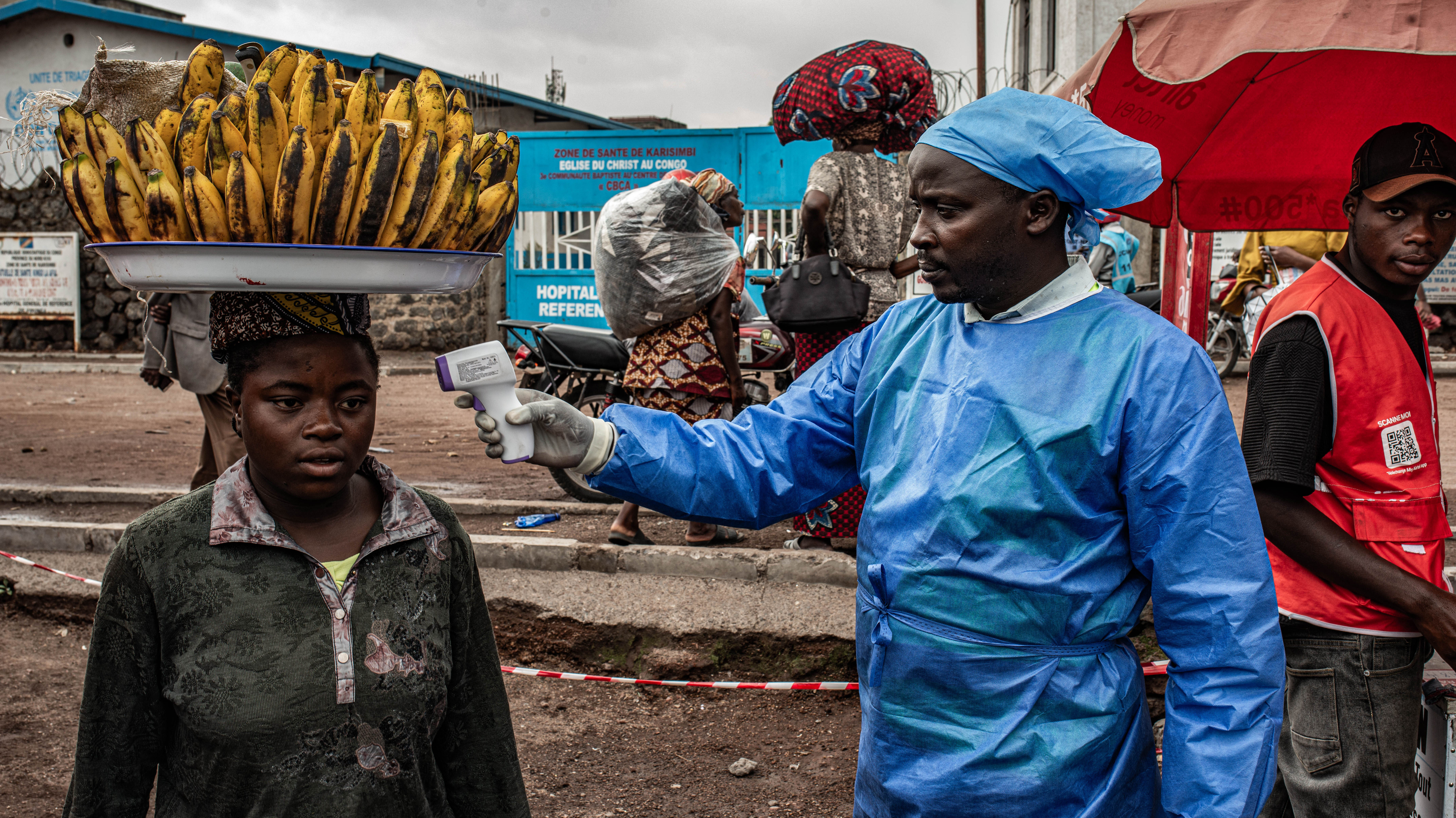
(NEW YORK) — More than 1,500 people have died from Ebola as an outbreak continues to spread in the eastern Democratic Republic of the Congo, according to government figures released on Thursday.
As of Tuesday, at least 3,442 cases and 1,521 deaths had been recorded, with 797 people hospitalized or in isolation, Congo’s Ministry of Health said.
Health officials said the contact tracing rate stands at 78.3%, which is below the 90-95% that the World Health Organization says needed to contain the outbreak.
The outbreak was first detected in the DRC’s northeastern province of Ituri, with cases officially confirmed by the health ministry on May 15.
It marks the 17th outbreak of Ebola virus disease in the DRC, which is Africa’s second-largest country and its fourth-most populous nation. The country had a population of about 105 million as of 2023, according to the WHO.
The majority of cases have been detected in Bunia, the capital of the Ituri province, with cases also recorded in the provinces of North Kivu, South Kivu, Haut-Uele and Tshopo, health officials noted.
Aid organizations have said that community mistrust, insecurity due to armed conflict, and gaps in healthcare have hindered response and containment efforts.
Mercy Corps, an aid organization responding to the outbreak, said in a press release this week that teams are finding it “increasingly difficult to reach communities safely, consistently, and early enough.”
Onesphore Bangenza, Ebola response team leader in Bunia for Mercy Corps, said that in 10 weeks, there have been about as many cases recorded as there were during the 2018-2020 outbreak, which is “alarming and should stop us in our tracks.”
“There is no doubt that the virus is moving faster than we can contain it,” Bangenza said in a statement. “We have seen a real improvement in people’s understanding of Ebola over the past month, but those gains are fragile. When basic healthcare is unavailable, insecurity interrupts humanitarian assistance, or essential prevention infrastructure.”
A doctor working on the Ebola response in the DRC told ABC News on Thursday that basic supplies for safe and dignified burials are running short in some areas. He asked to remain anonymous.
“People are crying because they don’t even have the materials needed to bury the bodies,” the doctor said.
Additionally, there aren’t enough people to perform the contact tracing needed to get the outbreak under control, according to the doctor.
“You cannot investigate, you cannot do contact tracing with so few epidemiologists. Two epidemiologists per hospital is the minimum, but it is nowhere near enough to respond to an outbreak of this scale,” he said. “The response needs more than money. It needs people, equipment and community engagement. All the partners need to work together.”
Meanwhile, in neighboring Uganda, health officials declared the Ebola outbreak over earlier this week. The majority of the 20 cases reported in Uganda were travel-related, according to the country’s health ministry.
Dr. Jean Kaseya, the head of Africa Centres for Disease Control and Prevention, wrote in a post on X on Thursday that he was joining Uganda’s Minister of Health for a media briefing following the declaration of the end of the Ebola outbreak.
“This milestone reflects the commitment and dedication of health workers, communities, national authorities and partners who worked tirelessly to detect, contain and overcome this outbreak,” he wrote. “I commend the leadership of Uganda and all those who contributed to this response, including the teams from Africa CDC, WHO and partners who supported efforts on the ground.”
Copyright © 2026, ABC Audio. All rights reserved.