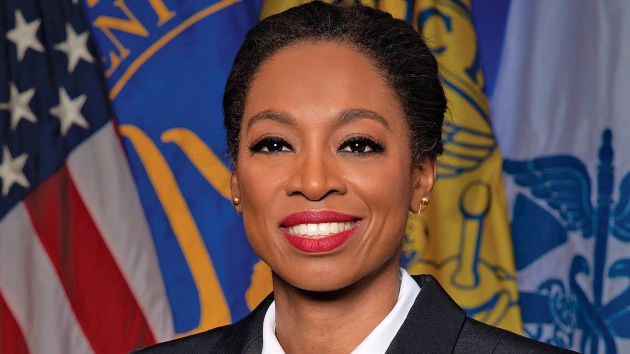
(WASHINGTON) — A confirmation hearing began on Wednesday for Dr. Erica Schwartz to be the next director of the Centers for Disease Control and Prevention (CDC).
Schwartz, a formal deputy surgeon general, was nominated by President Donald Trump in April. Trump made the announcement in a post on Truth Social, describing Schwartz as “incredibly talented.”
Schwartz is the fourth person named or nominated as head of the CDC since last summer. If confirmed by the Senate, Schwartz will replace Dr. Jay Bhattacharya, director of the National Institutes of Health, who took over as acting CDC director in February.
Schwartz earned a medical degree from Brown University and served in the U.S. Navy until 2005.
She served in the U.S. Public Health Service Commissioned Corps, as the Coast Guard Chief Medical Officer and as Deputy Surgeon General from 2019 to early 2021, during the first Trump administration.
“I was very pleased to see Dr. Schwartz nominated to be the next director of the CDC,” Dr. Richard Besser, former acting director of the CDC during the Obama administration, told ABC News. “What struck me is how refreshing it felt to see someone nominated for this job who actually has deep experience in public health and has the credentials necessary to lead a complex public health organization.”
Besser expressed concern about whether Schwartz, if confirmed, will have the independence from Health and Human Services Secretary Robert F. Kennedy Jr. to make public health recommendations, referencing a previous CDC director: Susan Monarez.
Monarez was confirmed as CDC director in July 2025, but she held the post for less than a month. Monarez was fired by Kennedy for reportedly not rubber-stamping the health secretary’s vaccine agenda or firing high-ranking CDC leaders whom he opposed.
The turmoil led to both Kennedy and Monarez appearing in front of Senate committees to address the ousting.
At a Senate hearing, Kennedy denied telling Monarez to accept vaccine recommendations without scientific evidence and claimed she was fired in part because she told him she was untrustworthy.
Besser said he expects that Schwartz will be asked by members of the Senate Committee on Health, Education, Labor and Pensions (HELP) about her perspectives on vaccinations, the Ebola outbreak in the Democratic Republic of the Congo and the rise of measles in the U.S.
“Those are some of the critical areas I think she’ll be asked about. There are so many other areas that are of concern to those who have relied on the CDC to prevent illness and promote health,” he said.
Sean Kaufman is also appearing before the Senate HELP Committee for his confirmation hearing on Wednesday. Kaufman was nominated to lead the Administration for Strategic Preparedness and Response, which was recently absorbed under CDC as part of an HHS reorganization in 2025.
Kaufman has claimed without evidence that the COVID-19 vaccine caused “excessive death and injury … in the United States and globally.” Health officials have said COVID-19 vaccines are safe and effective following clinical trials that involved tens of thousands of people and have since helped save millions of lives.
“What concerns me about Mr. Kaufman is that he has expressed very strong anti-vaccine views, and the ASPR is responsible for the strategic national stockpile,” Besser said. “So, I hope that the committee asks him questions to fully understand the approach that he would take in that role.”
Copyright © 2026, ABC Audio. All rights reserved.