
Dozens of Ukrainian drones target Moscow, mayor says, as Zelenskyy vows more strikes

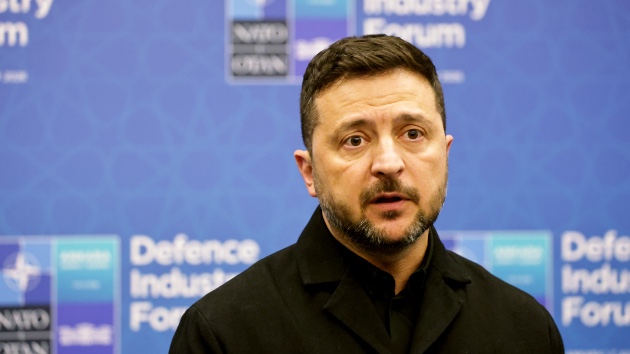
: President of Ukraine, Volodymyr Zelenskyy, during the NATO Summit at the ATO Congresium on July 7, 2026 in Ankara, Turkey. (Photo by Serdar Ozsoy/Getty Images)

(LONDON) — Ukraine launched more than 400 drones into Russia overnight in its latest wave of long-range strikes, according to authorities in Moscow, and as Ukrainian President Volodymyr Zelenskyy vowed to expand such attacks as a means to pressure Russian President Vladimir Putin to end Moscow’s full-scale invasion of its neighbor.

Russia’s Defense Ministry said its forces downed at least 452 Ukrainian drones overnight. The craft, the ministry said on Telegram, were intercepted over 16 Russian regions — including Moscow — plus over Russian-occupied Crimea, as well as over both the Azov and Black seas.

At least 43 drones were downed while flying toward Moscow, the city’s Mayor Sergey Sobyanin said in a series of posts to Telegram.

Russia’s federal air transport agency, Rosaviatsiya, said in posts to Telegram that temporary flight restrictions were introduced at airports in Sochi, Krasnodar, Kaluga, Saratov, Penza, Nizhny Novgorod, Yaroslavl and Cheboksary.

All four of Moscow’s international airports — Vnukovo, Sheremetyevo, Domodedovo and Zhukovsky — were also put under flight restrictions during the overnight attacks.

Zelenskyy said in posts to social media that Kyiv’s long-range strike campaign into Russia — the scale and intensity of which has been steadily increasing during the course of Moscow’s full-scale invasion of its neighbor — would evolve further.

“When our deep strikes were not reaching Moscow and St. Petersburg, Putin did not think much about it. He understood that the war was far from the Kremlin. Of course, once he feels what is happening in Moscow, he will begin to understand what is happening in the Kursk, Belgorod, and Bryansk regions. He’ll begin to grasp the reality of the situation,” Zelenskyy said, referring to Russian border regions which regularly come under Ukrainian attack.

“When not one hundred drones but a thousand start reaching Moscow, and when he feels it and sees it, he will be advised to move somewhere beyond the Urals. That will be a moment that opens a new chapter on the path toward ending the war. The farther Putin is from Moscow, the closer the end of the war and peace will be,” Zelenskyy added.

The Ukrainian leader also suggested that Kyiv’s expanding drone attacks would unsettle Russian elites, further undermining Putin’s Kremlin.

“He fears for his life,” Zelenskyy said of the Russian leader. “And then there are the elites. Where do the Russian elites live? Moscow and St. Petersburg — the two major cities. Those places will be reached, because that is where they make the decisions to kill us.”

“That is why deep strikes have had, and continue to have, a major impact. We must keep working on this,” Zelenskyy wrote.

Russia continued its own long-range strike campaign into Ukraine on Monday night into Tuesday. Ukraine’s air force said Russia launched 123 drones into the country in its latest wave, of which 108 drones were shot down or suppressed. Twelve drones impacted across 10 locations, the air force said.

Those attacks followed a series of missile and drone strikes on Ukraine on Sunday night and early on Monday morning, in which at least 22 people were killed in the capital Kyiv and in the surrounding region, according to Ukrainian officials.

Copyright © 2026, ABC Audio. All rights reserved.

Netanyahu calculates upsetting Trump is his least-bad option

(CNN) — On tricky issues, Netanyahu’s preference is to kick the can down the road. If he must take a position, he likes to include a twist of ambiguity, some wiggle room, just in case things get hairy later. Not this time, though, on the subject of US President Donald Trump’s roadmap for progressing the Gaza ceasefire agreement.“I wish to be precise: Israel does not accept the 15-point document,” Netanyahu said during opening remarks at Sunday’s weekly Israeli Cabinet meeting.In fact, he went on to say it twice.“I have heard people saying: ‘You didn’t say it.’ So here I am saying it again: Israel does not accept the 15-point document.”Clunk.Potentially a risky move because it could draw the ire of Trump.The US president – more desperate than ever for a win, as his Iran folly looks increasingly like handing him an L – reinvested in Gaza 10 days ago, declaring that his Board of Peace had reached a “historic agreement” with Hamas for its complete disarmament. The board’s top envoy, Nickolay Mladenov, went on to explain carefully on X that decommissioning would need to take place “in lockstep” with Israeli troop withdrawal, suggesting a phased process by which the Israel Defense Forces (IDF) would pull back in stages from positions inside Gaza, as Hamas turned in its arms.Any lingering hope that Netanyahu could be convinced to take part in such an endeavor now looks for the birds.“The IDF will not carry out any withdrawal until Hamas is disarmed. And when I say the disarming of Hamas, it means heavy weaponry, lighter weaponry, all weaponry. And we are talking about genuine disarmament, not fictitious disarmament,” the Israeli leader said Sunday.As of Sunday afternoon, Trump was still keeping his own counsel, beyond a Truth Social post quoting former US Secretary of State Hillary Clinton saying she supported his Gaza plan. Mladenov meanwhile went on Israel’s Channel 12 Sunday evening, appearing to suggest that some sort of phased process might still be the plan, but also seeming to make clear Hamas would need to make the first move.“Nobody is required to do anything, least of all Israel, before we actually have verified steps on the ground. If there is verified decommissioning of weapons, that they are taken away from the factions and stored and ultimately rendered unusable, Israel then withdraws from Gaza,” Mladenov said.Speaking to votersOf course, there are skeptics everywhere in this arena, not least concerning the two main protagonists. Both Israel and Hamas have a shared interest in making sure the other side gets the blame for any failure.So, Hamas’s response to Netanyahu’s remarks was quite sober and measured. It said it remained committed to the roadmap, adding that it expected the Board of Peace to “exert pressure” on Netanyahu to abide by it.In truth, there are plenty who doubt Hamas ever intends to give up all its weapons, which serve as the plainest manifestation of its leadership position in the Palestinian resistance and act as a guarantee of its own survival in the face of any internal instability inside Gaza. The group has made plenty of enemies during its almost 20 years in charge of the enclave.But regardless of any lack of confidence in Hamas’ true intentions, in Mladenov’s faith in the ability to verify weapons decommissioning, or indeed Netanyahu’s own willingness to order any troop withdrawals, why poke Trump so publicly in the eye? Surely, Netanyahu, the master strategist, as his many acolytes regard him, could have done it with a bit more finesse?The reason – unsurprisingly perhaps – is Israel’s general election. It is less than 12 weeks away, and the polls suggest he remains in trouble. It was time – unequivocally – to speak to the voters.All Israeli prime ministers must build a governing coalition made up of several parties. Netanyahu, as others have remarked, likes to build his next coalition ahead of the election rather than after it.When the counting is over, he will need his far-right allies to join him if he has any chance of remaining in charge, so he was stung by their very public criticism of the roadmap, as well as calls to reverse a previous Israeli Cabinet decision to approve the deployment of an International Stabilization Force for Gaza, which was meant to oversee security in a small pilot project in the territory. Netanyahu had quietly approved reconstruction work could begin in the pilot area, Army radio reported Sunday, which just looked like further weakness.And yet, it would be a mistake to see this only as pandering to the far-right. The vast majority of Israeli voters, while still favorable toward Trump, believe the US president is profoundly mistaken if he believes Israel should have its freedom to do what it likes in Gaza curtailed in any way.None of Netanyahu’s main challengers, for instance, is likely to pick up Mladenov’s attempt to appeal to Israel’s self-interest during his Sunday TV interview, when he said that only full implementation of the Board of Peace’s plan could guarantee there would never be another mass attack like the one in 2023 on Israeli communities living next to Gaza.“If we end up with arguments about this and that, and delaying tactics, I can assure you that the only alternative then is another process of rearming of Hamas and increasing the risk of another October 7th,” the senior envoy said.Truly, it would be a surprise if Gadi Eisenkott, Naftali Bennett, or many other would-be Israeli prime ministers believed there were many votes on that platform.A US Board of Peace official meanwhile sought to play up Israel’s military restraint in recent days in Gaza, as well as a change in targeting policy.“We are seeing co-operation behind the scenes,” the official offered.Cold comfort for Gaza’s two million residents, who remain shut out of the conversation and all but powerless to determine their fate.Eugenia Yosef and Jennifer Hansler contributed to this report.The-CNN-Wire™ & © 2026 Cable News Network, Inc., a Warner Bros. Discovery Company. All rights reserved.
Read Next Story