
▶ Watch Video: DOJ drops case against former Olympian accused of damaging Reflecting Pool
Federal prosecutors on Friday asked a judge to dismiss an indictment charging former U.S. Olympic canoeist David Hearn with ripping up the bottom of the Lincoln Memorial Reflecting Pool, citing new information that the damage was caused by a “botched installation” by a contractor, not vandalism.
The U.S. Attorney’s Office in D.C. had charged Hearn with felony destruction of government property, accusing him of causing more than $1,000 in damage to the sealant that was recently installed at the bottom of the Reflecting Pool. The project to renovate the pool was championed by President Trump.
Attorneys for Hearn — who strongly denied the vandalism allegations — said in a statement the government “owes Mr. Hearn an apology.”
“The Trump administration’s case against Davey Hearn should have never been brought,” attorneys Norm Eisen, Mary Dohrmann and Steve Levin said. “Its dismissal today does not erase the abuse of government power in arresting and charging a patriotic American who did nothing wrong. The government’s approach was ready, fire, aim.”
The U.S. Attorney’s Office declined to comment. CBS News has reached out to the Justice Department, the contractor that installed the sealant and the Department of the Interior, which managed the project.
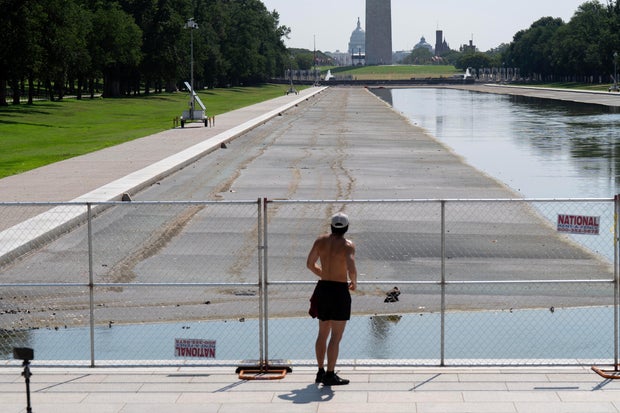
The decision to drop the case against Hearn marks a significant backtrack for federal prosecutors. Shortly after the new “American Flag Blue” sealant was installed at the bottom of the Reflecting Pool at the president’s direction, passersby began to notice chunks of the material were peeling off the bottom of the pool and an algae bloom had turned the water green. Mr. Trump frequently insisted the peeling was caused by vandals, not problems with the more than $10 million project.
“Who would do such a thing?” the president wrote in a Truth Social post on June 20 that also mentioned several arrests.
Hearn, a 67-year-old from Bethesda, Maryland, said he was arrested and held for several hours.
U.S. Attorney for D.C. Jeanine Pirro later unveiled an indictment against Hearn, accusing him of damaging “a national treasure.” Pirro accused Hearn of “forcefully and violently pulling up and removing the bottom liner with both hands,” and was told to stop by a National Park Service employee, drawing an angry response from Hearn.
Hearn denied any wrongdoing. Shortly after his arrest, he told The Associated Press he touched a chunk of pool liner that was still attached, but let go after a worker told him to stop.
“I’m a curious citizen,” Hearn said at the time.
In Friday’s court filing, prosecutors conceded the damage was actually “the result of flawed installation by the contractor, Atlantic Industrial Coatings (“AIC”), and the rush to complete the project prior to events associated with the America 250 celebration in the weeks surrounding Independence Day 2026.”
Jose Luis Magana/AP
Prosecutors said they did not become aware of those issues until two weeks ago, when they visited the site and “immediately noted extensive damage throughout the now-drained pool,” leading them to request more information from the Department of the Interior. Before then, they said, the department hadn’t shared information indicating the damage was “caused by anything other than the actions of the defendant and other vandals who damaged the pool’s lining.”
Citing internal documents provided by the Department of the Interior, the court filing describes a frenetic process to install the sealant, with frequent setbacks due to poor weather and reports of damage that emerged while the material was still being applied.
One particularly tricky part of the process was the installation of sealant around the “expansion joints,” or gaps in the pool’s concrete bed to allow it to shift, according to Friday’s court filing. Prosecutors said the peeling that was referenced in Hearn’s case was caused by sealant that was sprayed around those joints.
A National Park Service employee noticed the sealant was peeling and sent an email to colleagues just days after the pool was refilled, more than a week before Hearn was arrested and on the same day as fencing was removed.
The pool was drained for repairs earlier this month, which Mr. Trump said was necessary “to fix the scars and damage that was done by the Vandals.” Hearn’s lawyers argued that move effectively spoiled the evidence that is being used to prosecute Hearn, leading a judge to warn that the government was “operating at its own peril,” according to The Washington Post.
Mr. Trump took a personal interest in overhauling the Reflecting Pool, which was first built in the 1920s and has long struggled with leaks, faulty filtration systems and perennial algae blooms that prior renovation projects failed to fix. The president told reporters in April he was disturbed by the pool’s “terrible” condition.
The government awarded no-bid contracts to a pair of companies: Atlantic Industrial Coatings, which was responsible for applying a sealant in the “American Flag Blue” color selected by Mr. Trump, and Green Water Solutions, a company owned by a Trump donor that makes water filtration systems.
It’s one of several renovation projects in and around Washington, D.C., that have drawn Mr. Trump’s interest. The president has also sought to replace the East Wing of the White House with a ballroom, build a gigantic triumphal arch across the Potomac River from the Lincoln Memorial, overhaul the Kennedy Center and renovate Dulles International Airport.