
▶ Watch Video: Installation failures caused Reflecting Pool damage, Washington Post analysis finds
Congressional Democrats held a shadow hearing Tuesday to heap scorn on President Trump’s construction projects around Washington. Republicans did not participate.
Lawmakers hammered the president for bulldozing norms in pursuit of his construction goals and imposing his likeness on buildings, coins and passports. They focused their ire on what one congressman called the president’s “vanity projects,” like the East Wing renovation and triumphal arch.
“We are experiencing unprecedented corruption in plain sight,” said witness Norm Eisen, a former ethics lawyer for the Obama White House who now represents a man accused of damaging the Reflecting Pool.
“The biggest vandal in Washington, D.C., is the president of the United States,” Rep. Robert Garcia of California added.
The Trump administration has relied on no-bid contracts in order to expedite construction for certain projects like the White House ballroom and the recent renovation of the Reflecting Pool (which has been drained and is now undergoing repairs). One contract went to a water filtration company owned by a political donor and neighbor of Mr. Trump.
“Government contracts are juicy targets for thieves,” said Jon Golinger, a lawyer for left-leaning advocacy group Public Citizen. So far, no court has found that the administration has violated government contracting laws.
The hearing, led by Garcia and Connecticut Sen. Richard Blumenthal, felt rally-like at times with a supportive gallery applauding statements from witnesses and members of Congress. D.C. Delegate Eleanor Holmes Norton received a standing ovation at one point.
“Ordinarily we would have a presiding officer sternly gaveling down the applause, but actually there’s something very refreshing, inspiring about your approval,” Blumenthal remarked.
Republicans hold majorities in both chambers, and without their participation, the hearing was not part of official congressional business. Democratic lawmakers sat at temporary tables on the floor of a Senate hearing room instead of the raised dais typically used for official proceedings.
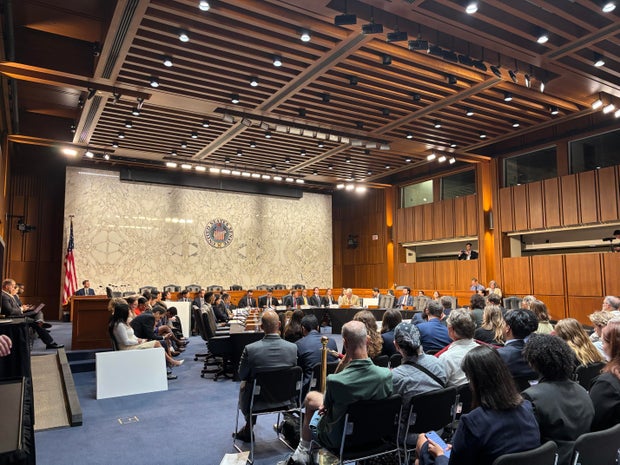
CBS News / Arden Farhi
The White House did not respond to a request for comment.
Lawmakers also highlighted potential conflicts of interest between donors to the president’s privately financed projects and the administration’s official actions.
“It’s one man’s vanity over the priorities of the American people,” said Rep. Raja Krishnamoorthi of Illinois.
Musician Ben Folds, who until early 2025 held an advisory role with the National Symphony Orchestra, testified before the panel. He said the Kennedy Center was in a “golden age” before Mr. Trump became chairman of its board.
Artists canceled shows, the president briefly added his name to the building, and the board announced a plan to close the famed performing arts center for two years for renovations.
“When you politicize art, you’ve got propaganda,” Folds said.
Democrats have multiple ongoing investigations into the financing and contracts tied to the White House ballroom and other Trump-led projects. They lack the ability to compel the administration to disclose details.
“We will use that subpoena power if we are fortunate enough to have it next year,” said Blumenthal.