
Cyclosporiasis cases in Michigan surpass 3,000 as health officials say lettuce or salad greens could be source

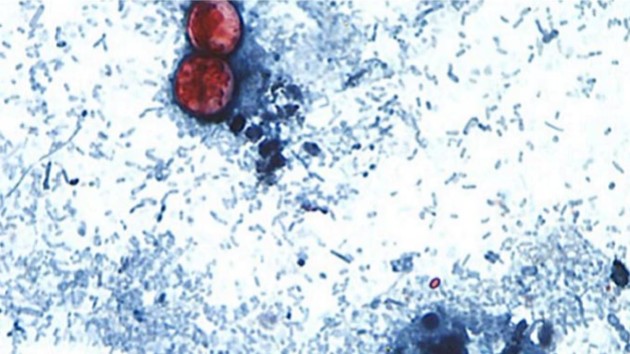
Cyclospora cayetanensis is a unicellular parasite that causes an intestinal infection called cyclosporiasis. (CDC)

(NEW YORK) — Reported cases of cyclosporiasis, an intestinal illness caused by a parasite, have surpassed 3,000 in Michigan, the state’s health department said on Tuesday.

Cases jumped more than 600 since Monday. There have been a total of 3,309 cases since June 22, according to the Michigan Department of Health and Human Services (MDHHS). At least 44 people have been hospitalized. Michigan typically sees about 50 cases per year.

Most cases have been reported in southeastern Michigan, including Wayne County, where Detroit is located, according to MDHHS.

On Monday, Michigan health officials said lettuce or salad greens could be the source of illnesses in the state.

MDHHS data shows that most cases have been among adults, with 30 to 39 year olds making up the highest share.

The outbreak was first identified on June 29, when the Monroe County Health Department announced it was investigating a cluster of cases.

Michigan health officials previously told ABC News the outbreak could be linked to food contamination. So far no produce, grower or supplier have been identified.

Earlier this month, MDHHS sent out recommendations to restaurants and other commercial kitchens in southeast Michigan to reduce risks of exposure.

The parasite usually spreads through food or water contaminated with feces, according to the Centers for Disease Control and Prevention. It does not typically spread person-to-person. 

Foodborne outbreaks of cyclosporiasis in the past have been linked to various types of imported fresh produce, such as raspberries, basil, snow peas, mesclun lettuce and cilantro, according to the CDC.

At least 31 other states have reported cases of cyclosporiasis, according to an ABC News tally, analyzing CDC data and state health department data.

As of Friday, New York has reported the second-highest number of cases at 470 cases since May 1, followed by Ohio at 364, state health officials told ABC News. Meanwhile, Illinois and Florida are each reporting more than 100 cases as of Friday, according to their respective health departments.

The CDC said it has confirmed 843 domestic cases from May 1 to July 9. The agency wrote on its website that it is “aware that states are likely to report higher case counts of cyclosporiasis than reflected in CDC data and is working closely with states to update numbers as additional cases are confirmed.”

The agency said it expects a six-week reporting lag between illness onset and case reporting to the CDC as it receives and reviews the data. 

Cyclosporiasis is treated with the oral antibiotic trimethoprim-sulfamethoxazole (TMP-SMX), commonly sold as Bactrim, Septra and Cotrim, and taken for 10 days, according to the CDC.

The agency says people can prevent infection by thoroughly washing produce, cutting away bruised or damaged parts of fruits and vegetables and refrigerating pre-prepared or pre-cut produce.

Additionally, the CDC recommends washing hands thoroughly with soap and water before handling or preparing raw fruits and vegetables.

ABC News’ Youri Benadjaoud contributed to this report.

Copyright © 2026, ABC Audio. All rights reserved.

The epic hiking trail that explores one of Europe’s last great wildernesses

Vusanje, Montenegro (CNN) — There are no obvious checkpoints or border crossings to disrupt the beauty of the Peaks of the Balkans trail, and yet it is not uncommon to start a long day of physical exertion with a hearty breakfast in one country, then refuel with a much-appreciated home-cooked dinner in another.The 120-mile loop meanders in and out of Montenegro, Albania and Kosovo — sometimes at several points during a single day’s hiking — over a range known as the Accursed Mountains.While that name may have initially dissuaded all but serious adventurers — mostly from northern Europe — the ever-changing trail is now starting to pull in visitors from all over the world to explore its towering limestone peaks, glacial lakes, rolling wildflower meadows and steamy cloud forests. They offer a peace and quiet that is rarely accessible on the continent’s southern reaches.The mountains actually take their name from their seasonally inhospitable surroundings. It’s equally applicable for the Cold War-era isolation that once rendered stretches of them off-limits.Today, they’re home to what has arguably become known as Europe’s last great wilderness — a landscape that has elevated the Peaks of the Balkans close to the top of the list of the world’s greatest transnational hiking trails.Technical climbing skills are not necessary, but this is no stroll in the park. The rugged allure of these mountains demands a sturdy pair of boots, a carefully filled backpack and a good level of fitness.Ascents are steep and the full trail has a cumulative altitude gain of nearly 35,000 feet, equivalent to well over the height of Everest. Some pre-trip training is advisable, as is a pair of walking poles.That quickly becomes apparent in the heat of a summer’s day when the upward sections can seem to stretch endlessly, becoming a slow and sweaty slog. The downs are no picnic either, requiring careful footing and steady balance.Danger zoneThe rewards are worth it though, with the sheer effort matched by the magnificent views at every summit — a chance to catch your breath and marvel at the awesome scale of the natural surroundings in glorious silence.Best of all is the rest, lunch and an icy swim stop at Montenegro’s magnificent Lake Hrid, located well over a mile above sea level, an added bonus. Cloudless blue skies, ancient green woodland and clear blue water you can dive into all combine to create a screensaver-worthy landscape.Many stretches of the Peaks of the Balkans trail — which can be completed in 10 days or broken down into smaller sections — follow traditional trade routes which were sealed off by geopolitics for much of the 20th century.The region was a heavily guarded danger zone during the Cold War, something that remains much in evidence in Albania, where the landscape is scattered with disused concrete bunkers built under the country’s former communist leader, Enver Hoxha. For more than four decades, Albanians were prevented from leaving due to the dictator’s infamously isolationist policies which led to the country being nicknamed the “North Korea of Europe.”Albania, Kosovo and Montenegro were heavily impacted by the collapse of the Soviet bloc, the breakup of Yugoslavia and the subsequent wars of the 1990s and early 21st century. There are few reminders along the way, besides the disused bunkers and the odd ex-military vehicle, which is perhaps just as well; many feel the topics of government, politics and nationalism are best kept out of these peaceful parts.Indeed, the hiking route was originally nicknamed the “peace trail” when it launched in 2006 as part of efforts to change global perceptions of the Balkans.“Most of the world knows about this region because of the conflict and the wars,” says Dušan Dragosavljević, a trail guide whose precise knowledge of the landscape enables him to point where one section of dense forest invisibly crosses into a neighboring country. “So, I think the Peaks of the Balkans trail is a really good way of changing that picture and the whole narrative.”A different worldDepending on one’s budget, engaging a professional guide like Dragosavljević — who leads trips for Serbian-based firm A.C.E. Adventure — can be a wise investment, not only for his knowledge of the poorly signposted route, but for the wealth of his insight into the region.He first walked the trail end to end in 2017. In the early days, he says, it was popular only with mountain guides, nature lovers and serious hikers. It began to attract a lot more widespread attention after Covid restrictions began to subside, but in many ways it’s still an undiscovered corner of Europe.“There is a lot of new territory to be explored, especially in Albania and Kosovo,” Dragosavljević says. “The Balkans has a lot to offer, not just in terms of nature and beauty, but in terms of hospitality, in terms of culture.“I’m not sure if people know, for example, that whenever you’re in the Balkans without any kind of accommodation or you’re hungry without food, people will help you out — Balkan people are very hospitable.”He says the trail has transformed the lives of many in the region. Farmers who once eked out a living by tending crops and livestock on its harsh terrain are now augmenting their pastoral incomes through tourism.Adis Balić — who runs the Grlja restaurant and guest house in Vusanje, a Montenegrin village close to the Albanian border — is among them.“Everything about our life here has changed since the start of the trail,” he says, sipping a thick Turkish coffee while a stray puppy pesters his customers at nearby picnic benches.Balić, who also runs a second establishment in the nearby town of Gusinje, says families like his were in a “pretty weak” economic situation before the trail officially opened, when trekkers were a rare sight.“During the day you would have maybe two or three trekkers with backpacks and most of the people from the area would look at them strangely, like ‘what are they doing?’ It was a completely different picture back then.”His restaurant and guesthouse, which opened seven years ago, is named after the dramatic waterfall that mesmerizes a crowd of locals and tourists a few steps away. It offers beds for 15 across four rooms, though most visitors who pass through sleep under canvas.“When we started the business, we had about 400 campers a year and this season we have more than 3,400 campers,” he says. “It’s been really good.”The trail still remains largely untroubled by mass tourism. Peak season runs from June to September. May and October are also options, but come with the possibility of snow and less choice when it comes to eating and sleeping.Grlja offers a menu of traditional food, mostly made from ingredients grown and produced by Balić’s family. There is an abundance of meat dishes, grilled to perfection and served with salads, homemade cheeses and dips, including ajvar, a rich blend of slow-roasted peppers and eggplant that is a staple on dining tables along the trail.“My father picks the vegetables in the morning and by the evening we have them on the table,” he says.Back in the early days, most visitors to the trail hailed from Germany, Belgium and the Netherlands. Today it appeals not only to trekkers, but also expatriate Montenegrins who return here from the United States, Western Europe and elsewhere for the summer months.“There are no nationalities that don’t come,” says Balić. “You have Australians, New Zealanders… people are basically coming from all over the world.“What fascinates them the most are the mountains — the views and how they’ve been preserved. What they’re most grateful for are the traditional meals and hospitality.”Balić personally oversees the small kitchen tucked away beneath his guest rooms, ensuring everything served is of a high standard.“I don’t see the visitors as tourists who will just come here once and never come again,” he says. “My message is: you’re not just cash, you’re long-term clients, and I’ll make sure everyone who comes here is fed well and leaves with a good feeling.”Such hospitality is evident throughout the trail, where mountain people have opened a window onto their long-held traditional lifestyles as their farm animals meander around them.Chalkboards offering homemade treats like baklava, raspberry cake and thick yogurt blended with honey produced by their bees — alongside cold cans of soda — are a welcome sight for weary hikers, as is the relative privacy offered by the rudimentary bathroom facilities.‘It’s perfect’In Albania, Kujtim Gocaj runs a cozy guesthouse named after himself in the remote village of Cerem. The 63-year-old police officer has been running the business as a side venture for 14 years but hopes it will become his main focus when he retires from the force in two years.“I started it to have a future,” he says, speaking through his English-speaking son-in-law while serving food and clearing tables.Initially, he operated from one building, before adding a new pine structure with plenty of scenic outside seating for diners in 2019. Today the property caters to up to 36 people in a mixture of dormitories and en suite private rooms.“I grew this from a small thing to how it is now,” he says. “It was hard at first but it’s much better now. People love this place and everyone in the area knows it.”The benefits for Gocaj and his family are not just financial. “I can’t even explain how good it is,” he says. “We learn so much from all the people who come here from all over the world — it’s like an education. It’s perfect.”With its highly unpredictable weather, the Accursed Mountains can still live up to their name. Ferocious storms which can batter the trail and last for hours, scuppering walking schedules and leaving visitors with little option but to shelter in basic trail accommodation, often converted from shepherd huts.Outside the tourist season, it can be much worse.“Winter is catastrophic,” says Balić. “It’s quite usual here to have one meter of snowfall and then everything is closed.”He believes the region could extend its appeal beyond the hiking season with some investment in winter sports. “You just need one ski lift, and people would come with skis and that would be good.”It is a far-off prospect for now but perhaps not impossible given how much the region has begun to draw in visitors from farther afield.The-CNN-Wire™ & © 2026 Cable News Network, Inc., a Warner Bros. Discovery Company. All rights reserved.
Read Next Story