
▶ Watch Video: A Summer Song: Corinne Bailey Rae
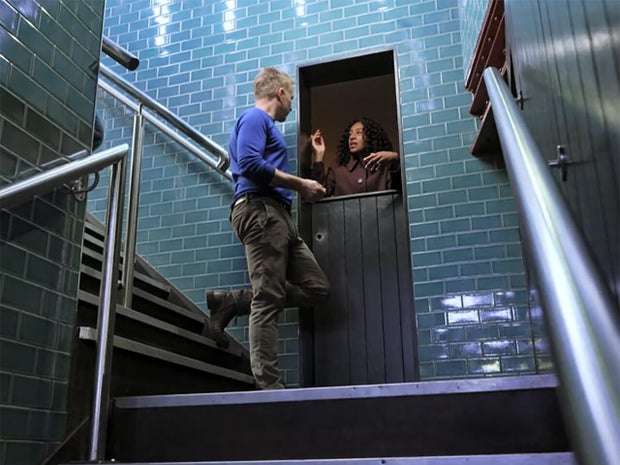
Before winning two Grammys and being nominated for four others, working the coat check was about as close as Corinne Bailey Rae was getting to a stage. She showed us the “little box” she once sat in at the Hi-Fi Club, in Leeds, England: “I mean, I really always wanted to see the bands. So, being here wasn’t great, because you couldn’t see exactly, [though] you could hear it,” she said.
CBS News
And it was here where a record label would later come to hear her in an audition, performing “Like a Star” with a guitarist.
“Like a Star,” her first single, became a hit, as did her second, “Put Your Records On”:
Maybe sometimes we feel afraid, but it’s alright
The more you stay the same,
the more they seem to change
Don’t you think it’s strange?
Girl, put your records on, tell me your favourite song
You go ahead, let your hair down
Sapphire and faded jeans, I hope you get your dreams
Just go ahead, let your hair down
You’re gonna find yourself somewhere, somehow
Its lyrics – music facilitating self-acceptance – have autobiographical notes: “As much as Leeds is a really ethnically-diverse place, you can still feel different as a person who has, you know, a Black parent and a white parent,” Bailey Rae said.
Growing up, she says, she’d sometimes felt “on the margins.” “I really wanted to play the cello, but we didn’t have a car. So, my mum was like, ‘What about the one you can carry?’ So, I ended up playing the violin, and I really enjoyed that. …
“I sort of noticed things like that – like, Oh, we don’t have a car. Oh, we don’t have a telephone. We didn’t have a lot of money, but it wasn’t a sad thing.”
Initially, Bailey Rae said, she felt “sad” about her voice, “because it had all this texture.” But that changed when she heard the voices of Billie Holiday and Kurt Cobain. “It was like, You are welcome in this space. Their songs don’t necessarily have to be, you know, shiny and perfect. And that just made me feel like I could be in music.”
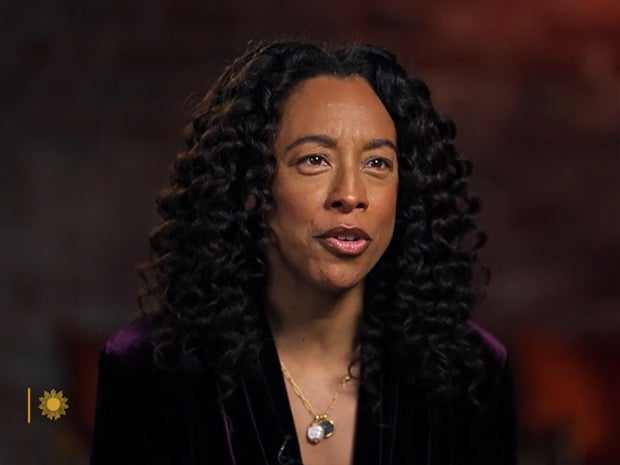
The release of her first album, in 2006, catapulted her to the top of the charts, and into new company. “Stevie Wonder called me,” she said. “Prince came to one of our shows.”
CBS News
But, in 2008, everything changed, when her husband and band member Jason Rae died of an accidental overdose. “It felt at that time to be the sort of end of my life,” she said. “It was just, like, such a huge amount of pain.”
Asked how she dealt with her grief, Bailey Rae replied, “I say a thing that someone said to me in the hospital. She said, ‘Oh, grief is a long journey. We’re all gonna lose people, you know? If we’re lucky to have a long life, we’re just gonna see other people just going, you know, through that door.’ And there’s something really, you know, beautiful about knowing that.
“I think it’s such a complex emotion because it’s sort of, like, the sadness of losing someone, but also the awareness of how beautiful, you know, life is, and how it’s a beautiful thing that everyone you know, you have that much time with them,” she said.
There was nothing from Bailey Rae for about two years until, amid the grief of losing Jason, she released her second album, “The Sea.” It was produced by Steve Brown, who had always just been a professional collaborator. “Actually, [it was] Jason’s mother who first said to me, you know, ‘What do you think of Steve?'”
She was the matchmaker? “She is just a really intuitive woman,” said Bailey Rae. “I felt it was two things: One was, I like this guy. But another thing was sort of like, We as the family kind of give you permission to, you know, move forward with your life, which just was a very beautiful thing of her to do.”
The couple married in 2013, and now have two daughters. “It was like having a second chance,” said Bailey Rae. “So, I do think of my life as having these two – kind of like a before and after.”
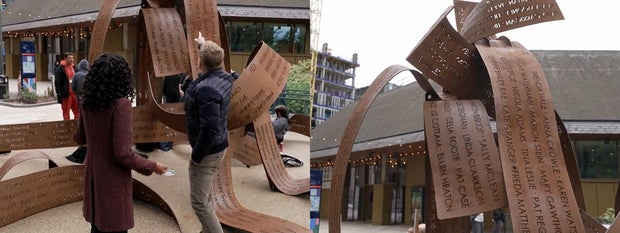
Bailey Rae released two more studio albums to critical acclaim, if not all-out commercial success; and she has been recognized in her hometown, with a sculpture, “Ribbons,” by artist Pippa Hale. “This is a beautiful sculpture that came out a few years ago, and it has more than 300 names of women who are from Leeds who’ve made an impact in culture – some suffragettes, some politicians, some artists.” Including Bailey Rae.
CBS News
Earlier this year, she released a children’s book – the title recalling her chart-topping song. “I wanted to write about how music can heal you, that music can sit with you in any emotion, and music can be your friend,” she said.
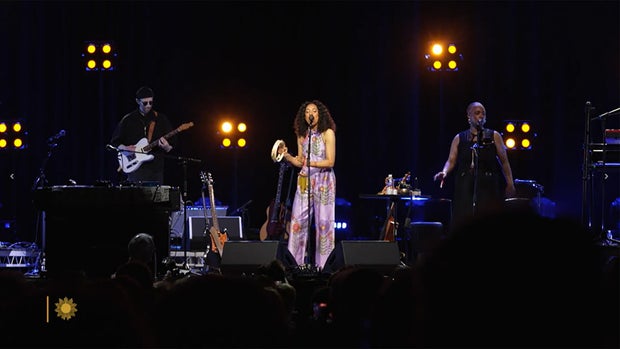
The book is part of a year-long celebration of her first album. There’s also a tour, which she kicked off at the Cheltenham Jazz Festival in England, singing those hits from 20 years ago that first made her famous.
CBS News
Asked if the success of “Put Your Records On” was a weight upon her, Bailey Rae replied, “I think when someone does really well, everyone wants you to kind of win in that particular way again. You know, the music industry is really brutal. They really want you to be commercially successful.”
And she? “I mean, yeah, definitely. But it was funny. With that first record, I wasn’t thinking like, ‘Oh, this is gonna be – ‘ Like, I had no idea that it was gonna be successful in that way. We made it in a basement studio with no windows. So, it wasn’t like I went in with a certain kind of ambition. I just wanted to make the songs work.”
She says rebirth is a big theme for her: “Because there’s a possibility, every single time, of starting again. You know, any age and any space, you can sort of hit reset and do it again and go back into the fire, transform, and be out as a new thing, you know, every single time.”
WEB EXCLUSIVE: Watch an extended interview with Corinne Bailey Rae (Video)
Extended interview: Corinne Bailey Rae
21:14
You can stream the 2006 album “Corinne Bailey Rae” by clicking on the embed below (Free Spotify registration required to hear the tracks in full):
For more info:
- corinnebaileyrae.com | Tour info
- “Put Your Records On” by Corinne Bailey Rae, illustrated by Gillian Eilidh O’Mara (Rocky Pond Books), in Hardcover, eBook and Audio formats, available via Amazon, Barnes & Noble and Bookshop.org
- Thanks to The Hi-Fi Club, Leeds, England; and to The Wardrobe, Leeds, England
Story produced by Robbyn McFadden. Editor: George Pozderec.