
Consumer sentiment improves but stays near all-time low, survey shows

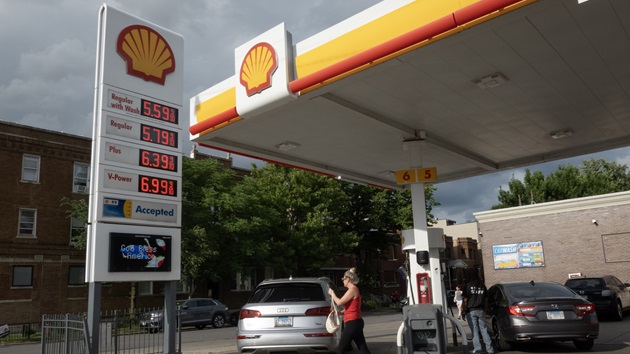
Fuel prices are displayed at a gas station on June 09, 2026 in Chicago, Illinois. (Scott Olson/Getty Images)

(NEW YORK) — Consumer sentiment improved in June for the first time since the outbreak of the Iran war as gasoline prices eased in recent weeks, but shopper attitudes remained near their worst level on record, University of Michigan survey data on Friday showed. The reading exceeded economists’ expectations.

The survey snapped three consecutive months of dampening consumer sentiment, recovering from an all-time low in May, data showed. The University of Michigan has conducted the survey for the past 80 years.

This improvement in sentiment was widespread, seen across age, education and political party, Surveys of Consumers Director Joanne Hsu said in a statement. Overall assessments and expectations of personal finances and business conditions all rose in June, she noted.

The fresh figure comes days after a government report on inflation showed the pace of price increases exceeded 4% for the first time in three years.

Prices rose 4.2% in May compared to a year earlier, increasing 0.5% from the prior month, according to U.S. Bureau of Labor Statistics data.

Consumers expect inflation to move higher over the next year, hitting a pace of 4.8% in June 2027, the University of Michigan survey showed.

The Middle East conflict prompted the Iranian closure of the Strait of Hormuz, a maritime trading route that facilitates the transport of about one-fifth of global oil supply. The standoff triggered one of the largest oil shocks ever recorded, sending gasoline prices higher.

Drivers stung by high gas prices have enjoyed some welcome relief over recent weeks, however, even as the impact of the Iran war continues to choke off oil supply.

The national average price of a gallon of gas stands at $4.10, marking a decline of 40 cents, or 8.8%, over the past month, AAA data showed. Gas prices, however, remain $1.12 higher than where they stood before the Iran war.

Consumer spending, which accounts for about two-thirds of U.S. economic activity, could weaken if shopper remains lackluster.

Spending slowed over the first three months of 2026 compared to the previous three-month period, according to government data issued earlier this year. The economy remained solid at the outset of this year, however, as gross domestic product rose 2% on an annualized basis, the report showed.

Copyright © 2026, ABC Audio. All rights reserved.

Ohio’s GOP governor calls Trump’s plans to deport Haitians a ‘mistake’

▶ Watch Video: Extended interview: Ohio Gov. Mike DeWine on Trump's plan to deport Hatians COLUMBUS, Ohio — Republican Ohio Gov. Mike DeWine told CBS News the Trump administration's plan to ramp up arrests and deportations of Haitian migrants is a "mistake," arguing the move could bruise the state's economy and risk putting Haitians in danger in their home country.More than 300,000 people from Haiti are set this week to lose Temporary Protected Status, a humanitarian immigration program that protects them from deportation and allows them to work, after the Supreme Court upheld the Trump administration's plan to end the policy for Haitians. Immigration and Customs Enforcement has drawn up plans to launch a deportation blitz focused on Haitian migrants as early as this week, CBS News reported Sunday.The operations could focus in part on the thousands of Haitians who live in Ohio, many of whom have settled in the city of Springfield in recent years. During the 2024 campaign, President Trump claimed, without evidence, that Haitian immigrants in the city were eating cats and dogs.In an interview on Monday in Columbus, DeWine said the planned deportation operations would be "a blow to Springfield" and "a blow to the state of Ohio.""These are people who have helped Springfield really come back," DeWine said, pointing to Haitians who have filled jobs and opened businesses in an economically challenged city. "The Haitians who are living there and employed there, they came there to work, and they came there because there were jobs that were not being filled by other people."DeWine also pointed to the dire security situation in Haiti, a deeply impoverished country that has dealt with years of political instability, with gangs controlling large swaths of territory. The country is mired in "virtual chaos," the governor said, with "no semblance of government," leading the U.S. State Department to warn Americans not to travel there.The governor predicted that many Haitians would go to some other country rather than return."Haiti is hell today. So you'd be sending people … back to hell," DeWine said. "Very few of these Haitians will voluntarily go back to Haiti. If they have to leave, they'll go someplace else. They want to work. They want to support their family. They don't want to go back to Haiti."Haiti has been designated under Temporary Protected Status since 2010, when the island nation was devastated by an earthquake. That status has been renewed periodically since then, allowing hundreds of thousands of Haitian migrants to remain in the United States. In 2024, the Biden administration extended the status, pointing to the country's "violence and instability."The Department of Homeland Security moved to terminate TPS for Haitians last year, concluding it was "not in the national interest" and arguing migration from Haiti poses a "risk" to the U.S. DHS also said the "environmental situation in Haiti has improved enough that it is safe for Haitian citizens to return home."Around 334,000 Haitians had temporary protected status as of last year, not including people who also have green cards, according to federal data.The decision was part of a broader effort by the Trump administration to wind down TPS for several countries, like Syria and Venezuela. DHS argues the status — which offers reprieve for people whose home countries are unsafe due to violence or natural disasters — was meant to be temporary, but has turned into a "defacto amnesty program.""What we would say now is it's closing time which means you don't have to go home, but you can't stay here," DHS said in a statement to CBS News over the weekend, encouraging people who are about to lose their protected status to self-deport for $2,600 and a "free flight home."The move to revoke protections for Haitians drew lawsuits, and a judge blocked the move in February, calling it "arbitrary and capricious" and partly "rooted in racial animus." The Trump administration fought the case to the Supreme Court, which ruled in late June that the government could move forward with plans to end Temporary Protected Status for Haiti and Syria. The decision was set to be formalized on Monday.DeWine has pushed back on Mr. Trump's stance toward Haitian migrants in the past. In a 2024 interview with CBS News, he called the president's claims about Haitians eating pets "something that came up on the internet, and the internet can be quite crazy sometimes." He noted that local officials have said there is no evidence to back up the claims.At the time, DeWine said the influx of as many as 15,000 immigrants in and around a city of less than 60,000 residents has caused some challenges, including to the local healthcare system. But he said Haitian migrants have "filled a lot of jobs" and "work very, very hard." 
Read Next Story