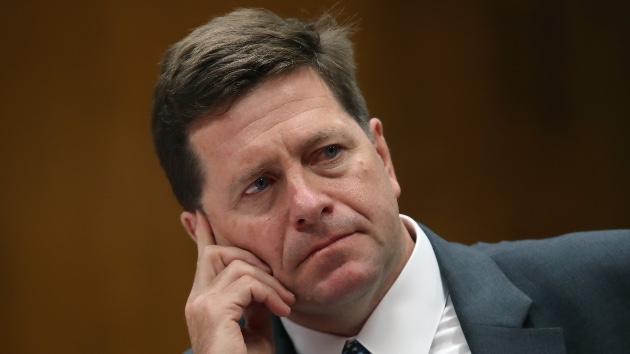
(WASHINGTON) — Jay Clayton, President Donald Trump’s pick to serve as director of national intelligence, is appearing before the Senate Select Committee on Intelligence for his nomination hearing on Wednesday.
The hearing could clear a path for lawmakers to replace the director of the Federal Housing Finance Agency and Trump loyalist Bill Pulte as acting director of national intelligence and could pave the way for an extension of a lapsed surveillance authority.
Clayton’s hearing comes weeks after the president abruptly canceled his previously scheduled confirmation hearing. Lawmakers had urgently scheduled a nomination hearing for Clayton in an effort to block Pulte from temporarily taking on the role, but Trump derailed the effort.
Pulte has been serving as the acting director since June 19.
Trump derails confirmation process
Trump, last month in an early morning social media post, said the confirmation process for Clayton would not continue until his pick to replace Clayton as U.S. Attorney for the Southern District of New York, Jamie McDonald, was confirmed.
“Regarding the approval of our Great Patriot, Jay Clayton, we are cancelling the Senate Hearing RE: DNI today, and will not be going forward until Jamie McDonald is approved to be U.S. Attorney,” Trump wrote. “In the meantime, Bill Pulte will remain as the Acting Director of National Intelligence.”
Pulte, who has no prior national security experience, is best known in the Trump administration for launching probes into several of the president’s perceived political enemies over allegations of mortgage fraud and possible misuse of authority.
Targets of the investigations include Federal Reserve Governor Lisa Cook, New York Attorney General Letitia James, Democratic Sen. Adam Schiff and former Democratic Rep. Eric Swalwell.
All have denied wrongdoing.
Pulte drew bipartisan concern on Capitol Hill after he sought to accelerate his predecessor’s departure from the role. The former DNI, Tulsi Gabbard, announced her intention to resign from the role in May, citing a desire to step away from public service to support her husband following his cancer diagnosis. Gabbard ultimately left the role on June 18, days earlier than planned.
In his short tenure as the acting director of national intelligence, Pulte made good on threats to cut hundreds of jobs at the Office of the Director of National Intelligence by mass firing employees in June.
It’s unclear how many jobs had been affected, but sources told ABC News last month that the National Counterterrorism Center was expected to be hit hard. Trump, for his part, had made clear he had instructed Pulte to slash jobs at the agency.
Pulte’s appointment also stalled efforts to renew Section 702 of the Foreign Intelligence Surveillance Act, which allows the federal government to collect communications of foreigners abroad without a warrant. The program’s legal authorization lapsed in June.
Scrutiny from skeptical lawmakers
It’s not clear how long the Intelligence Committee will take to consider Clayton’s nomination, but he could potentially be confirmed by the Senate by the end of next week if there is unanimous agreement to speed up his consideration.
Clayton may face questions from senators on the Trump administration’s decision to issue subpoenas on Friday to several journalists who work for The New York Times after the news outlet reported last week on security concerns involving Trump’s new Qatari-donated Air Force One.
Clayton, as U.S. attorney in Manhattan, issued the subpoenas. In a statement on Saturday, a Justice Department spokeswoman said that “reporters are not the targets, those leaking classified information are.”
Clayton, prior to his role as the U.S. attorney, was also the former chairman of the U.S. Securities and Exchange Commission.
Apart from the national security cases he oversaw while serving as U.S. attorney, Clayton also lacks experience in intelligence-gathering and national security matters.
Clayton spent the bulk of his career as a corporate attorney, and prior to his appointment as U.S. attorney last year, lacked meaningful experience in criminal matters.
He has spent the last year overseeing one of the country’s highest profile federal prosecutor’s offices — focusing on drugs, gangs, immigration and fraud cases. Clayton also oversaw the unsealing of grand jury materials related to convicted sex offender Jeffrey Epstein, prompting complaints from victims about the disclosure of their sensitive personal information.
Clayton was never confirmed by the Senate as U.S. attorney, though his nomination was approved by the federal judges in the district and was seen then by many as a steady hand to lead the high-profile office.
ABC News’ Aaron Katersky and Peter Charalambous contributed to this report.
Copyright © 2026, ABC Audio. All rights reserved.