CBS News poll finds more oppose than favor data centers in their area

▶ Watch Video: Some U.S. states stand against AI data centers

Many Americans are skeptical about having a data center in their area, fueled largely by what they perceive as negative impacts on the environment and resources.

The construction of data centers in the U.S. has accelerated in recent years, but most Americans feel they don’t know a lot about them yet. 

People’s own lack of familiarity with data centers contributes to their unease about having one in their local area. While people tend not to favor them no matter how much they feel they know, the less they feel they know about data centers, the less likely they are to favor one.

Overall, by more than two to one, more Americans oppose than favor having a new data center built in their area. Many aren’t sure.
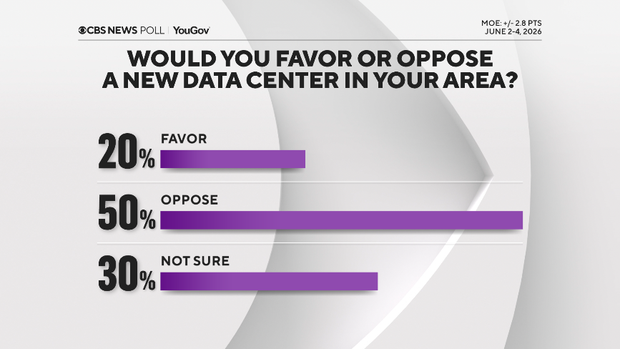
f-o-data-centers.png

The relatively few — 16% — who feel they know “a lot” see some potential upsides of having one locally, but more of them still oppose one than support one in their local area, anyway. 

(Those who report knowing “nothing” about data centers are mostly unsure about having one in their area.)

The country is generally divided on whether more data centers are necessary for the U.S. to remain competitive in the fields of technology and AI. Those who would favor a new data center in their area overwhelmingly think they are necessary for the U.S. to compete with other countries. 

More Republicans than Democrats think data centers are needed for competitiveness, but many of them, like Democrats, aren’t sold on having one in the area where they live. 
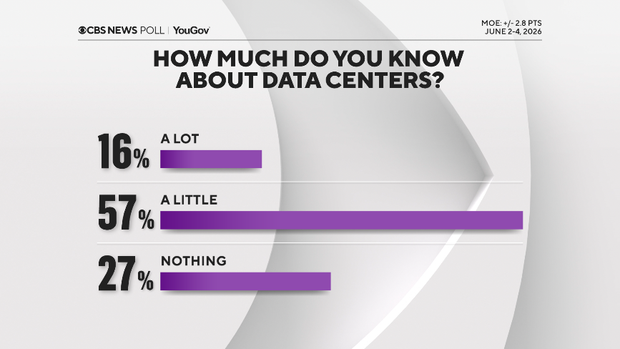
know-about-data-ctrs.png

Overall, majorities believe data centers are mostly bad for the environment, for resources like water and electricity, and for people’s energy or utility costs in the areas where they are built. 

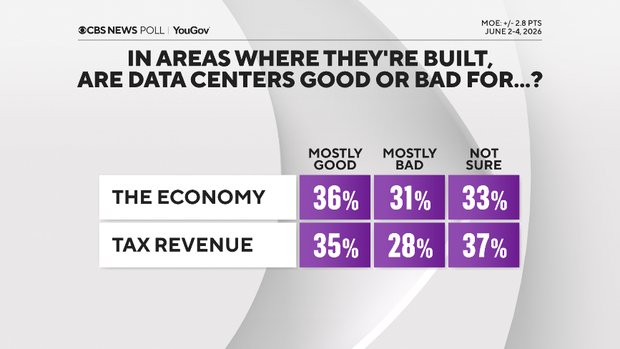
On a more positive note, slightly more Americans think the building of data centers is good, rather than bad, for both the local economy and for tax revenue. People who anticipate these benefits are more inclined to favor than oppose a data center in their area. 

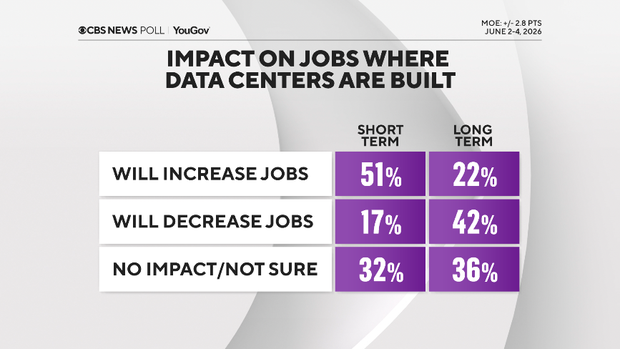
And on jobs specifically, half of Americans see data centers as boosting the number of jobs where they are built in the short term, but far fewer think that will be true in the long term.

On these questions about potential local impacts, sizable percentages say they are “not sure” — underscoring that these matters surrounding data centers are not yet familiar to many Americans.
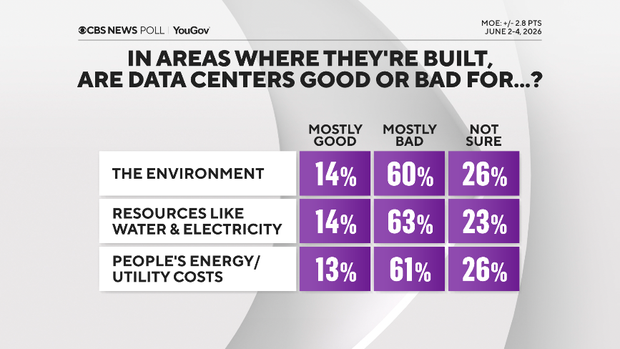
data-ctrns-good-bad-enviro.png
data-ctrns-good-bad-econ.png
data-cntrs-on-jobs.png

This CBS News/YouGov survey was conducted with a nationally representative sample of 2,023 U.S. adults interviewed between June 2-4, 2026. The sample was weighted to be representative of adults nationwide according to gender, age, race, and education, based on the U.S. Census American Community Survey and Current Population Survey, as well as 2024 presidential vote. The margin of error is ±2.8 points.


Toplines:

Inundación repentina arrasa en Nepal: hay al menos ocho muertos y cientos de desaparecidos

Una enorme inundación repentina arrasó varias aldeas en Nepal, donde la policía informó que ocho personas han muerto, aunque se teme que la cifra de víctimas aumente.Hay helicópteros rastreando la zona, pero el nivel del agua es demasiado alto en algunas partes para que puedan aterrizar. Aún no está clara la causa de la inundación.Cerca de 400 viajeros, entre ellos cientos de ciudadanos extranjeros, han sido reportados como desaparecidos tras la enorme inundación repentina ocurrida en Nepal, informó el miércoles la junta de turismo del país basándose en una evaluación inicial.“Un registro preliminar, recopilado a partir de la información de empresas de turismo y viajes, ha identificado a 384 viajeros —incluidos 291 extranjeros y 93 nepalíes— reportados como desaparecidos en las zonas afectadas”, publicó la junta de turismo de Nepal en un comunicado a través de X.Entre las nacionalidades de las personas desaparecidas figuran viajeros procedentes de India, Australia, los Países Bajos, Sudáfrica, el Reino Unido y Malasia.La información aún “se está verificando y contrastando en coordinación con agencias de viajes, guías, autoridades locales y organismos de seguridad”, señaló la junta de turismo.Los helicópteros de rescate no pueden aterrizar en las zonas afectadas de Syapru Besi y Timure, en el norte de Nepal, hasta que bajen las aguas, declaró el portavoz del ejército del país, Raja Ram Basnet, según informó Reuters.Por otra parte, el ejército de Nepal publicó un video en X en el que se ve a un helicóptero sobrevolando una zona elevada y fangosa junto a las aguas turbulentas de la crecida, lo que indica que se están llevando a cabo labores de búsqueda y rescate en la montañosa región de Rasuwa, en el norte del país. Otras imágenes muestran a efectivos trasladando a heridos en camillas hacia un helicóptero y un vehículo todoterreno.El primer ministro de Nepal, Balendra Shah, informó que la policía y el ejército se están sumando a los equipos de rescate, según Reuters.“Se han dado instrucciones… para trasladar a las personas que viven en las zonas bajas a lugares más seguros”, afirmó. “Se aconseja a quienes se encuentran cerca del río que extremen las precauciones y permanezcan alerta”.El Tíbet también se ha visto afectado.Los medios estatales chinos han advertido sobre la posibilidad de un gran número de víctimas.Un deslizamiento de tierra también golpeó el puerto chino de Gyirong, donde el líder chino Xi Jinping instó a realizar esfuerzos de búsqueda exhaustivos.The-CNN-Wire™ & © 2026 Cable News Network, Inc., a Warner Bros. Discovery Company. All rights reserved.
Read Next Story