
Cases of parasitic infection growing in 2 states: Health officials

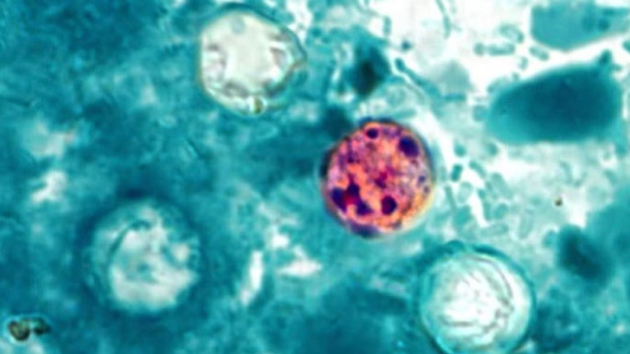
Cyclospora cayetanensis is a unicellular parasite that causes an intestinal infection called cyclosporiasis. (CDC)

(DETROIT) — Cases of a parasitic infection are continuing to rise in at least two states, local health officials said.

As of July 6, nearly 700 cases of cyclosporiasis, an intestinal infection, were confirmed, an official from the Michigan Department of Health and Human Services (MDHHS) told ABC News on Monday. This is an increase from the roughly 300 cases reported on Thursday.

The 678 cases have predominantly been confirmed the southeast region of Michigan including Wayne County, where Detroit is located.

Typically, the state has 50 cases per year, meaning cases are currently about 13.5 times higher than on average.

Dr. Natasha Bagdasarian, an infectious disease physician, epidemiologist and the chief medical executive for the state of Michigan, described the 678 figure as a “moving target,” meaning that cases are likely to continue rising.

“There is a significant lag time between exposure to contaminated produce or contaminated materials and development of symptoms,” she told ABC News. “So it can take a week, sometimes even two weeks between exposure and development of symptoms.”

She added that there may be some infected individuals who are only now reading news reports and getting tested, so there may be even more delayed diagnoses.

Additionally, in Ohio, there were 177 cases of cyclosporiasis as of July 2, Ken Gordon, press secretary for the Ohio Department of Health’s communications office, confirmed to ABC News.

Cases have been confirmed across 43 counties in Ohio so far this year, according to Gordon. Most of those cases — 171 — were reported since June 20.

Meanwhile, the Centers for Disease Control and Prevention (CDC) reports 145 cases have been detected in 17 states since May 1, excluding Michigan, as of June 16, with at least 20 people hospitalized. No deaths have been reported.

The CDC said cases ranged between age 5 and 86, with a median age of 42, and 61% were female.

So far, no cases have been linked between states and health officials are still investigating if there is a common source of the outbreak in Michigan.

The parasite usually spreads through food or water contaminated with feces, according to the CDC.

Foodborne outbreaks of cyclosporiasis have been linked to various types of imported fresh produce, such as raspberries, basil, snow peas, mesclun lettuce and cilantro, according to the CDC. The agency further said it takes about one week from the time of infection to become symptomatic, but that time can range from two days to two weeks.

Bagdasarian said MDHHS’s working hypothesis is that the outbreak is linked to contaminated produce, but it’s unclear which produce, how long it has been on the shelf or where it’s been distributed.

“We are making sure that we’re issuing guidance to the public as well as to restaurants and commercial kitchens so that folks know the safest way to eat produce right now,” she said. “If folks are making the switch and consuming all of these products as safely as possible, that could mean that we are still seeing cases where people were exposed.”

Some patients do not experience any symptoms but, for those who do, the most common symptom is “explosive watery diarrhea,” doctors previously told ABC News. Other symptoms can include cramping, bloating, low-grade fever, nausea and vomiting, the doctors said.

Since cyclosporiasis symptoms can resemble other illnesses, it may be hard for a patient to determine what they are infected with.

While a traditional stomach bug will have symptoms that typically disappear within 24 to 48 hours, cyclosporiasis symptoms may last for days or even weeks, Bagdasarian noted.

“If you believe that you could have cyclosporiasis, it’s really important to see your healthcare provider and to mention cyclosporiasis, just in case they haven’t heard about this outbreak happening right now, and ask for stool testing, because not all stool testing routinely will include cyclosporiasis,” she said.

The CDC said the infection is very unlikely to spread from person to person because it takes at least one to two weeks outside the body for the parasite to become infectious after someone passes a bowel movement.

Local and federal authorities are working to find the cause of cases in various states and to see if there are any connections. So far none have been identified.

Cyclosporiasis is treated with the oral antibiotic trimethoprim-sulfamethoxazole (TMP-SMX), commonly sold as Bactrim, Septra and Cotrim, taken for 10 days, according to the CDC.

The CDC recommends that people can prevent infection by thoroughly washing produce, cutting away bruised or damaged parts of fruits and vegetables and refrigerating pre-prepared or pre-cut produce.

“Grabbing a scrub brush can also be helpful,” Dr. Darien Sutton, an emergency medicine physician and ABC News medical correspondent, said on “Good Morning America Weekend” on Sunday. “And an important note here, this type of parasite doesn’t easily go away with alcohol-based hand sanitizer. So, good old handwashing is really key here.”

ABC News’ Megan Fahrney contributed to this report.

Copyright © 2026, ABC Audio. All rights reserved.

Record share of kindergartners missed required vaccines last year as Trump executive order takes aim at state mandates

(CNN) — A record share of kindergartners in the United States had an exemption for a required vaccination last school year, as the Trump administration continues to make moves to reduce the number of vaccinations recommended for children.An executive order signed by President Donald Trump last week aims to reshape the federal government’s approach to vaccines. The order offers recommendations to “give parents more information and options” — but the authority to set and enforce vaccine requirements still lies with states, and a growing share are utilizing existing policies that allow exemptions.The administration signaled that it will push states to rework their vaccine requirements to incorporate the new federal guidelines, effectively upending longstanding practices aimed at improving childhood immunization rates. It’s unclear exactly how officials plan to reinforce this, but the Department of Justice, the Department of Education and the Department of Health and Human Services have been directed to tie compliance with federal funding.The new executive order emphasizes the administration’s aim to “maximize parental choices over vaccinations for their children,” specifically noting that states should “provide religious and medical exemptions” to vaccine requirements.All 50 states have their own laws requiring certain vaccines for students to attend school, and all allow students to be exempted from school vaccine requirements for medical reasons. The vast majority of states also allow vaccine exemptions for non-medical reasons, which may be categorized as religious or personal.Utilization of these exemptions is more common than it’s ever been. Data published Monday by the US Centers for Disease Control and Prevention shows that 4.2% of kindergartners had an exemption for at least one required vaccine during the 2025-26 school year.This left about 157,000 new schoolchildren without full coverage for at least one state-mandated vaccine last school year, CDC data shows – nearly 20,000 more than the year before.The share of students with a vaccine exemption is the highest on record and twice as high as it was a decade ago. Last school year, only 0.2% of exemptions were for medical reasons, a share that has held steady for years.Exemptions increased in all but nine states, and nearly half of states report exemptions exceeding 5%, according to the CDC.According to the National Conference of State Legislatures, only four states do not allow exemptions that are not for medical reasons: California, Connecticut, Maine and New York.New York removed the option for religious exemptions for school vaccines in 2019 after measles outbreaks in the state grew to some of the largest the US had seen in decades.The new CDC data shows that the measles-mumps-rubella (MMR) vaccination rate among kindergartners fell only slightly last school year, from 92.5% to 92.4%, but that’s still well below the 95% coverage needed to provide herd immunity and prevent outbreaks.State authority to set vaccine policy has been challenged before but broadly upheld by the US Supreme Court.States are still reviewing the new executive order, but many – including those that follow federal guidance for vaccine policy and those that have broken from federal recommendations – say that it does not require any changes at the state level.“Federal recommendations do not change the requirements in Texas,” the state health department said in an email to CNN.Others responded to the president’s action with a commitment to science-based vaccine policy.“Vaccines are our most effective defense against vaccine-preventable illnesses,” Dr. Puthiery Va, director of the Maine Center for Disease Control and Prevention, said in a statement. “In Maine, vaccines remain available at no cost to eligible children through the Maine CDC’s Immunization Program. Maine’s school and child care immunization requirements remain unchanged by federal actions to date.”Changes to any state vaccine exemption laws would need to be passed by state legislatures, many of which will not meet again until January.But courts can get involved, too. Mississippi started allowing religious exemptions in 2023 after a federal court order, and a move to allow religious exemptions in West Virginia is facing legal challenges. Before these changes, both states were known to have exceptionally high childhood vaccination coverage under some of the strictest laws.Public health experts say that building trust in the safety and effectiveness of vaccines is key to reversing the decline in childhood immunization rates.“If more and more parents choose not to vaccinate their children for non-medical reasons, we will no doubt see a rise in disease outbreaks,” Dr. William Moss, an associate professor with Johns Hopkins Bloomberg School of Public Health, has said.Measles cases in the US have reached a 35-year-high this year, the vast majority of which are in people who have not been vaccinated with the MMR.But the new executive order advises that the MMR be separated into three individual shots — a dramatic change that goes against broad scientific consensus and a suggestion that could raise doubts.States have typically aligned their policies for vaccine requirements with recommendations from the CDC and its Advisory Committee on Immunization Practices (ACIP). But ACIP has undergone sweeping changes under US Department of Health and Human Services Secretary Robert F. Kennedy Jr., and actions by the federal agency and the advisory board to overhaul the childhood vaccine schedule — including a reduction in the number of diseases covered by routine vaccinations — have led many states to break from this longstanding practice.According to KFF, 28 states have announced that they will no longer follow federal vaccine recommendations. Most have indicated that they will instead follow recommendations from the American Academy of Pediatrics, an independent medical association. “For decades, the U.S. childhood immunization schedule was developed through a rigorous scientific process required by law that evaluates the safety and effectiveness of vaccines and how they should be given to patients. This transparent, expert-led process has helped prevent serious diseases, reduce hospitalizations, and save millions of lives,” the Governors Public Health Alliance said in a statement. The coalition includes more than a dozen governors who represent about a third of the US population.“President Trump’s Executive Order directing changes to longstanding federal vaccine recommendations circumvents that process and defies scientific consensus. It also risks causing confusion and endangering our children,” the alliance said.“Parents should know that vaccines currently available in the United States remain available and that the Executive Order does not change that. Governors and state public health leaders hold the power to continue working with healthcare providers, schools, and local health agencies to ensure that parents have access to trusted information and can make informed decisions regarding the health of their children.”The-CNN-Wire™ & © 2026 Cable News Network, Inc., a Warner Bros. Discovery Company. All rights reserved.
Read Next Story