Book excerpt: ‘The Let Them Theory’ by Mel Robbins

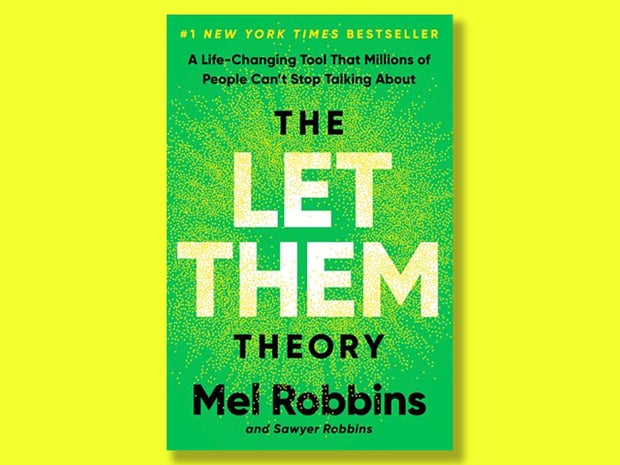
the-let-them-theory-cover-hay-house-1280.jpg

Hay House

We may receive an affiliate commission from anything you buy from this article.

Mel Robbins’ podcasts, TED Talk and bestselling books, including “The 5 Second Rule,” have made her one of the most successful motivational speakers.

In her latest bestseller, “The Let Them Theory” (Hay House), she discusses how personal growth is only possible when you stop pouring energy into things you cannot control – which includes changing other people.

Read an excerpt below, and don’t miss Norah O’Donnell’s conversation with Mel Robbins on “CBS Sunday Morning” February 1!


“The Let Them Theory” by Mel Robbins

Prefer to listen? Audible has a 30-day free trial available right now.


I’ve spent the last two years researching the Let Them Theory: why it works, and how you can use it to transform your life and improve your relationships with other people.

In writing this book, I’ve spoken to many of the world’s leading experts in psychology, neuroscience, behavioral science, relationships, stress, and happiness. You’ll meet them as you read the book, and their research will help you apply the theory in countless situations in your life. As you’ll soon see, the science is clear: This thing works. And it works really well.

But this book isn’t just about introducing you to the Let Them Theory. It’s about a fundamental law of human nature: All human beings have a hardwired need for control.

We all have an innate desire to control everything about our lives: our time, our thoughts, our actions, our environment, our plans, our future, our decisions, and our surroundings. Feeling in control makes you feel comfortable and safe, so naturally you try to control everyone and everything around you—oftentimes, without even realizing it. 

But the fact is, there is one thing you will never be able to control. No matter how hard you try, you will never be able to control or change another person. The only person you are in control of is you. Your thoughts, your actions, your feelings.

For too long you’ve been working against this fundamental law of human nature. You’ve been fighting to change people, battling to control situations, worrying about what people say, think, or do; and in doing so, you’ve created unnecessary stress, tension, and friction for yourself and in your relationships. I did too.

The Let Them Theory has transformed my entire approach to life and how I deal with other people. Instead of resisting the natural flow of human nature, I learned to embrace it. Instead of wasting my energy on something I can’t control—what others say, think, and do—I poured my energy into what I can control: me.

The result? I gained more control over my own life than I have ever had before. It was freeing. I stopped making other people the problem, and in doing so, my relationships improved in ways I never thought possible. It was like unlocking a door that had been sealed shut for years. And behind it? A life where I’m no longer weighed down by the need to manage other people.

In the coming pages, you’ll learn all about the theory, the easiest way to start using it, and how awesome it feels when you do. You’ll also learn about a surprising discovery I made early in our research. The Let Them Theory isn’t just … Let Them. Yes, it begins with these two words, but that’s not the whole story. Let Them is just the first half of the equation. There is a second, even more crucial step to this theory: Let Me.

In the next chapter, we’ll unpack both Let Them and Let Me and explore the science and psychology behind each one of the two steps. Then, you’ll learn about the eight core areas of your life where the theory will have the biggest positive impact. We’ll talk about your relationships, career, emotions, opinions, stress, love life, struggles, chronic comparison, friendship, and most importantly, your relationship with yourself. 

Over and over, you’ll learn how you’ve been trying to control the wrong things and unknowingly made other people a problem. The truth is, other people should be one of the greatest sources of happiness, support, and love in your life. But they can’t be if you keep trying to control what they feel, say, and do. That ends with this book.

Master the Let Them Theory, and you’ll stop exhausting yourself trying to control the uncontrollable. This isn’t just about feeling better. It’s about redesigning how you live your entire life. I can’t wait for you to discover the space and freedom to experience your life the way you’ve always wanted—on your terms.

Let’s begin.

     
From “The Let Them Theory” by Mel Robbins. Copyright © 2024 by Mel Robbins. All rights reserved. This excerpt, or any parts thereof, may not be reproduced without permission.


Get the book here:

“The Let Them Theory” by Mel Robbins

Buy locally from Bookshop.org


For more info:

Why is one corner of China’s internet insisting a golden era never existed?

Hong Kong (CNN) — Something weird has been happening on China’s internet. One small and vocal corner has been claiming the country’s most famous historical dynasty never existed.That’s the Tang, which ruled China from 618 AD to 907 AD, a period that saw huge territorial expansion, booming international trade and the flourishing of a high culture envied far beyond its borders. Every child learns about the Tang at school; historical dramas inspired by its palace intrigues are a staple of state TV.Claiming that the 300-year dynasty was actually a myth is akin to saying the American Civil War never happened, or telling a Brit that the Magna Carta is a fiction. But in recent months it’s been spreading among China’s very online population, posing a headache for a ruling Communist Party obsessed with controlling how its citizens talk about their 5,000 years of fractious and contested history.It all appears to have started when a history influencer named Qiao Yu deployed some baffling astrological data in a video in May, to “prove” the Tang had never existed.The outlandish claim has since spread far and wide. Reports later emerged that people were calling up the tourism bureau in Xi’an, the site of the ancient Tang capital, to demand it close down because the dynasty itself had been shown to be a hoax.The hashtag “the Tang dynasty doesn’t exist” now has tens of millions of views on China’s X-like Weibo.What motivated the hoax and its spread is hard to pin down. The Tang dynasty has been criticized in the past by Chinese nationalists as its founding emperor was not from the Han ethnic group that makes up most of China’s people. The basis of Qiao Yu’s claim is that the succeeding Song dynasty actually began far earlier than traditionally accepted, therefore canceling out the Tang. The Song dynasty was of ethnic Han origin.“This is basically insane,” said William Kirby, a professor of China studies at Harvard University, adding that there are facts in history and “the Tang dynasty is definitely one of them.”“It was much more than a Chinese dynasty. It was an inner Asian dynasty as well,” he said.As the fallacy spread on social media, China’s powerful and tightly controlled state media waded into the controversy.Many parents say that, thanks to the hoax, their children now feel confused about historical facts, the Nanjing Daily reported last month.Three days later, The Paper, a media outlet affiliated with the Shanghai government, was more strident. “Only when rational inquiry becomes the foundation of public life will historical nihilism truly lose the conditions that allow it to flourish,” it said in a commentary.“Historical nihilism” is a term coined by the ruling communist party that refers to discussion or research that challenges its version of China’s long history. The party itself is a relative newcomer to that story, coming to power in 1949 following a decades-long civil war that tore the country apart.By mid-August the Tang controversy had attracted the attention of the party’s mouthpiece. In an editorial, the People’s Daily called the claim “absurd,” and issued a warning: “Once young people begin to doubt our national history, our cultural confidence will become like water without a source or a tree without roots, and Chinese-style modernization will lose its profound historical perspective.”In recent years, Chinese leader Xi Jinping has tightened the party’s grip on history and sought harsher penalties for those who dare to challenge the official account.Xi himself has publicly evoked the past glory of the Tang. In 2023 he hosted leaders from several Central Asian countries in Xian, the ancient Tang capital and terminus of the Silk Road along which goods and ideas used to flow between China and Europe.The ceremony featured dancers and performers in Tang-style dress, observers noting the nod to a Tang past when foreign envoys came to pay tribute at the emperor’s court.Using the past to criticize the presentFor a thousand years, Chinese people have used reflections on history to reimagine the past, as a creative way to criticize or approach the present.For example, in the economic boom years of the early 2010s, amid growing criticism of the fixation on consumerism and bourgeois lifestyles, the hardships the Chinese people had undergone during Japan’s brutal occupation during WWII became a favored topic for intellectuals, according to Rana Mitter, a Harvard Kennedy School historian specializing in modern China.But that discussion also allowed some to point out that the current discourse didn’t give enough credit to the Kuomintang troops who fought the Japanese – but who were also the opponents of Mao Zedong’s communists, Mitter said.Even though the Tang era was more than a thousand years ago, any suggestion – however fanciful – that it never existed could be an irritant for the party, said Mitter.“Certainly under Xi, the CCP now honors the longer trajectory of Chinese history. This means that all history needs to point in a direction that suggests unified (rather than split) identity, historical and cultural continuity, and an idea of ‘China’ as a long-standing entity that has been continuous through history,” he said.Callum, a 24-year-old Beijing resident, told CNN that questioning the Tang’s existence could be a way to rebel against established wisdom and a way for China’s young – faced with a slowing economy and greater competition for jobs and resources – to criticize authorities.“It is a way for people to attack the established authorities. It is almost like saying ‘those so-called experts are nothing special. They have all been misleading people. I am the one who understands the truth, and I have exposed them all.’”As of mid-August, Qiao Yu’s accounts have been blocked and all of their videos taken down. Any search of Chinese social media questioning if the Tang dynasty existed now pulls up content condemning such lines of reasoning.In its editorial on the controversy, the People’s Daily attempted to have the final word.“Chinese civilization has endured for five thousand years,” it said, “and the Golden Age of the Tang Dynasty stands as one of its most dazzling chapters.”CNN’s Shuai Zhang contributed to the reporting.The-CNN-Wire™ & © 2026 Cable News Network, Inc., a Warner Bros. Discovery Company. All rights reserved.
Read Next Story