▶ Watch Video: Trump nominates Todd Blanche, his former personal attorney, for attorney general
Washington — Acting Attorney General Todd Blanche will appear Wednesday before the Senate Judiciary Committee for his confirmation hearing to take over the role on a permanent basis, where he is set to face tough questions about hot-button issues he has been involved in during his time at the Justice Department.
Democrats are expected to grill him over what they believe are politicized prosecutions, the department’s handling of the Jeffrey Epstein files and his prior advocacy for a nearly $1.8 billion “anti-weaponization” fund.
President Trump nominated Blanche, his former personal defense attorney, to lead the Justice Department last month following the ouster of Pam Bondi in early April. He has been acting in a temporary capacity since Bondi’s firing.
While Republicans hold the majority of seats on the Judiciary panel, the party’s margin narrowed with the unexpected death of Sen. Lindsey Graham of South Carolina late Saturday. Graham was one of the most senior Republicans on the Judiciary Committee and a staunch defender of Blanche.
Most observers believe Blanche is likely to be narrowly confirmed by the GOP-led Senate. Still, he may face skeptical questions from some Republicans on the Judiciary Committee, namely Sens. John Cornyn of Texas and Thom Tillis of North Carolina.
“Anti-weaponization” fund and IRS deal
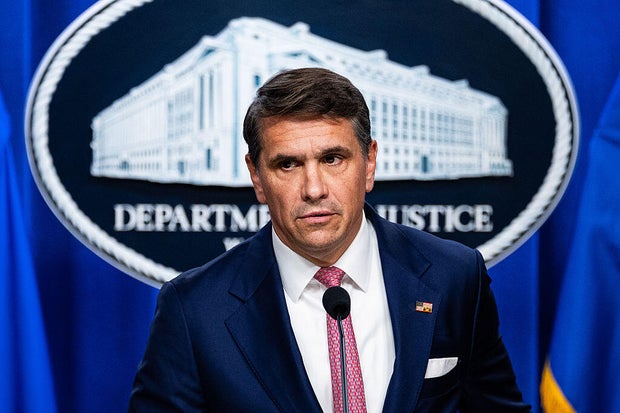
Graeme Sloan / Bloomberg via Getty Images
Cornyn, Tillis and other Republicans criticized a settlement between the IRS and Mr. Trump that resolved a civil lawsuit over the leak of the president’s tax returns by a former government contractor.
That deal called for the creation of the new fund at the Justice Department to pay victims of so-called government “weaponization” and granted immunity to Mr. Trump, his two oldest sons, his company and related companies from future tax claims.
Amid bipartisan backlash, Blanche testified to a House committee last month that the department was scrapping the payout plan. His assertions, though, have done little to quell the fallout from the anti-weaponization program and broader settlement.
On Monday, a federal judge in Miami rebuked the Justice Department and sanctioned an attorney for Mr. Trump in the IRS case, finding the president pursued the lawsuit “for an improper purpose.”
The ruling raised questions about whether Blanche and Stanley Woodward, the No. 3 official at the Justice Department, violated ethical rules. It barred them from citing the provisions of the deal as evidence of a settlement in any formal court or government proceeding.
In a separate case, which challenges the legality of the Justice Department’s fund, the Trump administration last month declined to submit to a court a sworn declaration from Blanche and Treasury Secretary Scott Bessent that reiterated the claim that the fund is defunct, calling the demand “unnecessary.”
A hearing in the case is set to take place Wednesday in federal court in Virginia, while Blanche’s confirmation hearing is unfolding.
Blanche reiterated to reporters last month that “the answer remains the same, that the anti-weaponization fund is dead, it’s not coming back to life, it’s not on life support, it never was really started.”
A Justice Department spokesperson dismissed the Miami judge’s ruling, saying it was incorrect.
“There was no collusion in this case, and the partisan judge who speculated otherwise has disregarded decades of precedent,” the spokesperson said.
“This case was brought by President Trump in his personal capacity, as well as by several members of his family, who were all victims of admitted violations of law. There was a live dispute because the plaintiffs sought relief that the government had not provided. The plaintiffs did not receive any money and were barred from receiving any from the now-defunct Anti-Weaponization Fund.”
Blanche’s handling of Trump’s political priorities
Blanche served as deputy attorney general before Bondi’s departure. During his time in that role, he oversaw the controversial indictments of former FBI Director James Comey and New York Attorney General Letitia James, who are frequent targets of Mr. Trump’s ire. Both of the cases were dismissed after a federal judge determined the indictments were secured by an unlawfully appointed interim U.S. attorney. The Justice Department is appealing that decision.
Comey faces a separate legal battle after he was indicted in April for allegedly making threats against the president. He briefly shared an image on Instagram last year that showed seashells arranged on a beach to form the numbers “86 47,” which Mr. Trump said on Truth Social is a “mob term for ‘kill him.'”
Legal experts and former federal prosecutors who spoke with CBS News in the wake of the indictment, however, were skeptical that the Justice Department can show Comey’s speech is not covered by the First Amendment. Comey deleted the image from his social media account soon after it was posted and said he did not realize some associate the numbers with violence.
He has denied any wrongdoing and is set to appear in court for an arraignment in September. On Tuesday, his lawyers indicated in court filings they intend to challenge the prosecution as being both selective and vindictive.
In the criminal case brought against Kilmar Abrego Garcia, a Salvadoran man who was mistakenly deported to El Salvador last year and brought back to face human smuggling charges, a federal judge in Tennessee dismissed the indictment after concluding the prosecution was vindictive. The judge wrote that public comments from Blanche, as well as other factors, tainted the investigation into Abrego Garcia “with a vindictive motive.”
A Justice Department spokesperson dismissed the judge as an “activist,” saying the decision “was a wrong and dangerous attempt to place politics above public safety.”
Blanche also made numerous misstatements about the ongoing criminal prosecution against the Southern Poverty Law Center in Alabama, including falsely claiming the case started during President Joe Biden’s tenure. The investigation, however, was opened during Mr. Trump’s first term, when Jeff Sessions was serving as attorney general. Blanche also incorrectly asserted that the nonprofit never shared intelligence about hate groups with law enforcement.
And his decision to personally interview Ghislaine Maxwell, Epstein’s accomplice who is serving a 20-year prison sentence, sparked shock among former prosecutors who viewed his actions as improper and unethical.
Blanche met with Maxwell while an appeal of her criminal conviction on sex-trafficking charges was pending before the Supreme Court. Soon after the two met, Maxwell was transferred from a low-security federal correctional institute in Tallahassee, Florida, to a minimum security prison camp in Texas.
A Bureau of Prisons spokesperson previously said that Maxwell was transferred for security reasons and received no preferential treatment.
Blanche’s career
Blanche has had a somewhat unusual career trajectory compared with others who have reached the top ranks of the Justice Department. He started working at the department as a paralegal while he attended night school at Brooklyn Law to earn his degree. He then worked his way up the ladder in New York’s Southern District, one of the most high-profile U.S. attorney’s offices in the country.
Those who knew Blanche from his time as a federal prosecutor in New York had largely positive interactions, telling CBS News he never discussed politics in the office and was considered a solid prosecutor. They described him as a “bro” who people in the office enjoyed getting a beer with after work.
After many years in New York’s Southern District, he left to join the law firm WilmerHale. In a somewhat unusual move given his experience as a federal prosecutor in Manhattan, he never worked as a partner. Blanche later shifted to the firm formerly known as Cadwalader, Wickersham & Taft LLP, where he became an equity partner after about two years, according to a person with direct knowledge.
In 2023, Blanche left to lead Mr. Trump’s defense against 34 felony charges in New York related to a “hush money” payment made in the closing days of the 2016 election. Blanche often stood side-by-side with Mr. Trump in the hallways of a Manhattan courthouse as lead counsel during the 2024 trial, which ended in felony convictions on all counts.
When Mr. Trump returned to the White House, he nominated Blanche to serve as deputy attorney general. The Senate confirmed him by a vote of 52 to 46.
At that time, many DOJ employees reserved judgment, assuming his years as a prosecutor in the Southern District of New York meant he respected long-standing Justice Department norms and would not cross a red line.
But several of those who adopted a wait-and-see approach told CBS News their hopes have been dashed.
“There is absolutely no wall between the Justice Department and the White House,” said Gene Rossi, a former federal prosecutor who is now in private practice. “Blanche literally does what Trump wants him to do.”
Some of those who know Blanche well said they observed a change after he began representing Mr. Trump in federal and state criminal cases.
Mimi Rocah, a former federal prosecutor who worked closely with Blanche in New York and once considered him a friend, said she believes he has fundamentally changed, and has allowed his views about the Justice Department’s prosecutions of Mr. Trump to cloud his judgment in his leadership roles at the department. Rocah successfully ran as a Democrat for district attorney of Westchester County, New York.
“I think his viewpoint became transformed by this experience of representing Trump,” she said. “I do think he genuinely believes that Trump was persecuted.”
“The problem is carrying it over into this position, and he seems to have rationalized that in his mind. And that to me is the really troubling part,” Rocah added.
The Justice Department has lost roughly 16,000 employees through firings, resignations and early retirements under the second Trump administration. As a result of the departures, Blanche is also facing hostility from current and former Justice Department employees who believe his leadership has been detrimental to the career workforce.
“Blanche has fired or overseen the firings of hundreds of these employees — usually without notice, and for improper, unlawful reasons,” wrote the advocacy group Justice Connection, in a letter signed by about 1,200 former Justice Department employees.
“Some were terminated for having worked on cases the President didn’t like; for being relatives of the President’s foes; for adjudicating immigration cases in accordance with due process; for declining to initiate vindictive prosecutions; or for refusing to lie in court,” they said. “These terminations violate the very civil service statutes designed to prevent corruption and political purges.”
Abhi Kambli, a former deputy associate attorney general who worked with Blanche at the department, said any ethical concerns about him are “overstated.”
“Todd Blanche is very careful and very ethical in my experience, and he’s very mindful,” he told CBS News.
Some inside the Justice Department initially saw him as a more moderating force against the White House’s worst impulses, several told CBS News.
Since then, between the new Comey prosecution, the indictment of the Southern Poverty Law Center and the proposal of the anti-weaponization fund, some said they think he has fully embraced the MAGA movement — likely in an effort to secure the attorney general nomination.
But Brian Nieves, Blanche’s former chief of staff, recently wrote a letter to the Wall Street Journal praising his leadership, and urging the Senate to swiftly confirm him.
“I saw what leadership looked like when the cameras were off,” he wrote. “I sat in meetings where the facts were contested, the legal questions were difficult and every available course carried consequences. Mr. Blanche listened, pressed for candor, challenged assumptions and demanded that recommendations be rooted in law and fact.”