Blanche must meet with Epstein victims to earn confirmation vote, Sen. Tillis says

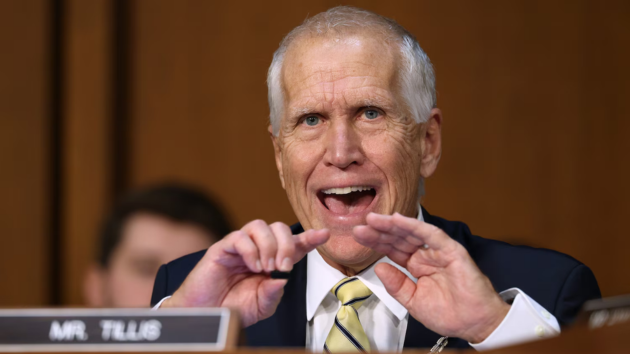
Sen. Thom Tillis attends the confirmation hearing by the Senate Judiciary Committee for acting Attorney General Todd Blanche on Capitol Hill, July 15, 2026, in Washington. Win McNamee/Getty Images

(WASHINGTON) — A key GOP member of the Senate Judiciary Committee whose vote is needed to secure acting Attorney General Todd Blanche’s confirmation as the next attorney general said Thursday that he will require Blanche to sit down with victims of deceased convicted sex offender Jeffrey Epstein before he can vote for him. 

Sen. Thom Tillis, R-N.C., announced the new condition during a hearing Thursday where one of the witnesses was Epstein victim Dani Bensky.

Facing a potentially rocky confirmation, Blanche made a brief attempt to meet with Epstein survivors on Capitol Hill Thursday afternoon. 

He and his team arrived at a Senate Judiciary Committee office where they sat for about half an hour, but no one joined them.

“I rearranged my schedule to try to meet with them,” Blanche told ABC News after leaving the office. “I’ve been here waiting. It didn’t work out, so we’re going to see if there’s a way we can meet either later today or sometime soon.”

“There’s nothing newsworthy about this fact because the Department of Justice will always meet with victims or their representatives, and if those victims or their representatives have evidence that anybody committed a crime, whether it has to do with Jeffrey Epstein, anybody else that was associated with Jeffrey Epstein, or anybody else, we will of course move forward and investigate and prosecute,” Blanche said.

Bensky testified in Thursday’s hearing that Blanche has never responded to repeated attempts to reach him to sit down and recount her story. 

“Blanche was willing to say that he would meet with [Epstein victims] and counsel — I understand the restriction that counsel has to be present,” Tillis said. “I expect that meeting to occur before I vote to vote out of this committee and I’m trying to get to yes. But this is a very important part of getting to yes.”

“There should not be any reason why, based on what Mr. Blanche said yesterday, if he said that he would do it today, then he can certainly do it over the next two weeks,” Tillis added.

Blanche told lawmakers during his confirmation hearing Wednesday that he would be happy to meet with victims but initially said he couldn’t meet with them personally if they were represented by legal counsel, before correcting himself later in the hearing. 

“I never said I can’t meet with them. I said if they were represented, I had to meet through counsel,” Blanche said. “But of course, I can meet with them. I’m the acting attorney general of the United States, so yes, I can.”

Copyright © 2026, ABC Audio. All rights reserved.

Trump is threatening new Canadian auto tariffs. That will hurt US automakers and workers

(CNN) — President Donald Trump’s threat of 50% auto tariffs on all imports from Canada is just the latest action to rattle an industry that’s endured shifting trade rules since he returned to office.Trump issued the auto tariff plans early Monday, just as trade tensions between the two neighbors ratcheted up. On Saturday, the US slapped 50% tariffs on a much more limited group of Canadian exports after efforts to strike a deal collapsed.But the steep auto tariffs, if enacted, could disrupt long-established business practices and have far-reaching consequences across the auto industry, experts say.“Sweaters, honey and hockey sticks are not a trade war. What the president just threatened this morning is a trade war,” said Patrick Anderson, CEO of Anderson Economic Group, a Michigan-based consulting firm. “It would be a body blow to the auto industry. We would see plants closing on both sides of the border.”Canada does have a large trade surplus with the United States. But when it comes to the auto industry, it’s the opposite — the US has a nearly $1 billion a month trade surplus with Canada.America imported $24.5 billion worth of Canadian vehicles and auto parts in the first six months of this year, according to Commerce Department trade data, compared to the $30.4 billion Canada imported.Since the North American Free Trade Agreement was first introduced in the 90s, and then the US-Mexico-Canada Agreement during Trump’s first term, the auto industry has been able to operate as if North America is a single market. Companies move parts and vehicles freely across borders, often multiple times before the car is assembled and sent to dealer showrooms.Even with last year’s auto tariffs, that process continued. That’s because carve outs allowed Canadian-made parts and vehicles to remain more or less tariff free.Disrupting that flow will cost US jobs, both for the auto parts industry and at assembly plants.“The impact of unworkable tariffs would be felt well beyond Canadian assembly plants,” said Erin Keating, executive analyst with Cox Automotive.Cars built at Canadian plants depend heavily on parts from US suppliers, which employs more than half a million Americans.And Canadians bought about 663,000 cars built at US assembly plants last year, according to research firm Mobility Global. Canadian buyers also spent more than three times as much on larger, more expensive vehicles — heavy trucks, buses and special purpose vehicles — than American buyers.Most major automakers contacted by CNN either had no comment on the tariffs or did not respond to a request for comment.Unifor, the union that represents Canadian auto workers, blasted the planned tariffs, calling them an “intimidation tactic.”“The US administration fails to recognize that our highly integrated auto industry means ongoing instability hurts workers on both sides of the border and makes it increasingly difficult to build cars in North America,” the Canadian union said. “We need to resolve this, together.”The-CNN-Wire™ & © 2026 Cable News Network, Inc., a Warner Bros. Discovery Company. All rights reserved.
Read Next Story