
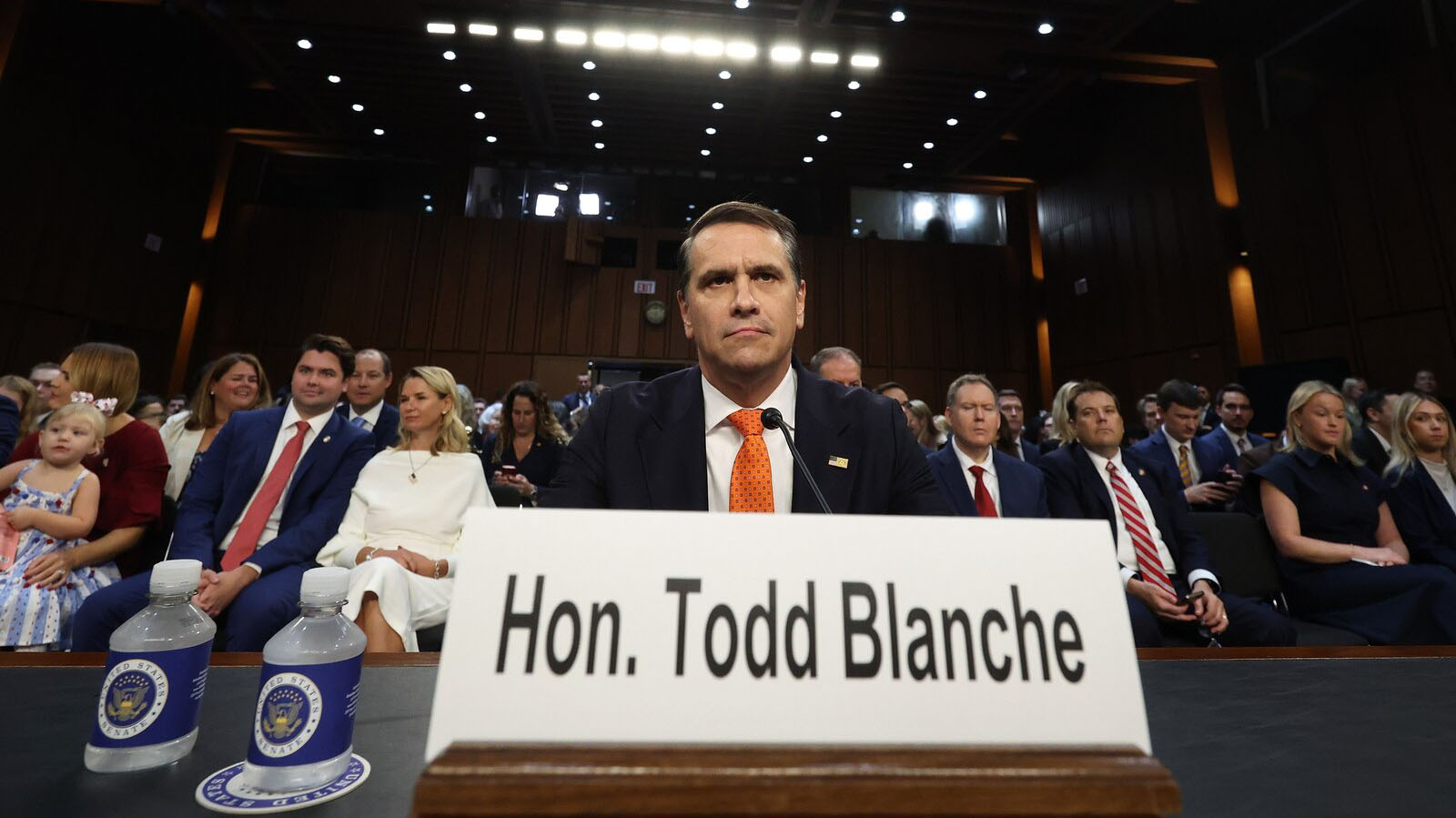
Blanche faces grilling on DOJ controversies as he seeks confirmation as AG

Acting Attorney General Todd Blanche appears before the Senate Judiciary Committee on Capitol Hill in Washington, July 15, 2026. (Win McNamee/Getty Images)

(WASHINGTON) — Acting Attorney General Todd Blanche is appearing before the Senate Judiciary Committee Wednesday as he seeks confirmation to secure his role on a permanent basis.

Blanche is facing questions over a series of controversies from his time with the Justice Department, including the handling of the Jeffrey Epstein files and what he says is the now-defunct “Anti-Weaponization Fund” part of a settlement after President Donald Trump sued the Internal Revenue Service for $10 billion.

Formerly Trump’s defense attorney, Blanche faced a relatively smooth glide path to confirmation with unanimous Republican support last year when he was nominated to serve as the department’s No. 2 official.

Since Trump’s ouster of Pam Bondi as attorney general in April, Blanche has served in the position in an acting role and Trump formally nominated him in June.

“We are here today with the awesome responsibility of choosing the next attorney general of the United States of America. We’re here because there is a vacancy in the office. The president decided to fire the predecessor of Mr. Blanche after just 14 months on the job after courts and grand juries blocked her from prosecuting the president’s political opponents,” Democratic Sen. Dick Durbin said in his opening statement. “Seemingly, President Trump believes you, Mr. Blanche, will be more successful.”

Blanche’s road to confirmation is further complicated by the sudden death of Sen. Lindsey Graham, a veteran of the Judiciary Committee who was expected to be a strong advocate for Blanche with his GOP colleagues. Blanche will likely need the support of every Republican on the committee in order for his nomination to advance to the Senate floor, as all Democrats are expected to oppose him.

It’s not immediately clear when the full Senate would move for a vote on Blanche’s nomination if passed by the committee, though administration officials have said their goal would be for him to be confirmed before the August recess.

Blanche argued Wednesday that his leadership has restored trust that was lost under the previous administration when the Department of Justice prosecuted Trump and many of his supporters.

“In recent years, Americans watched the Justice Department turned against many of you and a former president, and it damaged the public’s faith in justice,” Blanche said. “We are fixing that. Members of this committee — on both sides — have fair questions about the hard debates of this past year, and I welcome them.”

Blanche defends handling of Epstein files
Republican Sen. Chuck Grassley, the chairman of the committee, asked Blanche to give his response to allegations that he and other department officials deliberately mishandled the release of millions of files from the Justice Department’s past investigations of Epstein. 

As he has in previous congressional testimony, Blanche acknowledged “mistakes” made in the process regarding failures to properly redact certain names of victims, which he said the department immediately sought to fix once they were notified. 

“Whenever we learned that any victim’s name had been improperly non-redacted, we immediately took the document down and fixed it as soon as we could,” Blanche said. “That doesn’t excuse the mistakes of which I take full responsibility, but it does mean that we tried to fix them.”

Blanche also used his time to directly address victims of Epstein — several of whom were in the audience — telling them that the department would gladly meet with them and open new investigations of potential co-conspirators of Epstein if they came forth with evidence that would warrant it. 

“If we learn today, if we learn next week, if we learn next month, that there’s an individual that we can investigate, indict and prosecute out of the Epstein files, you better believe it we will,” Blanche said.

Asked if he would notify the committee once such a meeting takes place with a victim of Epstein or their counsel, Blanche demurred — drawing a rebuke from Durbin. 

“Well, you’re dancing on the head of a pin here,” Durbin said. 

“I’m not dancing on any pin,” Blanche replied. 

Blanche confirms “Anti-Weaponization Fund” is “dead”
For the first time under oath, Blanche confirmed in an exchange with Republican Sen. John Cornyn that the so-called “Anti-Weaponization Fund” is “dead.” 

Cornyn, one of the key Republican votes that Blanche will need to make it out of committee, repeatedly pushed him with specific and detailed questions regarding both the fund and the immunity agreement that would exempt President Trump and his family from IRS audits of their past taxes — which Cornyn described as “unusual.”

Cornyn repeatedly noted that the original settlement that first established the fund has still yet to be formally rescinded.

While Blanche acknowledged that, he also said the Department of Justice would be fine with codifying in some way to assure senators the fund would not move forward. 

“It is a moot issue, meaning there is no weaponization fund,” Blanche told lawmakers.

On Monday, a federal judge in Florida issued an extraordinary order that lambasted Trump and the Justice Department for misusing her court to legitimize a “settlement” that she says would never have survived judicial review.

U.S. District Judge Kathleen Williams, who had previously been assigned to oversee Trump’s IRS lawsuit, referred Trump’s attorneys for potential sanctions and separately sent her ruling to the State Bar of New York for consideration in potential disciplinary proceedings for Blanche — who Williams said had potentially given “misleading” testimony to Congress about how the settlement was executed. 

Blanche, when asked during Wednesday’s hearing about Williams’ order, said he rejected her “insinuations” and said she had never given the Department of Justice a chance to respond in the case before issuing her order. Judge Williams noted in her order that while the department had 109 days to enter an appearance in the case, it never did so.

“I very much disagree with — with the judge’s insinuations about me, and we’re going to do what we can to make that right,” Blanche said.

Copyright © 2026, ABC Audio. All rights reserved.

Parpadean luces rojas en los mercados energéticos

Los precios del petróleo vuelven a estar preocupantemente altos, pero el problema más grave acecha justo debajo de la superficie.Lo que inicialmente comenzó como una crisis de suministro de petróleo causada por el bloqueo del estrecho de Ormuz se está transformando en una crisis de suministro de combustible.Las refinerías se enfrentan a una combinación perfecta de guerra y restricciones a la exportación, lo que limita la cantidad de crudo que pueden transformar en gasolina, combustible para aviones y diésel, que impulsan la economía mundial.Un indicador clave de la rentabilidad de la refinación, conocido como margen de refinación del diésel, se disparó el lunes a US$ 102 por barril por primera vez en la historia, casi triplicando los niveles anteriores a la guerra.El margen de refinación del diésel mide cuánto pueden ganar las refinerías por cada barril de crudo que transforman en diésel.“Esto es una noticia catastrófica. El mercado está gritando que estamos apostando a la baja”, declaró a CNN Bob McNally, fundador y presidente de Rapidan Energy Group.El suministro de combustible sigue siendo históricamente escaso debido a que tres de los cuatro centros mundiales de refinación se encuentran en una situación de grave crisis.Las refinerías de Medio Oriente han sido atacadas durante la guerra con Irán. Y las refinerías que no han sufrido daños han tenido problemas para transportar mercancías debido al conflicto en el estrecho de Ormuz, donde Irán y Estados Unidos se disputan el control.Pero esto no se trata solo de la guerra con Irán.Las refinerías de Rusia, uno de los principales exportadores de combustible, han quedado paralizadas por ataques con drones procedentes de Ucrania.Aproximadamente el 40 % de la capacidad de refinación rusa está inactiva, lo que equivale a cerca del 3 % de la capacidad mundial, según la firma de investigación Capital Economics.Ante la escasez de combustible en su territorio, Moscú ha prohibido las exportaciones de gas y diésel hasta finales de enero de 2027.Luego está China, otro importante exportador de combustible.Beijing ha contribuido a evitar que los precios del petróleo se disparen a US$ 150 el barril reduciendo drásticamente sus importaciones de petróleo, más allá de lo que muchos creían posible.Pero Beijing también ha intentado evitar la escasez interna de combustible limitando sus propias exportaciones.Eso deja a la costa del Golfo de Estados Unidos como la única opción viable, y las refinerías estadounidenses están haciendo todo lo posible por capturar los márgenes de beneficio históricos.“El resultado es un mercado que está a punto de entrar en su período de mayor demanda estacional, con muy poco margen de error”, escribieron los analistas de Bank of America en un informe la semana pasada.Los márgenes de beneficio récord significan que las refinerías que no se han visto afectadas por la guerra están generando enormes beneficios en la actualidad.“Las refinerías están trabajando a toda máquina. Es como si la Navidad se hubiera adelantado y hubiera llegado a lo grande”, comentó McNally, exasesor de energía del presidente George W. Bush.Las acciones de las estadounidenses Marathon Petroleum y Valero Energy se han duplicado con creces en lo que va de año, mientras que las de Phillips 66 han subido casi un 90 %.Esta confluencia de acontecimientos también ha impulsado las enormes ganancias de importantes compañías petroleras como Chevron y ExxonMobil. Solo Exxon obtuvo US$ 160 millones diarios el trimestre pasado.Pero no está claro cuánto tiempo podrán las refinerías estadounidenses operar a pleno rendimiento.Se acerca el punto álgido de la temporada de huracanes, y las refinerías de la Costa del Golfo ya se han visto afectadas en el pasado por grandes huracanes que azotan la zona.Además, normalmente, las refinerías aprovechan la menor demanda en otoño para reducir su producción y realizar reparaciones.Los precios del combustible son considerablemente más altos que en esta misma época el verano pasado, aunque todavía no alcanzan los niveles que muchos temían al inicio de la guerra con Irán.El costo promedio nacional de la gasolina regular llegó a US$ 4,07 por galón el martes, un 30 % más que el año anterior.El diésel, un combustible crucial para la economía mundial, es un 48 % más caro que en esta misma época del año pasado.El aumento del precio del diésel supone un coste oculto para los consumidores, ya que este combustible impulsa los tractores agrícolas, así como los trenes y camiones que transportan mercancías por todo el país.Las empresas suelen repercutir, al menos en parte, este aumento del precio del combustible a los consumidores en forma de precios más elevados.Según una investigación del Climate Solutions Lab de la Universidad de Brown, la subida del diésel ha costado a los consumidores estadounidenses casi US$ 40.000 millones desde que comenzó la guerra.Mientras tanto, el precio del combustible para aviones se ha disparado en más de un 70 % durante el último año.Las aerolíneas, respaldadas por una demanda de viajes sólida y el cierre de la aerolínea de bajo coste Spirit en mayo, han aumentado las tarifas aéreas y los cargos por equipaje, además de cancelar los vuelos menos rentables.“El impacto directo para el consumidor se está haciendo notar en las gasolineras y en los aeropuertos, y ahí es donde la presión va a aumentar a partir de ahora”, escribieron los analistas de Rystad Energy en un informe la semana pasada.Mientras las grandes petroleras se benefician de las interrupciones en el suministro, la gente común se siente cada vez más frustrada por el alto costo.El riesgo reside en que los problemas en las refinerías mantengan los precios de la gasolina, el diésel y el combustible para aviones elevados durante más tiempo, lo que a su vez mantendrá la inflación elevada.“A menos que se resuelvan los problemas de suministro en Medio Oriente, China y/o Rusia, es probable que los precios del diésel se mantengan cerca de los máximos del ciclo, con un riesgo adicional de subida si las existencias siguen aumentando durante el invierno”, afirmó Bank of America.Los precios son tan altos que están empezando a frenar el consumo, un fenómeno conocido en el sector como “destrucción de la demanda”. Sin embargo, Bank of America afirmó que la demanda no se ha destruido lo suficiente como para reequilibrar el mercado, al menos no todavía.McNally, presidente de Rapidan, dijo que espera que o bien el precio del crudo se ajuste a la presión del mercado de combustibles, o bien la guerra con Irán alcance un punto de inflexión.“O Irán se rinde o el presidente se rinde”, sostuvo McNally. “No sabría decir qué ocurrirá primero”.The-CNN-Wire™ & © 2026 Cable News Network, Inc., a Warner Bros. Discovery Company. All rights reserved.
Read Next Story