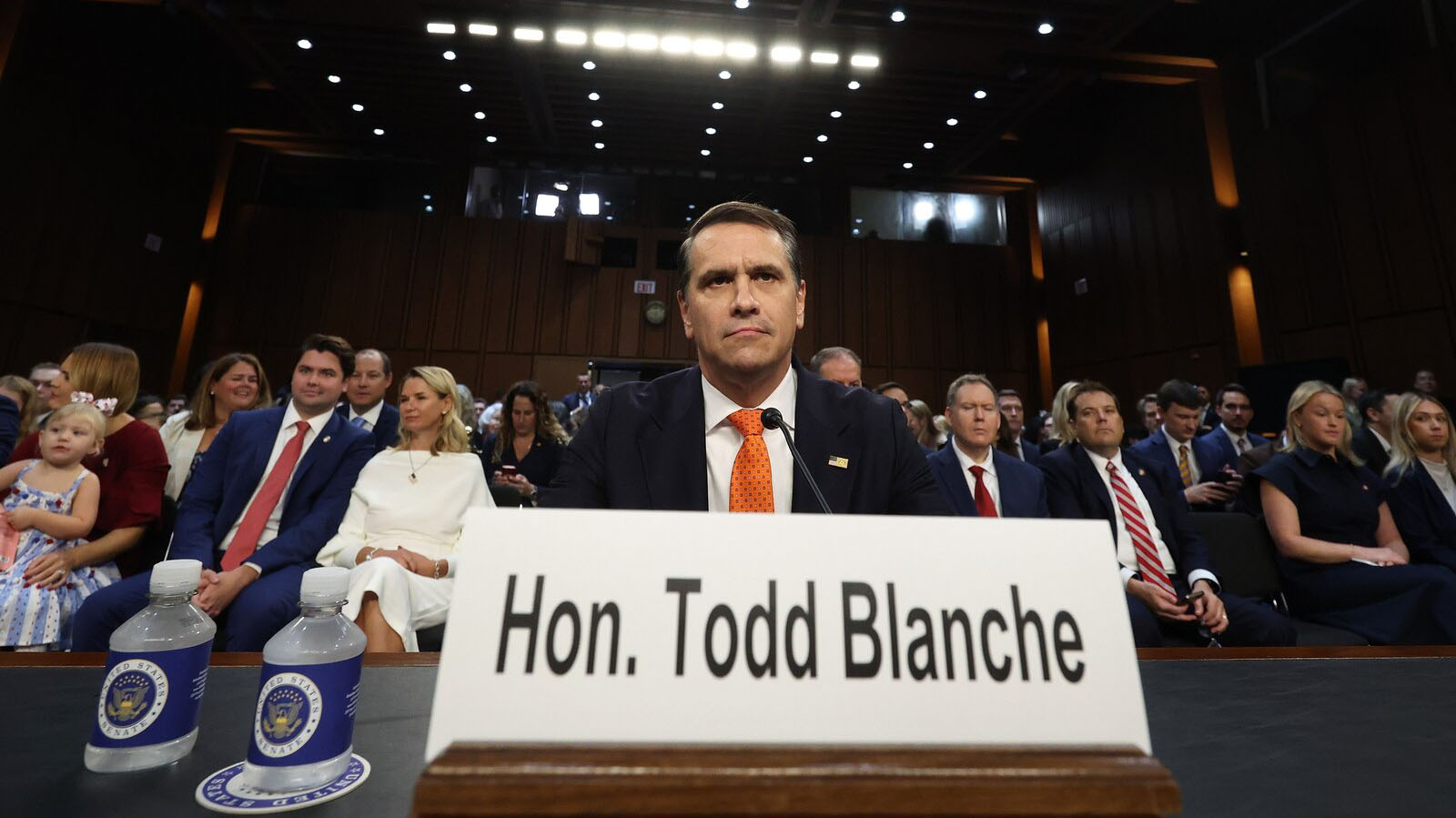
(WASHINGTON) — Acting Attorney General Todd Blanche is appearing before the Senate Judiciary Committee Wednesday as he seeks confirmation to secure his role on a permanent basis.
Blanche is facing questions over a series of controversies from his time with the Justice Department, including the handling of the Jeffrey Epstein files and what he says is the now-defunct “Anti-Weaponization Fund” part of a settlement after President Donald Trump sued the Internal Revenue Service for $10 billion.
Formerly Trump’s defense attorney, Blanche faced a relatively smooth glide path to confirmation with unanimous Republican support last year when he was nominated to serve as the department’s No. 2 official.
Since Trump’s ouster of Pam Bondi as attorney general in April, Blanche has served in the position in an acting role and Trump formally nominated him in June.
“We are here today with the awesome responsibility of choosing the next attorney general of the United States of America. We’re here because there is a vacancy in the office. The president decided to fire the predecessor of Mr. Blanche after just 14 months on the job after courts and grand juries blocked her from prosecuting the president’s political opponents,” Democratic Sen. Dick Durbin said in his opening statement. “Seemingly, President Trump believes you, Mr. Blanche, will be more successful.”
Blanche’s road to confirmation is further complicated by the sudden death of Sen. Lindsey Graham, a veteran of the Judiciary Committee who was expected to be a strong advocate for Blanche with his GOP colleagues. Blanche will likely need the support of every Republican on the committee in order for his nomination to advance to the Senate floor, as all Democrats are expected to oppose him.
It’s not immediately clear when the full Senate would move for a vote on Blanche’s nomination if passed by the committee, though administration officials have said their goal would be for him to be confirmed before the August recess.
Blanche argued Wednesday that his leadership has restored trust that was lost under the previous administration when the Department of Justice prosecuted Trump and many of his supporters.
“In recent years, Americans watched the Justice Department turned against many of you and a former president, and it damaged the public’s faith in justice,” Blanche said. “We are fixing that. Members of this committee — on both sides — have fair questions about the hard debates of this past year, and I welcome them.”
Blanche defends handling of Epstein files
Republican Sen. Chuck Grassley, the chairman of the committee, asked Blanche to give his response to allegations that he and other department officials deliberately mishandled the release of millions of files from the Justice Department’s past investigations of Epstein.
As he has in previous congressional testimony, Blanche acknowledged “mistakes” made in the process regarding failures to properly redact certain names of victims, which he said the department immediately sought to fix once they were notified.
“Whenever we learned that any victim’s name had been improperly non-redacted, we immediately took the document down and fixed it as soon as we could,” Blanche said. “That doesn’t excuse the mistakes of which I take full responsibility, but it does mean that we tried to fix them.”
Blanche also used his time to directly address victims of Epstein — several of whom were in the audience — telling them that the department would gladly meet with them and open new investigations of potential co-conspirators of Epstein if they came forth with evidence that would warrant it.
“If we learn today, if we learn next week, if we learn next month, that there’s an individual that we can investigate, indict and prosecute out of the Epstein files, you better believe it we will,” Blanche said.
Asked if he would notify the committee once such a meeting takes place with a victim of Epstein or their counsel, Blanche demurred — drawing a rebuke from Durbin.
“Well, you’re dancing on the head of a pin here,” Durbin said.
“I’m not dancing on any pin,” Blanche replied.
Blanche confirms “Anti-Weaponization Fund” is “dead”
For the first time under oath, Blanche confirmed in an exchange with Republican Sen. John Cornyn that the so-called “Anti-Weaponization Fund” is “dead.”
Cornyn, one of the key Republican votes that Blanche will need to make it out of committee, repeatedly pushed him with specific and detailed questions regarding both the fund and the immunity agreement that would exempt President Trump and his family from IRS audits of their past taxes — which Cornyn described as “unusual.”
Cornyn repeatedly noted that the original settlement that first established the fund has still yet to be formally rescinded.
While Blanche acknowledged that, he also said the Department of Justice would be fine with codifying in some way to assure senators the fund would not move forward.
“It is a moot issue, meaning there is no weaponization fund,” Blanche told lawmakers.
On Monday, a federal judge in Florida issued an extraordinary order that lambasted Trump and the Justice Department for misusing her court to legitimize a “settlement” that she says would never have survived judicial review.
U.S. District Judge Kathleen Williams, who had previously been assigned to oversee Trump’s IRS lawsuit, referred Trump’s attorneys for potential sanctions and separately sent her ruling to the State Bar of New York for consideration in potential disciplinary proceedings for Blanche — who Williams said had potentially given “misleading” testimony to Congress about how the settlement was executed.
Blanche, when asked during Wednesday’s hearing about Williams’ order, said he rejected her “insinuations” and said she had never given the Department of Justice a chance to respond in the case before issuing her order. Judge Williams noted in her order that while the department had 109 days to enter an appearance in the case, it never did so.
“I very much disagree with — with the judge’s insinuations about me, and we’re going to do what we can to make that right,” Blanche said.
Copyright © 2026, ABC Audio. All rights reserved.