▶ Watch Video: U.S. star’s red card suspension lifted after Trump called FIFA president
U.S. Men’s National Team star Folarin Balogun will be eligible to play in the World Cup match against Belgium on Monday, after FIFA’s disciplinary committee lifted a red card suspension he received on Wednesday.
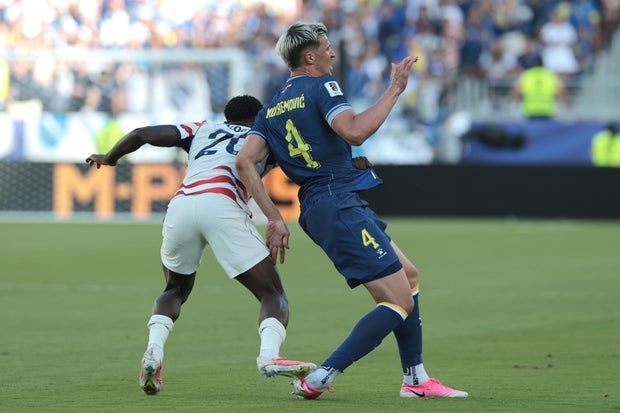
Balogun’s reinstatement came after President Trump called FIFA President Gianni Infantino on Thursday and spoke about the suspension against the 25-year-old striker, Mr. Trump confirmed Monday. Balogun received the red card during the United States’ match against Bosnia and Herzegovina when he collided with a Bosnian defender.
“I asked for a review because I didn’t think it was a foul,” Mr. Trump told reporters in the Oval Office after an unrelated event. “I thought it was two great athletes that crashed into each other and got entangled.”
Infantino also confirmed the call Monday in a statement responding to criticism of FIFA’s decision.
“During our conversation, I explained that there was an ongoing legal process involving FIFA’s independent judicial bodies and that the case would be decided in due course by the competent bodies,” he said of his call with Mr. Trump.
Infantino said the judicial bodies “operate autonomously, apply the FIFA Disciplinary Code, and decide cases based on the applicable regulations and the specific facts before them.”
Mr. Trump praised Infantino as “a smart, tough man” and said he didn’t tell him what to do.
“I can’t tell him what to do,” Mr. Trump said. “I don’t believe he made the decision. I think it was a committee that made the decision, and they made the right decision.”
Andrew Giuliani, the executive director of the White House’s World Cup task force, also spoke to Infantino about the situation, and Secretary of Commerce Howard Lutnick was also in communication with FIFA. Spokespeople for the White House, Lutnick and Giuliani did not immediately respond to CBS News’ request for comment.
In a statement Monday, FIFA said that under Article 27 of its Disciplinary Code, “the FIFA Disciplinary Committee has the discretion to suspend the implementation of any disciplinary measures so long as they do not relate to match manipulation—which, of course, did not occur here.”
“It should be added that employment of art. 27 FDC is not unprecedented, as similar decisions have previously been issued during the FIFA World Cup 2026 qualifiers,” FIFA said.
The organization maintained that sanctions against Balogun were not lifted, saying that the FIFA Disciplinary Committee imposed a $40,000 fine against the U.S. Soccer Federation. The committee’s move to suspend the one-match ban was “decided considering all of the specific circumstances surrounding the incident and evidence available,” FIFA said, but did not go into details.
“Reviewing the legal consequences of red cards in football is nothing new in the modern game,” the statement said. “Suspending the effects of a red card based on an explicit provision of the applicable regulations is a much more balanced measure.”
The Royal Belgian Football Association had requested FIFA provide a copy of the decision to defer Balogun’s suspension and an explanation of the process that had been followed, according to a statement.
Later, the FIFA Appeal Committee said the association’s request “was rendered inadmissible on the grounds that the RBFA is not a party to the proceedings and, as such, has no standing to appeal the decision.”
The association said it was “merely seeking legitimate explanations,” but “FIFA itself created an appeal and immediately ensured that it would be declared inadmissible.”
The group added it had not received any information on the grounds for the decision.
“The RBFA has informed the United States Soccer Federation that it contests the eligibility of the player, should the player be listed on the referee’s team sheet,” the association said.
Robert Gauthier / Los Angeles Times via Getty Images
Decision draws criticism
In its statement, the Royal Belgian Football Association said it was “astonished” by FIFA’s decision.
“In order to safeguard the legitimate rights of all participating teams and to protect the fundamental principles of fair play in our sport, both at this FIFA World Cup and at future editions of the tournament, the RBFA is investigating all potential options,” the organization said.
UEFA, Europe’s governing body for soccer, said on Monday the decision “crossed a red line.”
“We express our disbelief at such an unprecedented, incomprehensible and unjustifiable decision,” the body said in a statement. “When the certainty of rules is no longer guaranteed by its guardians, the integrity of the game is at stake and the credibility of a competition is undermined.”
Wayne Rooney, a former player for Manchester United and England’s national team, called the decision an “absolute disgrace.”
“Infantino should be ashamed of this because I think the sportsmanship of the game is in question here,” Rooney told the BBC on Sunday.
Prominent commentator and former England player Gary Neville said Sunday the decision “absolutely stinks.”
“There should be a review process in place,” he told ITV Sports. “Are we surprised? No, not with this lot,” Neville added.
How the decision was made
The phone call was first reported by The New York Times, and the reversal was first reported by The Athletic and confirmed by U.S. Soccer. The organization said it is “pleased” that Balogun will be able to compete at the match in Seattle, Washington. The winner of the match will advance to the World Cup quarterfinals.
FIFA did not revoke the red card entirely. The organization said in a statement that Balogun is on probation for one year, and if he “commits another infringement of a similar nature and gravity during the probationary period, the suspension shall be revoked and the sanction enforced.”
Referees called it a “serious foul” when Balogun collided with a Bosnian defender while trying to get in position for a pass in the second half of the match. Balogun raked his cleats down the player’s leg and landed on his ankle. Balogun was sent off after a referee punished him with a red card following a VAR review. The U.S. went on to win the match, but Balogun’s suspension was set to keep him from Monday’s game.
The call was immediately controversial, as red cards are often given for intentionally dirty plays. While Balogun’s actions appeared accidental, they can be considered serious foul play under the International Football Association Board’s laws of the game.
“Any player who lunges at an opponent in challenging for the ball from the front, from the side or from behind using one or both legs, with excessive force or endangers the safety of an opponent is guilty of serious foul play,” the IFAB states under Law 12 – Fouls and Misconduct.
Players on the USMNT told CBS News they disagreed with the decision. Appeals of red card suspensions are typically rejected because referees have already reviewed the incidents after the fact using the Video Assistant Referee (VAR).
FIFA has said that it lifted the suspension citing Article 27 of the governing body’s disciplinary code, which allows its judicial bodies to suspend the implementation of all or part of a disciplinary sanction. A spokesperson for U.S. Soccer said the organization was “engaged in the process” to get Balogun back.
The disciplinary committee reserves the right to fully or partially suspend disciplinary action. A similar decision was made for Cristiano Ronaldo, who picked up a red card against Ireland in the qualifying stages for the competition that would have kept him from playing in Portugal’s opening World Cup match.
FIFA said Monday that its disciplinary committee fined the U.S. Soccer Federation $40,000 for the infraction.
U.S. team focused on next match
Star USMNT player Christian Pulisic told CBS News that Balogun is “super happy” with the decision, as is the rest of the team.
“Just a big smile on his face and all of ours,” Pulisic said.
Pulisic and fellow USMNT players Alex Freeman and Chris Richards told CBS News that they are focused on mentally preparing for the match on Monday. Pulisic said that Balogun has been practicing with the team despite the suspension, and Freeman said no matter what, Balogun had intended to “be here for the team.”
With Balogun’s suspension lifted, he will be able to “bring physicality” and “hold up play,” Freeman said. Richards said that Balogun’s return “gives us a little bit more confidence” heading into the match.
“He brings a lot of space, a lot of power,” Freeman said.
Balogun has scored three goals so far in the World Cup. His offensive presence will likely be on display against Belgium, as the USMNT looks to enter the quarterfinals for the first time since 2002.
FIFA routinely conducts pre-match presentations for World Cup teams playing each other, typically 24 to 48 hours before the game, outlining the game’s rules, including disciplinary rules.
A Belgian source told CBS News that “one slide was suddenly missing from FIFA’s standard pre-match presentation” when it was presented to the Belgian team Sunday.
The source said that the pre-match presentation had been modified to remove FIFA guidance on automatic one-game suspensions for players who received a red card.