Appeals court gives Trump temporary win in mail-in voting fight

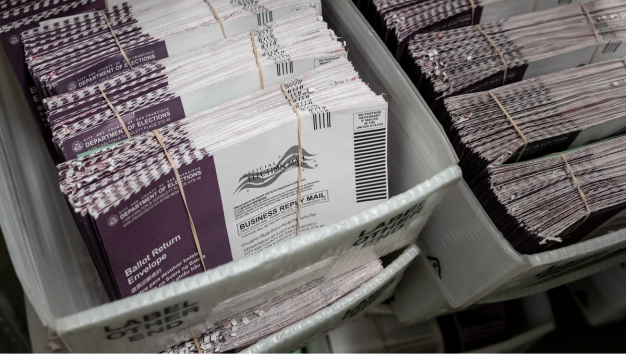
Mail-in ballots following a primary election at San Francisco County’s election operations facility at City Hall in San Francisco, California, US, on Tuesday, June 9, 2026. (David Paul Morris/Bloomberg via Getty Images)

(NEW YORK) — A federal appeals court in Washington, D.C., handed the Trump administration a temporary win on Friday in its attempt to increase federal oversight of elections.

In a unanimous ruling, a three-judge panel of the D.C. Circuit Court of Appeals put on hold a lower court ruling, which had blocked the U.S. Postal Service from attempting to restrict mail-in voting.

However, the Trump administration does not yet have a green light to move forward with the proposed rule. A separate judge in Massachusetts blocked the policy last month, and that injunction still stands. 

The cases center on a proposed rule from the U.S. Postal Service that sought to compel states to create lists of approved voters, as well as impose stricter regulations on mail-in ballots.

Last month, Postmaster General David Steiner told the Senate Homeland Security and Governmental Affairs Committee that under the proposed rule, the Postal Service would refuse to deliver mail-in ballots in states that do not turn over their voter lists.

“Yes or no — if a state refuses to turn their absentee voter list over to the federal government, will the Postal Service still mail their ballots under this proposed rule?” asked Sen. Gary Peters, D-Mich.

“Under our proposed regulation, no. We would tell the state that we need the manifest,” Steiner said. 

The NAACP, which brought the lawsuit, had previously sued the Postal Service in 2020, seeking to challenge delays in delivering mail-in ballots heading into that year’s presidential election. The two sides settled in 2021, with the Postal Service agreeing to “prioritiz[e] . . . the timely delivery of Election Mail” for every national election through 2028.

In Friday’s ruling, the appeals court said the Trump administration is likely to succeed because the lawsuit is premature — since the rule itself is not yet finalized — and not covered by a 2021 settlement between the NAACP and Postal Service. 

The appeals court also said the Trump administration demonstrated they would be irreparably harmed if the Postal Service can’t finalize and implement the rule in time for the midterms. 

“In this context, ‘there can be no do over’ once the election occurs,” the ruling said.

While the Trump administration cannot yet move forward with the new rule, the D.C. Circuit’s ruling signals that the Trump administration may be able convince other appeals courts to let them implement the policy while the lawsuits move through the courts — potentially past the November elections. 

Copyright © 2026, ABC Audio. All rights reserved.

Trump has squandered Republicans’ typical advantages in 2 key areas

(CNN) — President Donald Trump’s political stature is so poor right now that he has squandered the Republican Party’s advantage on two major issues that almost always favor the GOP: the economy and national security.A Reuters-Ipsos poll this week showed Democrats and Republicans virtually tied on “war, foreign conflicts and terrorism.” The GOP led on that issue by 11 points after the 2024 election. Today, 37% of US adults say Democrats have a better approach, compared to 36% who say the GOP does.Fox News polling a couple weeks back showed something very similar: On national security, 50% of registered voters preferred the GOP, to 48% who preferred the Democratic Party. That’s compared to a 12-point edge for Republicans in January, before the Iran war.Both recent findings are within the margin of error. But the numbers even being that close is basically unheard of.Fox polling has regularly tested how registered voters compare the two parties on terrorism and national security. Until the Iran war, Democrats had never even been within double-digits of the Republican Party on either issue.Republicans have also led consistently on national security in Gallup polling. Democrats only nosed ahead on that issue once in the 21st century: in 2007.Gallup’s data on which party is better on “international terrorism and military threats” has been even more lopsided in the GOP’s favor.Across 22 polls conducted since a year after 9/11, Democrats have led on that issue only once — again, in 2007 — and most of the time Republicans led by double-digits.And then there’s the economy.The most recent Fox survey showed Democrats leading on that issue by nine points, 54%-45%. That was the biggest Democratic advantage since 2006, when they led by 20 points.And when they took a lead on the economy back in April, it marked the first time they were ahead since 2010, shortly after the 2008 financial crisis that began during the George W. Bush administration.CNN polling back in May showed a closer split between the two parties on the economy, with 35% of adults preferring Democrats, compared to 33% who preferred the GOP.The poll previously asked people to choose between congressional Republicans and congressional Democrats. The last time Republicans didn’t lead on that question was 2009.The numbers on both fronts seem to illustrate that Trump greatly miscalculated the fallout from launching the Iran war — as well as other controversial policies like his global tariffs.By launching the tariffs, he effectively took ownership of whatever became of the economic picture. Then he compounded negative public sentiment by basically shrugging off any responsibility to address Americans’ inflation concerns. Now he’s contending with a still-stagnant economic picture, with the economy shedding 23,000 jobs in July.Americans don’t love Democrats; in fact, the blue side remains pretty unpopular in polls. So the fact that they’ve apparently taken a lead on the economy really says something.And the national security numbers might be even more striking — because Democrats hardly ever even compete with Republicans on the topic.Just as education and health care almost always favor Democrats, national security and defending the homeland are almost always signature GOP issues, and lopsidedly so.That remained true even when Bush launched wars in the Middle East that gradually became pretty unpopular.Trump, though, seems to have botched the Iran war so badly that Americans suddenly see Democrats on equal footing with the GOP — in terms of issues on the GOP’s own turf.The-CNN-Wire™ & © 2026 Cable News Network, Inc., a Warner Bros. Discovery Company. All rights reserved.
Read Next Story