
Apalachee High School shooting suspect pleads guilty to all charges

▶ Watch Video: Apalachee High School shooting suspect pleads guilty in Georgia courtroom

Colt Gray, the teen accused of killing two teachers and two students and injuring nine others in the 2024 shooting at Georgia’s Apalachee High School, pleaded guilty to all 55 charges in court on Friday morning.

Gray entered a “non-negotiated” plea, which means that he admitted guilt to all of his charges without a pre-arranged deal between his attorneys and the prosecution.

Gray, who was charged as an adult, is facing a total of 55 counts, including malice murder, aggravated battery, and aggravated assault. The judge will have the ultimate say in the sentence. The minimum is life with parole; the maximum is life without parole. 
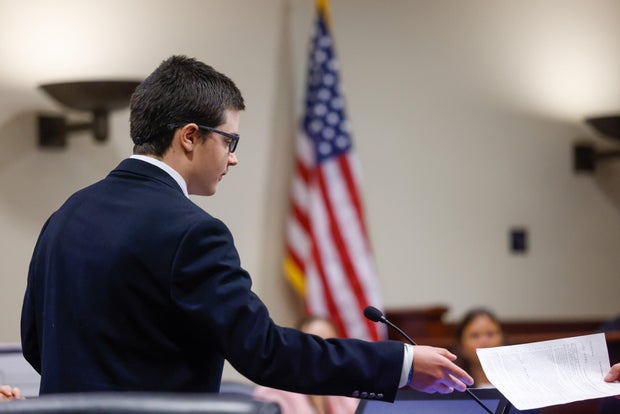
Georgia High School Shooting
Colt Gray, the 16-year-old Apalachee High School shooting suspect, pleads guilty at Barrow County Superior Court in Winder, Ga., on Friday, July 24, 2026. (Arvin Temkar/Atlanta Journal-Constitution via AP)

Arvin Temkar

The hearing comes months after Gray’s attorneys indicated that they were attempting to negotiate a plea deal for the teen. This week is the deadline set by Judge Nicholas Primm for a possible plea. Following a day of testimony from victims and evidence presented by investigators, Primm adjuourned Friday’s sentencing hearing, saying that it would resume on Monday morning. 

In June, Primm ordered Gray’s trial be moved to Columbia County, arguing that the “widespread local, statewide and national coverage of the case” would make it difficult to find unbiased jurors in Barrow County, where the shooting took place.

Four people, 14-year-old students Mason Schermerhorn and Christian Angulo and teachers Richard Aspinwall and Cristina Irimie, were killed in the shooting. Another teacher and eight students were wounded.

Family, friends of victims give emotional testimony

One by one, family members and survivors described the grief, trauma and lives forever changed by the 2024 shooting at Apalachee High School. 

Mason Schermerhorn’s family remembered him as a caring teenager who “was so much more than a victim,” while recounting the frantic search for him and the moment they learned he had been killed. His sisters told the court they continue to struggle with anxiety, panic attacks and the emotional weight of returning to schools and public places. 
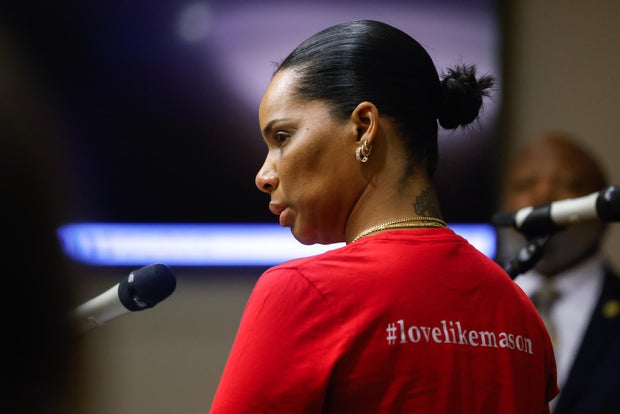
Georgia High School Shooting
Breanna Schermerhorn, the mother of Mason Schermerhorn, looks toward Colt Gray during the plea hearing for the 16-year-old Apalachee High School shooting suspect at Barrow County Superior Court in Winder, Ga, on July 24, 2026. (Arvin Temkar/Atlanta Journal-Constitution via AP)

Arvin Temkar

Ricky Aspinwall’s widow said the life they planned together “no longer exists,” and Christian Angulo’s brother asked the judge to ensure the shooter is never released. 

A student who survived after being shot described the chaos inside the school, months of hospitalization and rehabilitation, and the lasting pain carried by the Apalachee community.

“I hope my story makes Colt realize all the horrible things he has done and all the pain and suffering he has caused,” the student said.

Investigators present notebooks, cellphone evidence they say show shooting was planned

Prosecutors then began presenting evidence they said showed the shooting was planned well before Sept. 4. 

Barrow County Sheriff’s Office investigator Jason Smith testified that Colt Gray’s cellphone, notebooks and other evidence documented what investigators described as a detailed plan for the attack. 

Smith said Gray initially told investigators the shooting was a spontaneous decision after hearing voices, but investigators concluded it had been planned in advance. Jurors were shown pages from a black notebook prosecutors said Gray brought to school that day, which included sketches of classrooms, handwritten plans outlining the attack, references to ammunition and the number of people he expected to kill or injure, and repeated writings questioning why he was the way he was. 

Investigators also recovered a notebook from Gray’s home containing writings expressing despair, drawings and references to previous mass shooters, including Nikolas Cruz, whom prosecutors said Gray had become fixated on. Smith also testified that Gray showed little emotion after his arrest as investigators advised him of the charges against him.

A father and son facing charges

Colt Gray’s father, Colin Gray, was convicted on 27 counts, including second-degree murder, involuntary manslaughter, and cruelty to children in March. He was the first parent charged in connection with a mass school shooting in Georgia and the third time a parent was charged for their connection to a mass shooting allegedly carried out by their child.

Prosecutors claimed that Colin Gray gave his son the gun used in the shooting at his high school as a Christmas gift, and allowed him access to it and ammunition despite warning signs that the teen’s mental state was deteriorating. The prosecution pointed to evidence of what they called an obsession with school shooters, including a “shrine” Colt Gray built to Nikolas Cruz, convicted of the 2018 shooting at Marjory Stoneman Douglas High School in Florida.
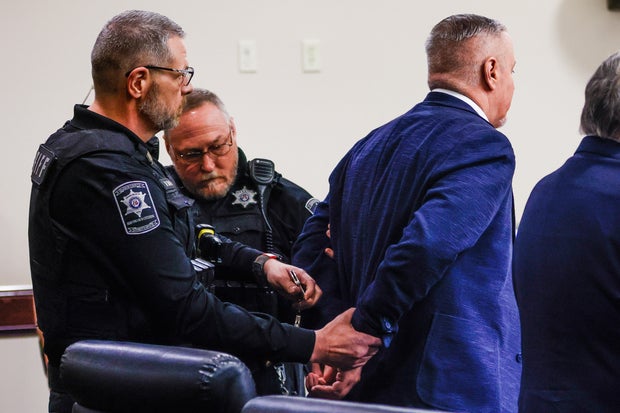
Georgia High School Shooting
Colin Gray, the father of Apalachee High School shooting suspect Colt Gray, is handcuffed and escorted out of the room after jury deliberations at his trial at Barrow County Courthouse on March 3, 2026.

Abbey Cutrer / AP

Colin Gray had admitted to giving his son the rifle, but said he had hoped to bond with Colt while hunting and at the gun range. His sentencing hearing is scheduled to take place on July 30.

On Sept. 4 2024, investigators say then-14-year-old Gray carried a semiautomatic assault-style rifle onto the school bus, with the barrel sticking out of his book bag, wrapped up in a poster board. He left his second-period class and then emerged from a bathroom with the rifle before shooting people in a classroom and hallways.

Agents with the Georgia Bureau of Investigation have previously testified in court to finding notebooks in which Colt Gray wrote about his plans to commit the shooting, including a note to “shoot the teacher first.” 

Pages of the notebook were shown in the sentencing hearing afterward which included drawings of what Gray’s second period class looked like and plans that showed the teen expected to kill up to 26 people and injure 11. Several pages showed doodles of guns with magazines attached.

Shooting At Apalachee High School In Winder, Georgia Leaves 4 Dead
A memorial of flowers and balloons grows in front of Apalachee High School on Sept. 5, 2024 in Winder, Georgia.

Jessica McGowan / Getty Images

Colt Gray surrendered to school resource officers at the scene. He has remained in custody ever since.

Jared Eggleston, Chris St. Peter and Cara Tabachnick contributed to this report.

Record share of kindergartners missed required vaccines last year as Trump executive order takes aim at state mandates

(CNN) — A record share of kindergartners in the United States had an exemption for a required vaccination last school year, as the Trump administration continues to make moves to reduce the number of vaccinations recommended for children.An executive order signed by President Donald Trump last week aims to reshape the federal government’s approach to vaccines. The order offers recommendations to “give parents more information and options” — but the authority to set and enforce vaccine requirements still lies with states, and a growing share are utilizing existing policies that allow exemptions.The administration signaled that it will push states to rework their vaccine requirements to incorporate the new federal guidelines, effectively upending longstanding practices aimed at improving childhood immunization rates. It’s unclear exactly how officials plan to reinforce this, but the Department of Justice, the Department of Education and the Department of Health and Human Services have been directed to tie compliance with federal funding.The new executive order emphasizes the administration’s aim to “maximize parental choices over vaccinations for their children,” specifically noting that states should “provide religious and medical exemptions” to vaccine requirements.All 50 states have their own laws requiring certain vaccines for students to attend school, and all allow students to be exempted from school vaccine requirements for medical reasons. The vast majority of states also allow vaccine exemptions for non-medical reasons, which may be categorized as religious or personal.Utilization of these exemptions is more common than it’s ever been. Data published Monday by the US Centers for Disease Control and Prevention shows that 4.2% of kindergartners had an exemption for at least one required vaccine during the 2025-26 school year.This left about 157,000 new schoolchildren without full coverage for at least one state-mandated vaccine last school year, CDC data shows – nearly 20,000 more than the year before.The share of students with a vaccine exemption is the highest on record and twice as high as it was a decade ago. Last school year, only 0.2% of exemptions were for medical reasons, a share that has held steady for years.Exemptions increased in all but nine states, and nearly half of states report exemptions exceeding 5%, according to the CDC.According to the National Conference of State Legislatures, only four states do not allow exemptions that are not for medical reasons: California, Connecticut, Maine and New York.New York removed the option for religious exemptions for school vaccines in 2019 after measles outbreaks in the state grew to some of the largest the US had seen in decades.The new CDC data shows that the measles-mumps-rubella (MMR) vaccination rate among kindergartners fell only slightly last school year, from 92.5% to 92.4%, but that’s still well below the 95% coverage needed to provide herd immunity and prevent outbreaks.State authority to set vaccine policy has been challenged before but broadly upheld by the US Supreme Court.States are still reviewing the new executive order, but many – including those that follow federal guidance for vaccine policy and those that have broken from federal recommendations – say that it does not require any changes at the state level.“Federal recommendations do not change the requirements in Texas,” the state health department said in an email to CNN.Others responded to the president’s action with a commitment to science-based vaccine policy.“Vaccines are our most effective defense against vaccine-preventable illnesses,” Dr. Puthiery Va, director of the Maine Center for Disease Control and Prevention, said in a statement. “In Maine, vaccines remain available at no cost to eligible children through the Maine CDC’s Immunization Program. Maine’s school and child care immunization requirements remain unchanged by federal actions to date.”Changes to any state vaccine exemption laws would need to be passed by state legislatures, many of which will not meet again until January.But courts can get involved, too. Mississippi started allowing religious exemptions in 2023 after a federal court order, and a move to allow religious exemptions in West Virginia is facing legal challenges. Before these changes, both states were known to have exceptionally high childhood vaccination coverage under some of the strictest laws.Public health experts say that building trust in the safety and effectiveness of vaccines is key to reversing the decline in childhood immunization rates.“If more and more parents choose not to vaccinate their children for non-medical reasons, we will no doubt see a rise in disease outbreaks,” Dr. William Moss, an associate professor with Johns Hopkins Bloomberg School of Public Health, has said.Measles cases in the US have reached a 35-year-high this year, the vast majority of which are in people who have not been vaccinated with the MMR.But the new executive order advises that the MMR be separated into three individual shots — a dramatic change that goes against broad scientific consensus and a suggestion that could raise doubts.States have typically aligned their policies for vaccine requirements with recommendations from the CDC and its Advisory Committee on Immunization Practices (ACIP). But ACIP has undergone sweeping changes under US Department of Health and Human Services Secretary Robert F. Kennedy Jr., and actions by the federal agency and the advisory board to overhaul the childhood vaccine schedule — including a reduction in the number of diseases covered by routine vaccinations — have led many states to break from this longstanding practice.According to KFF, 28 states have announced that they will no longer follow federal vaccine recommendations. Most have indicated that they will instead follow recommendations from the American Academy of Pediatrics, an independent medical association. “For decades, the U.S. childhood immunization schedule was developed through a rigorous scientific process required by law that evaluates the safety and effectiveness of vaccines and how they should be given to patients. This transparent, expert-led process has helped prevent serious diseases, reduce hospitalizations, and save millions of lives,” the Governors Public Health Alliance said in a statement. The coalition includes more than a dozen governors who represent about a third of the US population.“President Trump’s Executive Order directing changes to longstanding federal vaccine recommendations circumvents that process and defies scientific consensus. It also risks causing confusion and endangering our children,” the alliance said.“Parents should know that vaccines currently available in the United States remain available and that the Executive Order does not change that. Governors and state public health leaders hold the power to continue working with healthcare providers, schools, and local health agencies to ensure that parents have access to trusted information and can make informed decisions regarding the health of their children.”The-CNN-Wire™ & © 2026 Cable News Network, Inc., a Warner Bros. Discovery Company. All rights reserved.
Read Next Story