
Apalachee High School shooting suspect pleads guilty to all charges

▶ Watch Video: Apalachee High School shooting suspect pleads guilty in Georgia courtroom

Colt Gray, the teen accused of killing two teachers and two students and injuring nine others in the 2024 shooting at Georgia’s Apalachee High School, pleaded guilty to all 55 charges in court on Friday morning.

Gray entered a “non-negotiated” plea, which means that he admitted guilt to all of his charges without a pre-arranged deal between his attorneys and the prosecution.

Gray, who was charged as an adult, is facing a total of 55 counts, including malice murder, aggravated battery, and aggravated assault. The judge will have the ultimate say in the sentence. The minimum is life with parole; the maximum is life without parole. 
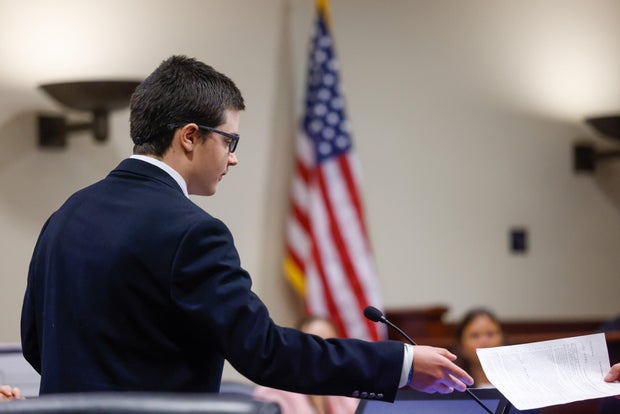
Georgia High School Shooting
Colt Gray, the 16-year-old Apalachee High School shooting suspect, pleads guilty at Barrow County Superior Court in Winder, Ga., on Friday, July 24, 2026. (Arvin Temkar/Atlanta Journal-Constitution via AP)

Arvin Temkar

The hearing comes months after Gray’s attorneys indicated that they were attempting to negotiate a plea deal for the teen. This week is the deadline set by Judge Nicholas Primm for a possible plea. Following a day of testimony from victims and evidence presented by investigators, Primm adjuourned Friday’s sentencing hearing, saying that it would resume on Monday morning. 

In June, Primm ordered Gray’s trial be moved to Columbia County, arguing that the “widespread local, statewide and national coverage of the case” would make it difficult to find unbiased jurors in Barrow County, where the shooting took place.

Four people, 14-year-old students Mason Schermerhorn and Christian Angulo and teachers Richard Aspinwall and Cristina Irimie, were killed in the shooting. Another teacher and eight students were wounded.

Family, friends of victims give emotional testimony

One by one, family members and survivors described the grief, trauma and lives forever changed by the 2024 shooting at Apalachee High School. 

Mason Schermerhorn’s family remembered him as a caring teenager who “was so much more than a victim,” while recounting the frantic search for him and the moment they learned he had been killed. His sisters told the court they continue to struggle with anxiety, panic attacks and the emotional weight of returning to schools and public places. 

Georgia High School Shooting
Breanna Schermerhorn, the mother of Mason Schermerhorn, looks toward Colt Gray during the plea hearing for the 16-year-old Apalachee High School shooting suspect at Barrow County Superior Court in Winder, Ga, on July 24, 2026. (Arvin Temkar/Atlanta Journal-Constitution via AP)

Arvin Temkar

Ricky Aspinwall’s widow said the life they planned together “no longer exists,” and Christian Angulo’s brother asked the judge to ensure the shooter is never released. 

A student who survived after being shot described the chaos inside the school, months of hospitalization and rehabilitation, and the lasting pain carried by the Apalachee community.

“I hope my story makes Colt realize all the horrible things he has done and all the pain and suffering he has caused,” the student said.

Investigators present notebooks, cellphone evidence they say show shooting was planned

Prosecutors then began presenting evidence they said showed the shooting was planned well before Sept. 4. 

Barrow County Sheriff’s Office investigator Jason Smith testified that Colt Gray’s cellphone, notebooks and other evidence documented what investigators described as a detailed plan for the attack. 

Smith said Gray initially told investigators the shooting was a spontaneous decision after hearing voices, but investigators concluded it had been planned in advance. Jurors were shown pages from a black notebook prosecutors said Gray brought to school that day, which included sketches of classrooms, handwritten plans outlining the attack, references to ammunition and the number of people he expected to kill or injure, and repeated writings questioning why he was the way he was. 

Investigators also recovered a notebook from Gray’s home containing writings expressing despair, drawings and references to previous mass shooters, including Nikolas Cruz, whom prosecutors said Gray had become fixated on. Smith also testified that Gray showed little emotion after his arrest as investigators advised him of the charges against him.

A father and son facing charges

Colt Gray’s father, Colin Gray, was convicted on 27 counts, including second-degree murder, involuntary manslaughter, and cruelty to children in March. He was the first parent charged in connection with a mass school shooting in Georgia and the third time a parent was charged for their connection to a mass shooting allegedly carried out by their child.

Prosecutors claimed that Colin Gray gave his son the gun used in the shooting at his high school as a Christmas gift, and allowed him access to it and ammunition despite warning signs that the teen’s mental state was deteriorating. The prosecution pointed to evidence of what they called an obsession with school shooters, including a “shrine” Colt Gray built to Nikolas Cruz, convicted of the 2018 shooting at Marjory Stoneman Douglas High School in Florida.

Georgia High School Shooting
Colin Gray, the father of Apalachee High School shooting suspect Colt Gray, is handcuffed and escorted out of the room after jury deliberations at his trial at Barrow County Courthouse on March 3, 2026.

Abbey Cutrer / AP

Colin Gray had admitted to giving his son the rifle, but said he had hoped to bond with Colt while hunting and at the gun range. His sentencing hearing is scheduled to take place on July 30.

On Sept. 4 2024, investigators say then-14-year-old Gray carried a semiautomatic assault-style rifle onto the school bus, with the barrel sticking out of his book bag, wrapped up in a poster board. He left his second-period class and then emerged from a bathroom with the rifle before shooting people in a classroom and hallways.

Agents with the Georgia Bureau of Investigation have previously testified in court to finding notebooks in which Colt Gray wrote about his plans to commit the shooting, including a note to “shoot the teacher first.” 

Pages of the notebook were shown in the sentencing hearing afterward which included drawings of what Gray’s second period class looked like and plans that showed the teen expected to kill up to 26 people and injure 11. Several pages showed doodles of guns with magazines attached.
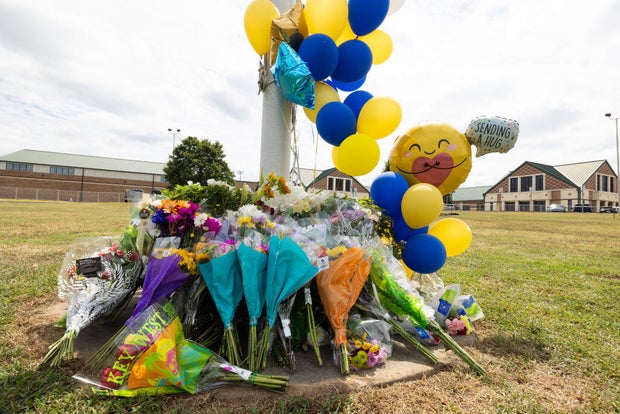
Shooting At Apalachee High School In Winder, Georgia Leaves 4 Dead
A memorial of flowers and balloons grows in front of Apalachee High School on Sept. 5, 2024 in Winder, Georgia.

Jessica McGowan / Getty Images

Colt Gray surrendered to school resource officers at the scene. He has remained in custody ever since.

Jared Eggleston, Chris St. Peter and Cara Tabachnick contributed to this report.

A cosmic breadcrumb trail leads astronomers to a discovery in another galaxy

(CNN) — A faint ribbon of stars in a distant galaxy has led astronomers to a discovery that could reveal secrets about one of our universe’s greatest mysteries.Hidden within the Hubble Space Telescope’s archival data, researchers found the barely visible trail of stars — the first globular cluster stellar stream detected outside the Milky Way. The celestial phenomenon, located in a galaxy roughly 115 million light-years from Earth, is the remnant of a dense ball of stars being slowly pulled apart by the gravity of its host galaxy. As the cluster loses stars, the remnants form a long, narrow stream.Astronomers have found dozens of stellar streams within the Milky Way, but because these trails are faint and hard to detect, many more are likely left to be discovered. Now, with evidence that they occur in other galaxies, astronomers may be able to use them as cosmic tracers to understand better how galaxies form and evolve.The finding, which was detailed in a study published Wednesday in the journal Nature, also allowed the team of astronomers to map the galaxy — known as UGC 9050-Dw1 — and its gravitational field by modeling the stream.Because the galaxy’s gravity influences the stellar stream’s shape and motion, the researchers used the trail of stars to trace the galaxy’s gravitational field. Through their modeling, they were also able to estimate the galaxy’s total mass, how much of it is made up of visible objects, such as stars, and how much is composed of dark matter — a mysterious form of matter that cannot be seen but has gravity.When the study team started to realize that it had found a stellar stream beyond our galaxy, “it was very exciting,” said co-lead author Julie Kiel Holm, a doctoral fellow at the Niels Bohr Institute at Denmark’s University of Copenhagen who studies globular clusters and the formation of stellar streams. “And then we sort of looked at each other and asked, ‘Where do we go from here?’“Dark matter intrigues scientists because they don’t know what it is, yet they can see its gravitational influence on stars and galaxies. “About 80% to 85% of our universe, we think is dark matter, so that makes it very, very enticing to try and figure out what it is,” Kiel Holm added.Stellar streams have been used to help scientists map the dark matter within our own galaxy. Now, those same tools can be used to help better understand the dark matter composition and structure of other galaxies that share the universe.Spotting stellar streamsThe newly discovered stream is located within an ultra-diffuse galaxy — one that is spread out and extremely faint, which likely made the stellar stream easier to spot, the study authors speculated.“At the same time, these ultra-diffuse galaxies are thought to be very massive, and you need to be massive in order to actually pull out stars from that parent cluster,” said co-lead author Sarah Pearson, an associate professor at DTU Space, the National Space Institute at the Technical University of Denmark.“So those two things together — the fact that it provides a faint background, but also has a strong enough tidal field to pull out stars from the cluster — is a great combination if you would want to find one of these,” she added.When trying to identify these streams, astronomers look for thin, elongated structures on their telescopes. The streams can also be tracked through their movement along the sky; however, doing so requires a telescope to be in the same position over time, and the technique has so far only been able to find stellar streams in the Milky Way.“The area that the Hubble can see is actually not that big. So you have to be very, very lucky to be able to see this, and we don’t really know where to look to basically target them,” said study coauthor Tjitske Starkenburg, a research assistant professor at the Center for Interdisciplinary Exploration and Research in Astrophysics at Northwestern University in Evanston, Illinois.The study authors predict that future telescope advancements will allow for further detection of these clusters within and outside our galaxy. Starkenburg pointed to NASA’s Nancy Grace Roman Space Telescope that is expected to launch at the end of the month and will have a larger field of view, “like 100 Hubbles in one image.”Detecting a faint stellar stream in a galaxy outside the Local Group — our galactic neighborhood that consists of more than 50 galaxies that are gravitationally bound together — is remarkable, David Martínez-Delgado, an astrophysicist and researcher for the nonprofit foundation ARAID at the Center for Studies of the Cosmos Physics of Aragón in Teruel, Spain, said in an email. Martínez-Delgado was not involved with the new study.“I had previously thought that detecting globular cluster tidal tails in external galaxies would be extremely challenging, given their small angular size and extremely low surface brightness,” he added. “This result demonstrates that, with sufficiently deep and high-resolution observations, such structures may be detectable well beyond the Local Group.”A record of galactic evolutionStellar streams can act as records of a galaxy’s past, giving astronomers clues about how galaxies change over time. When a larger galaxy pulls apart a smaller dwarf galaxy, the dwarf’s stars can stretch into a stream — a cosmic breadcrumb trail of that encounter.Streams from globular clusters, such as the one described in the study, preserve that history on a smaller scale, revealing how the cluster has traveled through its host galaxy and how the galaxy’s gravity has gradually pulled it apart. By tracing that history, researchers can then learn how the galaxy’s mass is distributed, including the unseen dark matter that shapes its gravitational field.Observing the first globular cluster stellar stream outside the Milky Way opens the door to detecting more of these phenomena in galaxies across the universe. The study authors said they hope that future detections will help reveal more secrets about other galaxies as well as the dark matter within them.One feature worth further research, the authors noted, are the gaps or clumps in stellar streams that scientists theorize develop when small concentrations of dark matter pass through them. “But there are other things that could cause some of those similar effects,” Starkenburg said.Finding more streams, perhaps in other galaxies, and observing whether they have similar gaps or clumps, “that’s a much stronger argument for that it has to be dark matter,” Starkenburg added.Many questions remain about dark matter despite its existence being known for almost a century, Pearson noted.“It really is just one of the biggest open questions in physics,” she said. “What is the nature of dark matter? Is it a particle? Is it many? Is it something completely different? We don’t know.”The-CNN-Wire™ & © 2026 Cable News Network, Inc., a Warner Bros. Discovery Company. All rights reserved.
Read Next Story